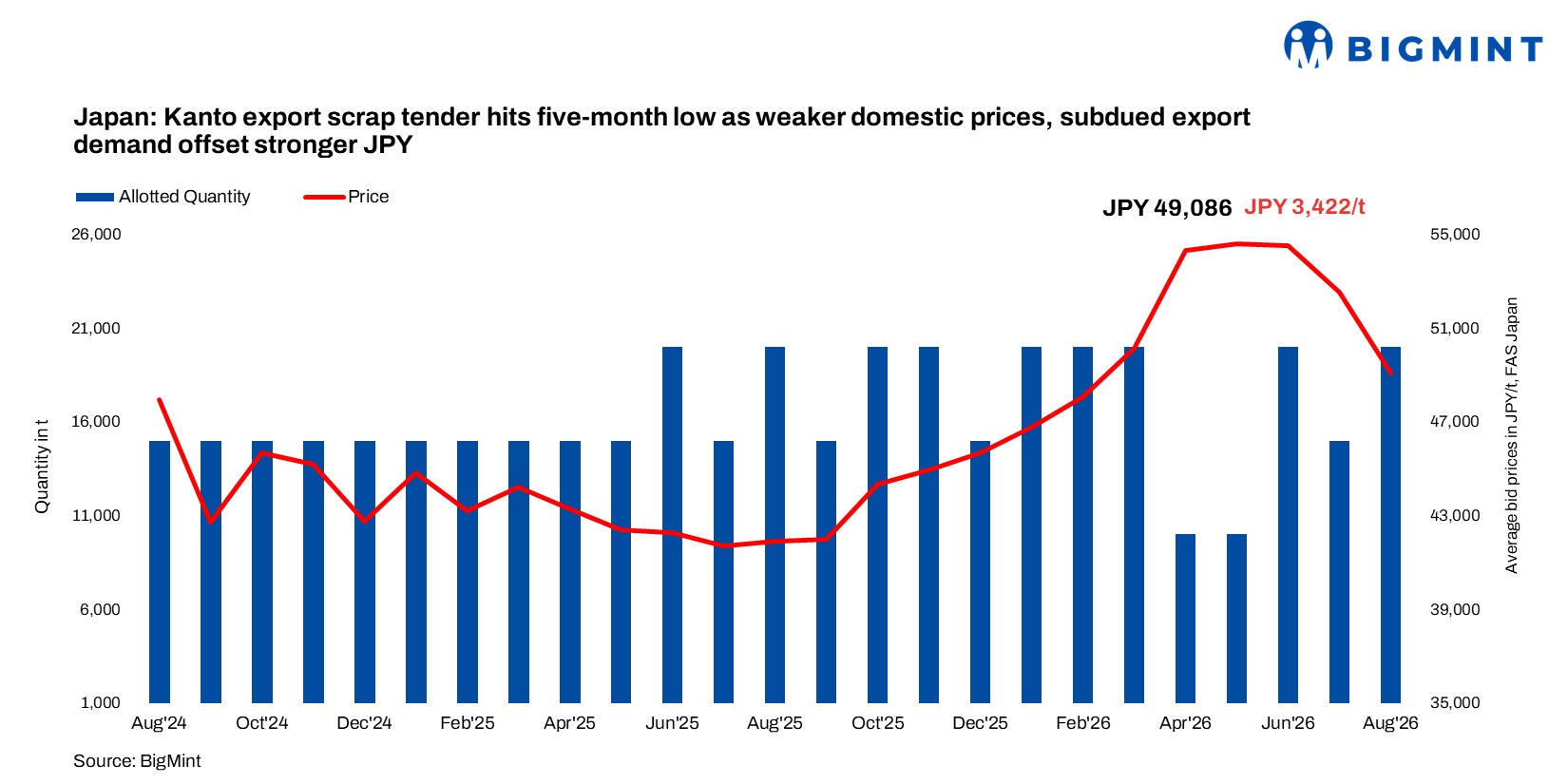
- Successful bid price declines JPY 3,422/t m-o-m to JPY 49,086/t FAS
- Appreciating yen erodes export competitiveness as SEA buying remains cautious
- Tokyo Steel cuts scrap prices for the seventh consecutive time since the previous tender
Japan’s August Kanto export scrap tender concluded at an average winning bid of JPY 49,086/t FAS ($309.87/t), down JPY 3,422/t ($21.5/t) from July’s JPY 52,508/t. The bid fell below JPY 50,000/t for the first time since February, when it stood at JPY 48,083/t, and was also below March’s JPY 50,121/t, reversing gains recorded during April-July amid weak overseas markets and a stronger yen.
The tender attracted 12 bids from 14 trading companies, covering 105,400 t, up 10,000 t from July. Against an offered volume of 20,000 t, the cargo is scheduled for shipment by September 30 to a Chattogram-based mill in Bangladesh.
Based on the winning bid and prevailing freight, the landed cost is estimated at above $380/t CFR Chattogram, broadly in line with current import parity for Japanese H2 scrap. The winning price was also around prevailing domestic mill purchase levels, leaving the Japanese domestic market with limited price direction.
Export competitiveness weakened and buyers resisted higher prices
The JPY’s appreciation was a key factor in the August Kanto tender, strengthening to around JPY 158.4/$ on 7 August from JPY 162/$ during the previous tender on 9 July. While this cushioned the decline in the tender price in yen terms, it raised the dollar cost of Japanese scrap and reduced its competitiveness against alternative origins.
The winning bid fell JPY 3,422/t, but the decline was only around $13/t in dollar terms, with the August bid of JPY 49,086/t equivalent to $310/t at JPY 158.4/$, compared with July’s JPY 52,508/t at around $323/t. The stronger yen followed coordinated intervention by the Japanese and US governments at the end of July.
Meanwhile, shipment of the previous 15,000-t July contract was scheduled for 18-24 August, with 10,000 t set for shipment during the period. The remaining 5,000 t was undecided but expected to be completed within August.
Domestic scrap prices continue to soften
Alongside weaker export demand, softer domestic scrap prices also weighed on the August tender. H2 purchase prices in the Kanto region fell below JPY 50,000/t ($309-316/t) for the first time in nearly four months, as EAF mills lowered procurement benchmarks in response to weaker export realisations. Collection prices around Kanto Bay also declined to JPY 47,500-48,000/t ($300-303/t), remaining below mill purchase levels and signalling weaker sentiment among recyclers.

A domestic mill source said the stronger yen allowed mills to make deeper price cuts, but they opted for gradual reductions to avoid disrupting procurement and maintain stable scrap inflows. Market participants considered the August winning bid broadly in line with expectations, while Chairman Minami said overseas buyers likely viewed prices around JPY 50,000/t as expensive.
As of 7 August, Kanto EAF mills were paying JPY 48,500-49,500/t for H2 scrap, compared with JPY 46,500-47,500/t in the Gulf. The August tender price therefore remained broadly aligned with domestic mill buying levels but above Gulf prices.
Tokyo Steel, Japan’s largest electric arc furnace (EAF) steelmaker, announced its third H2 scrap price cut in August, reducing purchase prices by JPY 500-1,000/t ($3-6/t) across all plants, effective 8 August. The latest revision marks the eighth consecutive price cut since July, the seventh since the previous Kanto tender, and the first adjustment following the latest Kanto tender held on 7 August.
 At its major plants, including Tahara, Utsunomiya, Takamatsu and the Tokyo Bay Satellite Yard, H2 purchase prices now stand at JPY 48,000-51,000/t DAP. Other domestic EAF producers have also followed with similar reductions, bringing prevailing H2 purchase prices across Japan to around JPY 48,000-50,000/t ($305-318/t).
Overseas buying remains cautious
A Japanese exporter attributed the weaker tender primarily to subdued buying interest across key Asian markets.
“The stronger yen seems to be the main reason behind the weaker tender. It has made Japanese scrap less competitive in the export market, while buying interest from Southeast Asia and Bangladesh has remained far from aggressive.”
Buying activity across Southeast Asia remained largely need-based, with mills limiting purchases amid weak finished steel demand, challenging import economics and cautious inventory management.
Bangladesh, one of the key destinations for the successful Kanto cargo, also continued to show restrained procurement activity. A major Chattogram-based steelmaker told BigMint:
“Our last US-origin purchase was concluded in April at around $425/t CFR for shredded and $415/t CFR for HMS. We haven’t booked any fresh US cargoes since then.”
When asked about market rumours of lower-priced US cargoes concluded during late July, the source said the mill had not secured any such bookings, suggesting that any recent transactions, if concluded, were either executed by other buyers or remained confidential.
Meanwhile, market participants reported that another leading Bangladeshi steelmaker booked around 15,000 t of Thailand-origin busheling during the week. A representative familiar with the transaction clarified: “Busheling is typically $20-30/t higher than HMS. The cargo was concluded closer to $410/t CFR Chattogram.”
The transaction indicated that Bangladeshi mills continue to procure selectively, particularly for higher-grade scrap, while overall deep-sea buying remains driven by immediate production requirements.
Vietnam also emerged as a less competitive destination during the tender. Export negotiations for Japanese H2 scrap were reportedly heard around JPY 48,000-49,000/t FOB ($303-309/t), below the successful Kanto tender level, limiting Vietnamese buyers’ ability to compete for the cargo. As a result, the shipment was ultimately awarded to a Bangladeshi mill.
Outlook
Japanese scrap prices may find support through early September as the yen has weakened over the past 4-5 days following its sharp recent appreciation, improving export competitiveness. However, limited Asian buying interest is likely to cap upside. The next Kanto export scrap tender is scheduled for 9 September, which will provide the next key price signal for Japanese scrap.
Leave a Reply