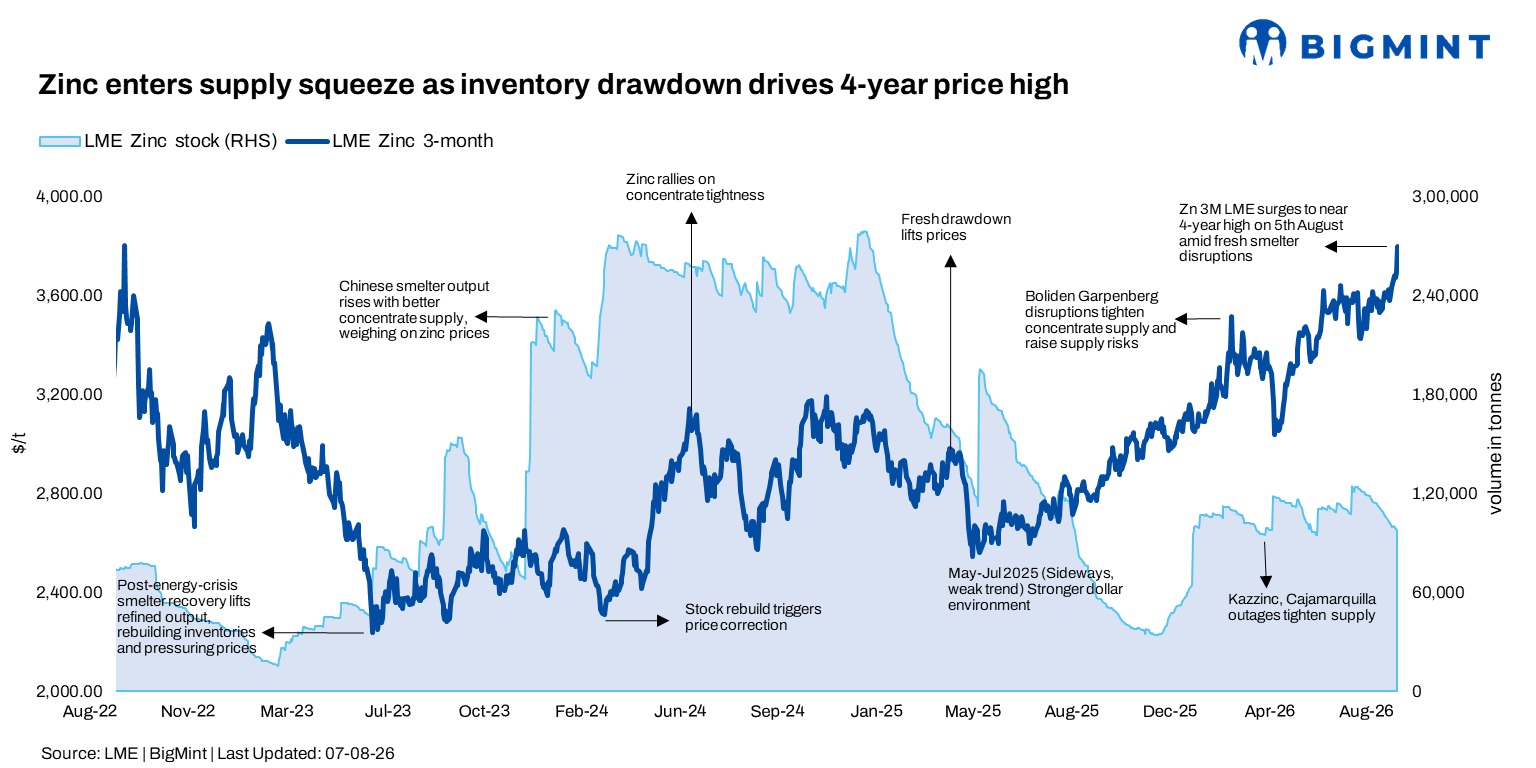
- Six-week inventory drawdown lifts LME zinc to four-year high
- Negative treatment charges and backwardation deepen supply concerns
For most of H1CY’26, zinc traded in a predictable rhythm. Every drawdown in London Metal Exchange (LME) inventories pushed prices higher, only for fresh warrant inflows to rebuild stocks and pull the market back into range.
That pattern repeated three times between January and June.
Then, in late June, the cycle broke.
Since 22 June, LME zinc inventories have fallen almost uninterrupted from 123,450 t to 98,450 t by 5 August, while cash zinc climbed to $3,751/t on 3 August, its highest level in nearly four years. Unlike previous episodes, the latest squeeze has not been met by a meaningful stock rebuild.
The shift suggests that zinc is no longer trading solely as a cyclical inventory story. Instead, the market is increasingly being driven by concentrate shortages, concentrated warrant holdings and tightening refined metal availability.
For Indian galvanisers and battery manufacturers, the question for H2 FY27 is whether this marks a temporary squeeze or the beginning of a more structural tightening cycle.
H1 was a market of drawdowns and replenishment
The first half of 2026 was characterised by repeated inventory cycles.
Zinc began the year at $3,131/t on 2 January, with LME inventories at 106,325 t. By mid-February, stocks had declined below 100,000 t and prices climbed to $3,447/t. Yet the rally faded as fresh metal entered the exchange.
A similar pattern unfolded in March. Inventories surged from around 97,500 t to more than 118,000 t within days, dragging zinc prices down to nearly $3,037/t, their lowest level of the year.
April brought another reversal. Stocks fell sharply towards 98,000 t and prices rebounded above $3,470/t, only for inventories to rebuild once again during May and June.
For five months, zinc remained a mean-reverting market. Every squeeze was eventually resolved by fresh warrant inflows.
The cycle that never reversed
The latest drawdown has been fundamentally different.
Inventories stood at 123,450 t on 22 June. By 31 July, they had fallen below 100,000 t, reaching 98,450 t on 5 August.
At the same time, cash zinc rose from $3,546/t at the end of June to $3,737/t in early August, while three-month prices climbed to $3,693/t. The significance lies not in the magnitude of the move alone, but in the absence of any meaningful replenishment.
Previous drawdowns were temporary. This time, the expected supply response has failed to materialise.
That breakdown coincides with a series of disruptions across the zinc supply chain, including the Kazzinc outage in Kazakhstan, the fire at Peru’s Cajamarquilla smelter and operational constraints at Boliden’s Garpenberg mine.
At the same time, treatment charges in China have reportedly fallen into negative territory, highlighting intense competition for concentrate and limiting the industry’s ability to bring additional metal to market.
Market grappling with concentration as much as scarcity
The current squeeze reflects more than shrinking inventories.
Available zinc stocks on the LME have become increasingly concentrated among a small group of market participants, intensifying concerns over near-term availability.
The result has been a steep backwardation, with cash zinc trading around $60/t above the three-month contract. The premium on nearby contracts indicates that buyers are paying increasingly for immediate delivery rather than future supply.
This marks an important shift.
The first half of the year was largely a story about how much zinc existed in exchange warehouses. The second half is increasingly becoming a story about who controls that metal.
Supply tightness outpaces demand recovery
The rally has unfolded despite the absence of a broad-based recovery in zinc consumption.
Chinese refined zinc production rose 9.4% y-o-y in May to around 641,000 t, while January-May output increased 6.1%, suggesting that supply growth within China continues to offset part of the deficit emerging elsewhere.
Some of the recent gains have also been driven by broader investor positioning across the base-metals complex.
Copper prices have remained near record highs amid ore shortages, attracting capital into zinc and aluminium markets. By contrast, lead and nickel prices have weakened, underlining that not all industrial metals are experiencing the same supply dynamics.
The divergence suggests that zinc’s rally reflects both genuine supply concerns and a financial premium linked to broader commodity sentiment.
What could break the squeeze?
The key question for H2 is whether the current tightness proves structural or whether the market eventually reverts to the pattern seen earlier this year.
Several indicators will determine the answer:
- Recovery timelines at Kazzinc and Cajamarquilla.
- Whether large warrant holders release inventories back onto the exchange.
- The resolution of August contract positions.
- Treatment-charge movements in China.
- Chinese refined zinc production trends.
- The direction of copper prices and broader investor flows.
A meaningful inventory rebuild would challenge the current deficit narrative and could trigger a sharp correction.
India’s capacity expansion arrives at a critical moment
For India, the recent volatility reinforces the strategic importance of domestic zinc production.
Hindustan Zinc produced a record 268,000 t of mined metal and 202,000 t of refined zinc in Q1 FY27, while pursuing plans to expand integrated capacity towards 2 mnt per year.
India’s zinc demand remains closely tied to galvanised steel consumption in infrastructure, railways and power transmission. Higher domestic output could gradually reduce the country’s exposure to disruptions originating in overseas mines and smelters.
For galvanisers, the immediate challenge remains price volatility rather than physical shortages. Battery manufacturers, meanwhile, remain relatively insulated because their supply chain depends more heavily on secondary lead and recycling flows.
Outlook
The first half of 2026 was defined by false breakouts. Inventories tightened, prices rallied and fresh metal eventually restored balance.
The current cycle is the first in which that mechanism has failed to materialise.
Negative treatment charges, concentrated warrant holdings and persistent backwardation suggest that the zinc market is confronting a deeper form of tightness than it experienced earlier in the year.
Whether this proves to be another temporary squeeze or the beginning of a more structural shift in refined zinc availability will be the defining question for H2CY’27. For now, the market has moved beyond a simple inventory story and into a test of how resilient the global zinc supply chain really is.
This article has been curated by BigMint as part of the Global Commodity Conclave (GCC) 2026 knowledge series, examining the evolving supply, inventory and price dynamics shaping the global zinc market.
Continue the discussion at GCC 2026
The outlook for zinc amid tightening inventories, supply-side constraints, changing treatment charges and evolving demand dynamics will be explored during the “Zinc outlook: Demand strength & emerging opportunities” session at the Global Commodity Conclave (GCC) 2026, hosted by MCX with BigMint as the Event Partner, from 12-14 August 2026 at the Jio World Convention Centre, Mumbai.
Join industry leaders and market participants as they discuss the forces shaping zinc demand, supply availability, price volatility and emerging opportunities across the global and Indian zinc markets.

Leave a Reply