- CFI remains firm; lower bunker prices offer cost relief
- Europe-India rates edge higher; Australia route remains stable
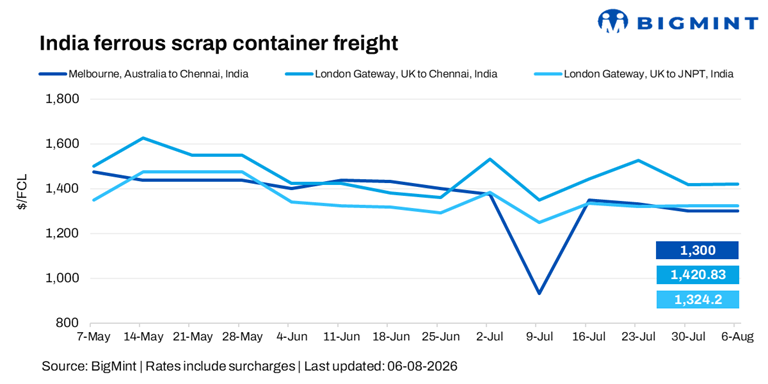
India-bound ferrous scrap container freight rates remained firm in the week ended 6 August, despite subdued import demand, as modest carrier-led rate increases on the Europe-India route supported freight levels. Indian mills remained cautious due to unfavourable import economics, weak finished steel demand, and a persistent bid-offer gap, resulting in limited fresh scrap bookings.
The Europe-India corridor witnessed a slight uptick in freight, supported by carrier pricing revisions and a marginal improvement in container utilisation. However, the increase reflected shipping lines’ pricing discipline rather than any meaningful revival in ferrous scrap trade.
Meanwhile, freight on the Australia-India route was stable, with balanced vessel availability and limited scrap exports maintaining market equilibrium. Exporters continued to prioritise Southeast Asian markets, particularly Indonesia, where demand remained comparatively stronger.
Route-wise update

Market highlights
- CFI surge w-o-w: The Shanghai Containerized Freight Index (SCFI) increased 4.7% w-o-w to 3,205.9 on 31 July 2026 from 3,062.9 on 24 July, ending its three-week declining streak and remaining above the 3,200 mark despite softer freights across major east-west trade lanes. The rebound reflected an overall elevated freight environment, although improving vessel availability and moderating booking activity suggested that peak-season momentum is gradually easing.
- Bunker prices drop w-o-w: Bunker prices declined by $25/tonne (t) (3%) w-o-w to $801/t on 6 August, from $826/t a week earlier, primarily tracking a correction in global marine fuel values as concerns over immediate Middle East supply disruptions eased and bunker availability improved across major hubs. The decline was also supported by softer fuel oil fundamentals despite crude oil remaining relatively firm on persistent geopolitical risks.
Outlook
India-bound ferrous scrap container freight rates are expected to remain mixed in the near term. Weak import appetite, poor scrap import economics, and cautious buying by Indian mills are likely to keep booking volumes subdued, limiting any significant upside in freight rates.
However, carrier pricing discipline and selective capacity management on Europe-India services could continue to support freight levels on specific routes. A sustained recovery in Indian steel demand or renewed ferrous scrap buying would be required for a broader improvement in container freight sentiment.

Leave a Reply