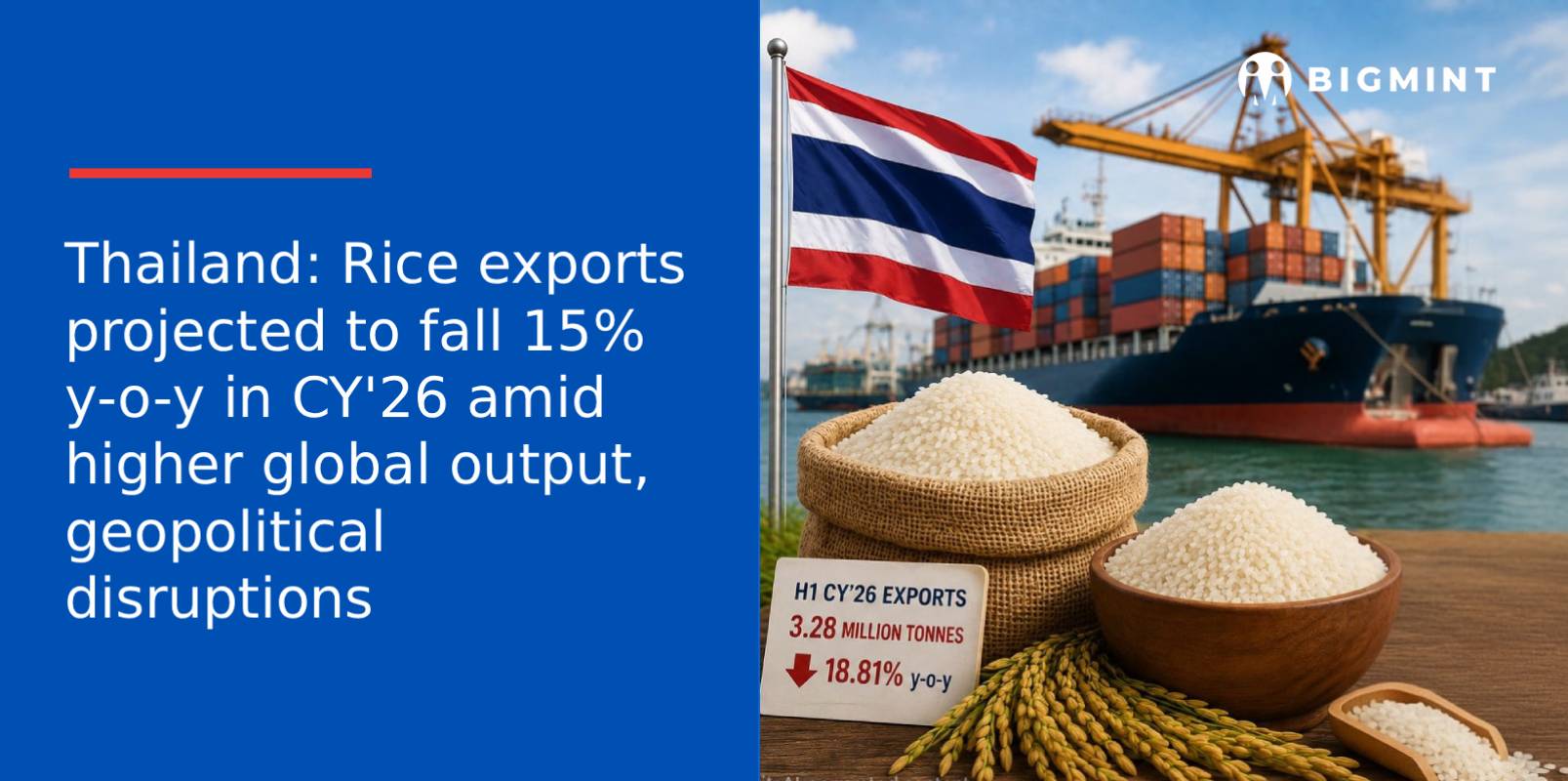
- Exports fall 19% y-o-y in H1CY’26 due to abundant global supply
- Government to advance G-to-G rice sale negotiations with China
Thailand’s rice exports are projected to reach 7 million tonnes (mnt) in CY’26, down 15% from the 8.3 mnt exported in 2025, according to the Commerce Ministry. The ministry attributed the lower export outlook to higher global rice supplies, geopolitical disruptions, and increased price competition. It also stated that demand from key markets in Asia and Africa, along with stockpiling linked to drought concerns, could support rice shipments during the remaining months of the year and help achieve the annual export target.
Rice exports decline 19% in H1CY’26
According to Arada Fuangtong, Director-General of the Department of Foreign Trade, Thailand exported 3.28 mnt of rice between January and June 2026, down 18.81% y-o-y. The country’s rice exports during the period were valued at more than $1.911 billion.
The decline reflects increasingly challenging conditions in the global rice market, where abundant supplies have intensified competition among major exporters.
Global oversupply, Middle East conflict weigh on exports
The Commerce Ministry attributed the decline in shipments to higher global rice production, which has increased competition and pressured export prices. In addition, the conflict in the Middle East has disrupted Thailand’s rice exports to Iraq since March 2026, affecting one of the country’s established export destinations.
Thailand’s rice has also become comparatively more expensive than competing origins due to higher production, transportation and energy costs, alongside rising oil prices.
Current export prices for white rice illustrate the competitive gap:
- Thailand: $447/tonne (t)
- Vietnam: $435/t
- Pakistan: $405/t
- India: $367/t
White rice continues to dominate export mix
White rice remained Thailand’s largest export category during the first half of the year, accounting for 1.51 mnt, or 46.03% of total shipments.
Other export categories included:
- Thai Hom Mali (Jasmine) rice: 0.81 mnt (24.67%)
- Parboiled rice: 0.61 mnt (18.69%)
- Other fragrant rice: 0.23 mnt (6.97%)
- Glutinous (sticky) rice: 0.11 mnt (3.31%)
- Brown rice: 0.01 mnt (0.33%)
Malaysia, Philippines identified as key growth markets
To offset weaker shipments to Iraq, Thailand is focusing on expanding exports to markets where demand continues to grow. The Commerce Ministry has identified Malaysia and the Philippines as priority destinations in Asia, while South Africa, the Democratic Republic of the Congo, and Mozambique have emerged as promising markets in Africa.
According to the ministry, these countries imported more Thai rice during the first half of CY’26 than in the corresponding period last year, reflecting continued confidence in Thailand’s position as a reliable supplier of quality rice.
Government expands export promotion efforts
The Department of Foreign Trade said it will continue diversifying export markets through public-private collaboration to support Thai rice shipments and reduce reliance on any single destination. The department is also advancing government-to-government (G-to-G) rice sale negotiations with COFCO and the Chinese government, while a joint delegation will visit the Philippines and Malaysia to promote exports and strengthen trade ties.
Leave a Reply