- South African, Indonesian imports double on cost competitiveness
- Higher freights make imports from Atlantic suppliers less competitive
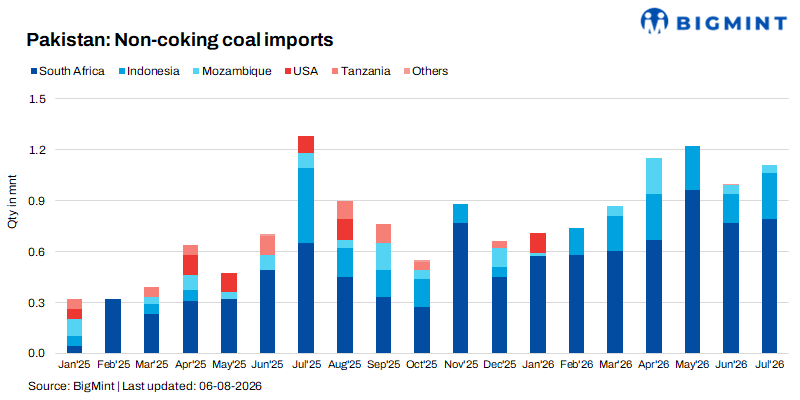
Pakistan’s non-coking (thermal) coal imports rose sharply during the first seven months of 2026, reflecting stronger demand from coal-fired power plants and energy-intensive industries. Imports reached 6.44 mnt during January-July 2026, compared with 4.1 mnt during the corresponding period of 2025, representing a 57.1% year-on-year increase.
Thermal coal imports remain well above last year’s levels
Pakistan’s thermal coal imports strengthened steadily during the first half of the year, exceeding 1 mnt per month between April and June before moderating in July.

Although imports eased in July, the strong growth recorded during the first six months ensured cumulative imports remained substantially above 2025 levels, indicating a sustained recovery in Pakistan’s thermal coal demand.
South Africa consolidates its position as Pakistan’s preferred supplier
The supplier mix changed markedly during 2026, with South Africa capturing an even larger share of Pakistan’s thermal coal market.

South African shipments almost doubled y-o-y, increasing by 2.33 mnt, and accounted for nearly three-quarters of Pakistan’s thermal coal imports. Indonesia also expanded its presence, more than doubling shipments, although it remained a distant second supplier.
Conversely, imports from Mozambique and the United States declined significantly, suggesting Pakistani buyers increasingly concentrated procurement on the two most competitive origins, with South African RB coal emerging as the preferred fuel for both power generation and industrial consumption.
Changing procurement patterns reflect evolving fuel economics
The data indicate that Pakistan’s import strategy is being shaped not only by higher fuel demand but also by changing international market dynamics.
The sharp increase in South African coal imports and the simultaneous decline in US-origin coal and pet coke suggest buyers are increasingly optimising procurement based on delivered fuel costs rather than maintaining a diversified supplier base. As freight costs strengthened and Atlantic-origin fuels became relatively less competitive, South African coal emerged as the preferred imported fuel owing to its favourable balance of calorific value, delivered cost and logistical advantage.
Looking ahead, Pakistan is likely to remain an important growth market for South African thermal coal. If electricity demand and industrial activity continue to strengthen during the second half of 2026, imports are expected to remain above last year’s levels. Unless Atlantic freights soften materially or pet coke availability improves, South African exporters appear well positioned to retain — and potentially expand — their dominant share of Pakistan’s imported thermal coal market.

Leave a Reply