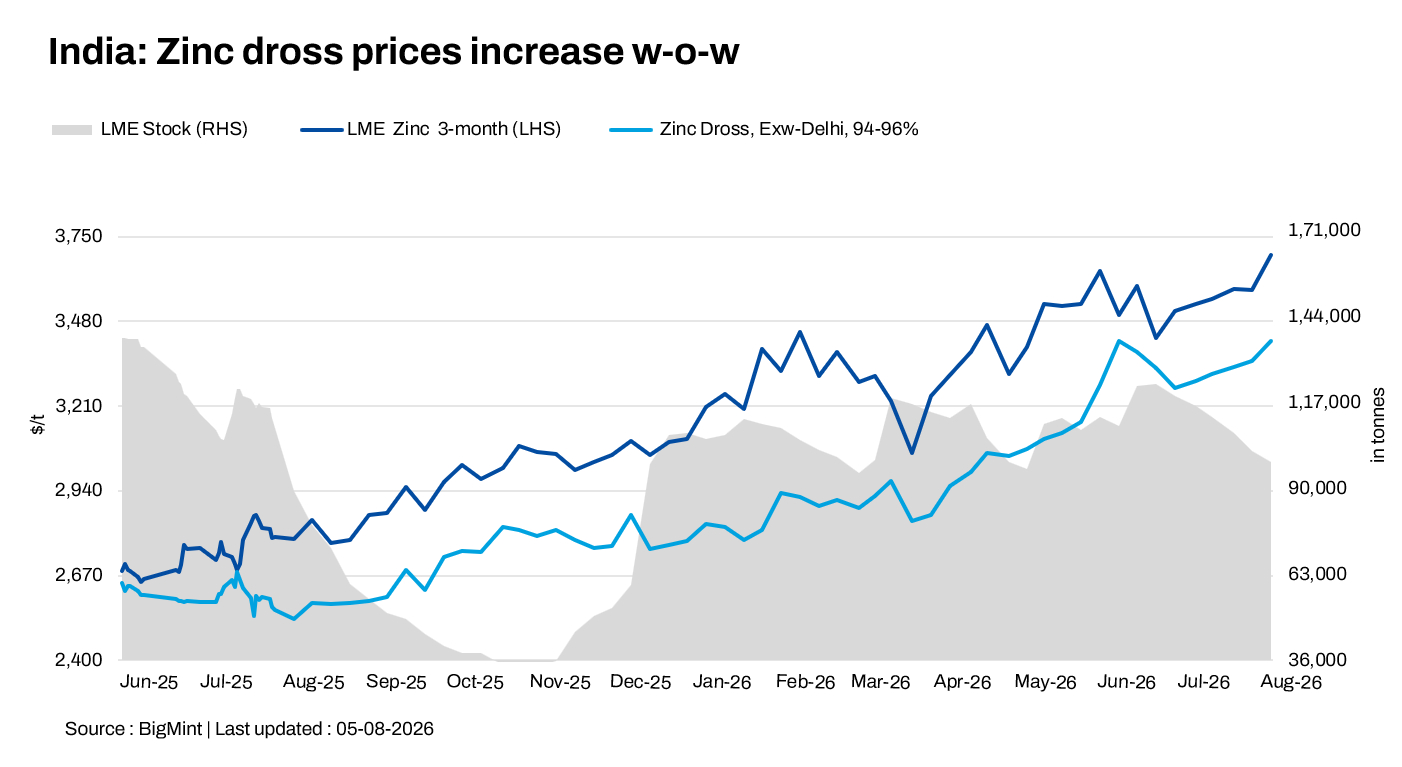
- Zinc dross and oxide prices gained amid higher benchmark zinc prices and declining LME inventories
- Buyers remain cautious as downstream demand stays subdued despite firm seller offers
India’s zinc dross and zinc oxide prices increased in the week ended 6 August 2026, supported by a recovery in benchmark zinc prices, lower LME zinc inventories, and higher replacement costs. Although downstream demand remained muted, sellers continued to maintain firm offers due to improved cost economics and limited scope for price reductions.
Three-month LME zinc prices averaged around $3,647/t during the assessment week ended 6 August, compared with approximately $3,596/t in the previous assessment period. LME zinc prices remained elevated during the week, moving from $3,631/t on 31 July to $3,693/t on 5 August, after touching a high of $3,678/t on 3 August.
Meanwhile, LME zinc inventories continued their downward trend, declining to 98,450 t on 5 August from 101,800 t on 29 July, marking a weekly decline of 3.29%. The drop below the 100,000-t level provided further support to zinc market sentiment and strengthened replacement costs for secondary zinc products.
Zinc dross, oxide price movements
Domestic zinc dross prices increased by INR 4,200/t w-o-w to INR 324,700/t ex-Delhi, compared with INR 320,500/t in the previous assessment period.
Zinc oxide (99% Zn) prices also moved higher, rising by INR 1,100/t w-o-w to INR 310,800/t ex-Delhi, against INR 309,700/t a week earlier.
In the western market, zinc dross offers in Mumbai were reported at around INR 326,000/t.
The increase in secondary zinc prices remained relatively measured compared with the rise in benchmark zinc prices, reflecting continued pressure from weak downstream consumption. Market participants noted that while replacement costs have increased, buyers are reluctant to build inventories and continue to procure mainly for immediate requirements.
Scrap segment trends
In the north Indian zinc scrap market, big Tukdi (97-98% Zn) was heard at around INR 325,000/t ex-Delhi.
Regular Tukdi (97-98% Zn) was reported at around INR 320,000/t, while small-sized Tukdi was heard at approximately INR 318,000/t.
Scrap quotations remained supported by higher zinc replacement costs, with suppliers maintaining offers in line with prevailing market levels. However, trading activity remained limited as consumers continued to adopt a cautious buying approach amid subdued downstream demand.
Availability of zinc-bearing scrap remained adequate, preventing any major supply-side constraints. Market participants indicated that despite firm seller expectations, buyers remained focused on short-term requirements rather than inventory accumulation.
Market sentiment
Market sentiment remained cautiously positive during the assessment period as falling LME inventories and stronger zinc benchmarks supported seller confidence. However, the improvement in international fundamentals has not translated into a significant recovery in physical demand.
Participants noted that zinc dross and oxide prices continue to be influenced by local demand conditions, auction-based availability, and secondary market dynamics. As a result, price gains have remained gradual compared with movements in primary zinc markets.
Buyers continued to resist aggressive price increases, citing weak consumption from downstream users. While enquiries remained present, actual conversions remained limited, keeping trading volumes subdued.
The recent rise in HZL zinc benchmark prices also supported replacement cost calculations for secondary zinc products. HZL raised its zinc ingot prices by INR 4,400/t during the week, increasing the benchmark from INR 393,800/t on 3 August to INR 398,200/t on 6 August.
Outlook
Zinc dross and zinc oxide prices are expected to remain supported in the near term due to declining LME inventories, firm benchmark zinc prices, and higher replacement costs. However, weak downstream demand and cautious buying behaviour are likely to limit sharp upward movements.
Market participants will closely monitor whether the recent improvement in global zinc fundamentals translates into stronger physical demand in India. Unless consumption improves, domestic secondary zinc prices are expected to witness gradual gains rather than a sharp rally.

Leave a Reply