- Europe’s alumina sanctions reshape global trade.
- Indonesia resumes mineral exports after easing restrictions.
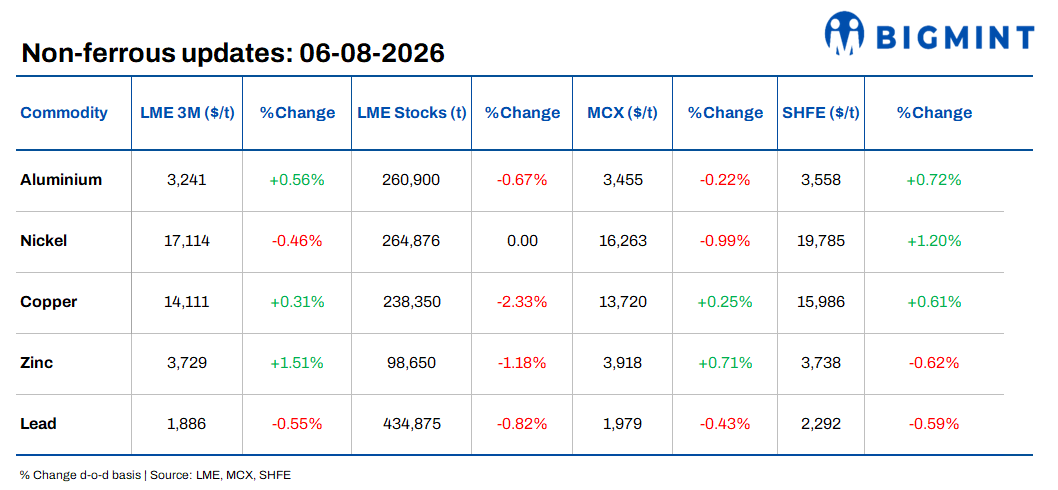
LME base metals traded mixed on 05 August. Zinc recorded the strongest gain, rising 1.51% d-o-d to $3,729/t. Aluminium followed with a 0.56% increase to $3,241/t, while lead posted the steepest decline, slipping 0.55% to $1,886/t. Meanwhile, nickel edged lower by 0.46% to $17,114/t. In contrast, copper gained 0.31% to $14,111/t.
LME inventories recorded mixed trends across major base metals. Copper stocks registered the sharpest decline, falling 2.33% d-o-d to 238,350 t. Meanwhile, zinc inventories fell 1.18% to 98,650 t. Lead stocks eased 0.82% to 434,875 t, while aluminium inventories declined 0.67% to 260,900 t. However, nickel inventories remained unchanged at 264,876 t.
Domestic Market Overview
India’s non-ferrous scrap market remained largely stable on 05 August. Aluminium tense scrap (loose) was unchanged at INR 245,000/t ex-Delhi and INR 244,000/t ex-Chennai. Overall, balanced domestic supply and steady buying interest kept prices stable despite mixed global aluminium trends.
Meanwhile, copper armature scrap (Cu 99%), ex-Delhi, increased by INR 7,600/t (0.6%) to INR 1,284,000/t from INR 1,276,400/t. The increase also reflected stronger domestic buying interest alongside firmer LME copper prices.

Other Updates
Europe’s alumina sanctions tighten supply outlook
Europe’s sanctions on Russian alumina continue to reshape global trade flows. As a result, buyers are sourcing material from alternative suppliers in an already tight market. Alumina accounts for nearly 35–40% of aluminium smelting costs. Consequently, tighter feedstock availability could support aluminium premiums and reinforce supply-side risks across the global market.
Indonesia resumes mineral exports after easing restrictions
Indonesia has resumed exports of rare-earth byproducts recovered from tin processing after easing export restrictions. Although the policy has only a limited direct impact on aluminium, it improves confidence in Southeast Asia’s mineral supply chain. Moreover, the move supports broader non-ferrous trade and regional raw material availability.
Oil prices fall below $80 on Iran-Oman talks
Brent crude declined 0.42% to $79.12 per barrel, while WTI fell 0.56% to $74.80 per barrel. Prices weakened after reports of progress in Iran-Oman talks over shipping through the Strait of Hormuz. As a result, lower energy prices could reduce production costs for aluminium smelters and other energy-intensive metal producers. However, geopolitical uncertainty continues to limit downside risks.
Alba posts stronger profit despite lower output
Aluminium Bahrain (Alba) reported a 22.8% year-on-year rise in first-half profit despite a 6.1% decline in second-quarter aluminium output. Although production fell, strong aluminium margins supported earnings during the period. At the same time, lower output marginally tightened primary aluminium supply. Consequently, the development offers modest support to the global aluminium market.
Leave a Reply