- LME zinc trades near a three-year high as inventories continue to decline
- Producer benchmark remains above domestic spot prices despite strong market sentiment
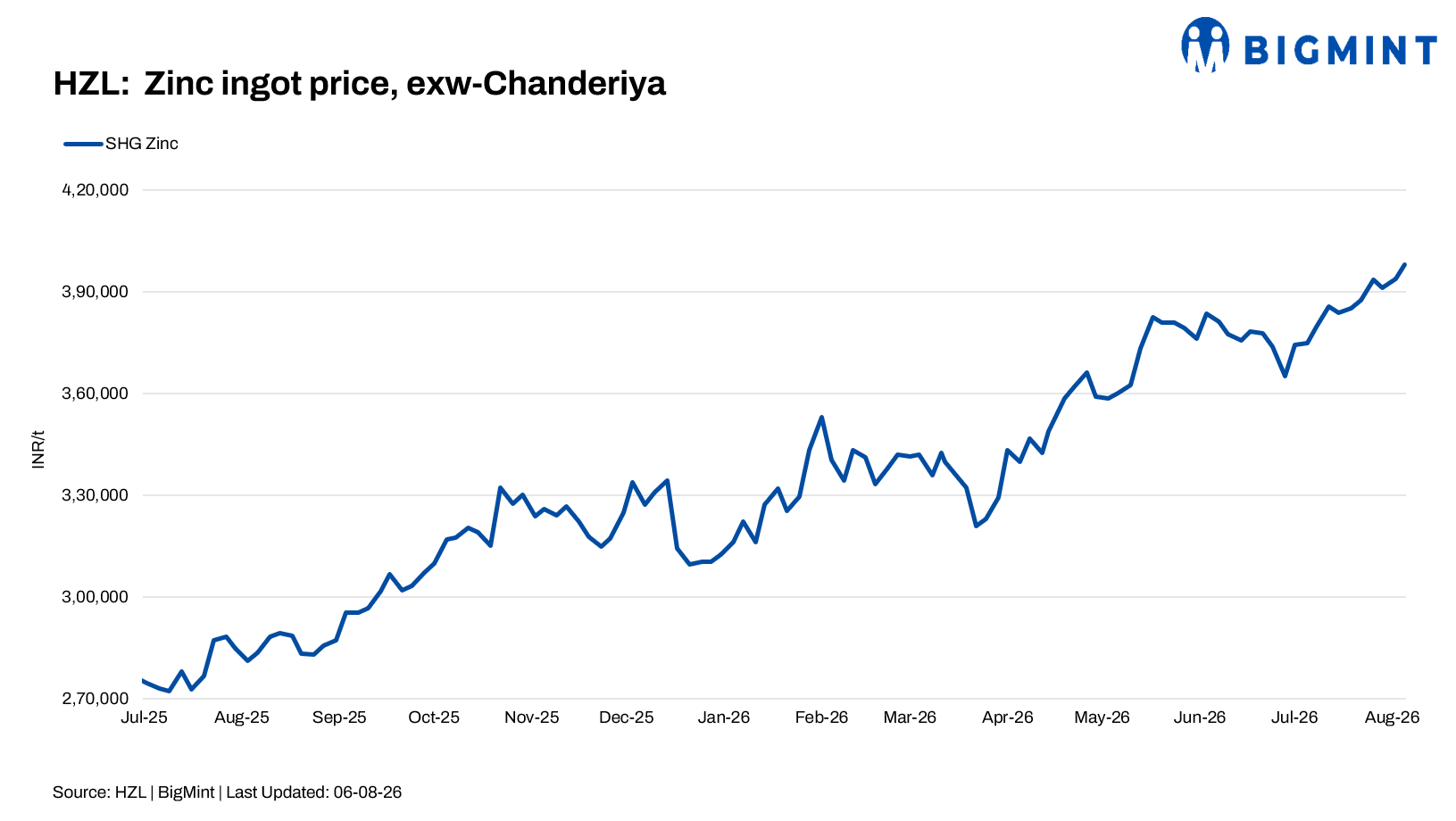
Hindustan Zinc Ltd (HZL) increased zinc ingot prices by INR 4,400/t ($51/t) while reducing lead ingot prices by INR 2,200/t ($26/t) on 6 August 2026 compared with its previous revision on 3 August 2026.
Following the latest revision, HZL’s benchmark Special High Grade (SHG) zinc ingot prices rose to INR 398,200/t ($4,626/t), while lead ingot prices declined to INR 210,500/t ($2,444/t).
On the London Metal Exchange (LME), zinc prices were trading at $3,692/t, up 0.86%, while lead prices stood at $1,903/t, up 0.4%, as of 12:30 PM IST. Zinc prices continue to hover near their highest levels since August 2022, supported by tightening concentrate availability, constrained mine supply and declining exchange inventories.
LME zinc inventories fell to 98,450 t on 5 August from 100,700 t on 30 July, extending the recent downward trend and reinforcing bullish sentiment across the market. Over the past month, zinc prices have remained firm amid persistent supply-side concerns.
According to BigMint’s latest assessment, SHG zinc ingot prices were assessed at INR 396,700/t ex-Delhi on 5 August. Despite the latest revision, HZL’s benchmark zinc price remained INR 1,500/t above the prevailing domestic spot-market level, indicating that producer prices continue to command a premium over physical market transactions.
Market participants noted that the sharp upward revision reflects sustained strength in global zinc prices and tightening supply fundamentals. However, the premium over domestic spot prices could restrict procurement to immediate requirements, with buyers likely to remain cautious until physical market prices align more closely with producer benchmarks.

In the alloy segment, Zamak prices also strengthened, tracking gains in primary zinc prices. As of 6 August, Zamak 3 was assessed at INR 408,000/t ex-Delhi, while Zamak 5 stood at INR 414,000/t ex-Delhi. Demand from the die-casting, automotive, hardware and consumer-durables sectors continued to support alloy prices, although higher replacement costs kept procurement largely need-based.
Internationally, sentiment in the zinc market remained firm amid positive developments in the global smelting industry. Korea Zinc, the world’s largest zinc smelter, reported record earnings for the first half of 2026, with zinc revenue increasing 22.6% year-on-year to KRW 1.56 trillion ($1.1 billion). The company attributed the strong performance to robust demand across its diversified metals portfolio, technological innovation and its ability to recover valuable metals from concentrates and recycled feedstock.
Fundamentally, the zinc market continues to receive support from constrained mine output, low treatment charges and tight concentrate availability. Demand from infrastructure, galvanising and renewable-energy sectors remains resilient, although elevated prices have tempered immediate buying interest across several downstream segments.
Meanwhile, lead prices continued to trade within a relatively narrow range, with demand from the battery and automotive sectors providing support. However, softer domestic consumption trends and fluctuations in international lead prices are expected to influence producer pricing decisions in the coming weeks.
On the corporate front, shares of Hindustan Zinc gained 13.05% over the past month, outperforming the BSE Metal index, which rose 5.71% during the same period. Market participants continue to monitor the company’s growth trajectory amid strong global demand for zinc, silver and other industrial metals.
Overall, domestic zinc prices are expected to remain firm in the near term, supported by strong global sentiment and tightening supply fundamentals. However, the premium of HZL’s benchmark over domestic spot prices could limit aggressive buying unless physical market prices strengthen further. Market participants will closely monitor developments in Chinese demand, LME inventories, US dollar movements and broader macroeconomic conditions for further price direction.

Leave a Reply