- Rhine river disruptions, limited EU supply support offers
- Weak rebar demand leads to need-based buying by mills
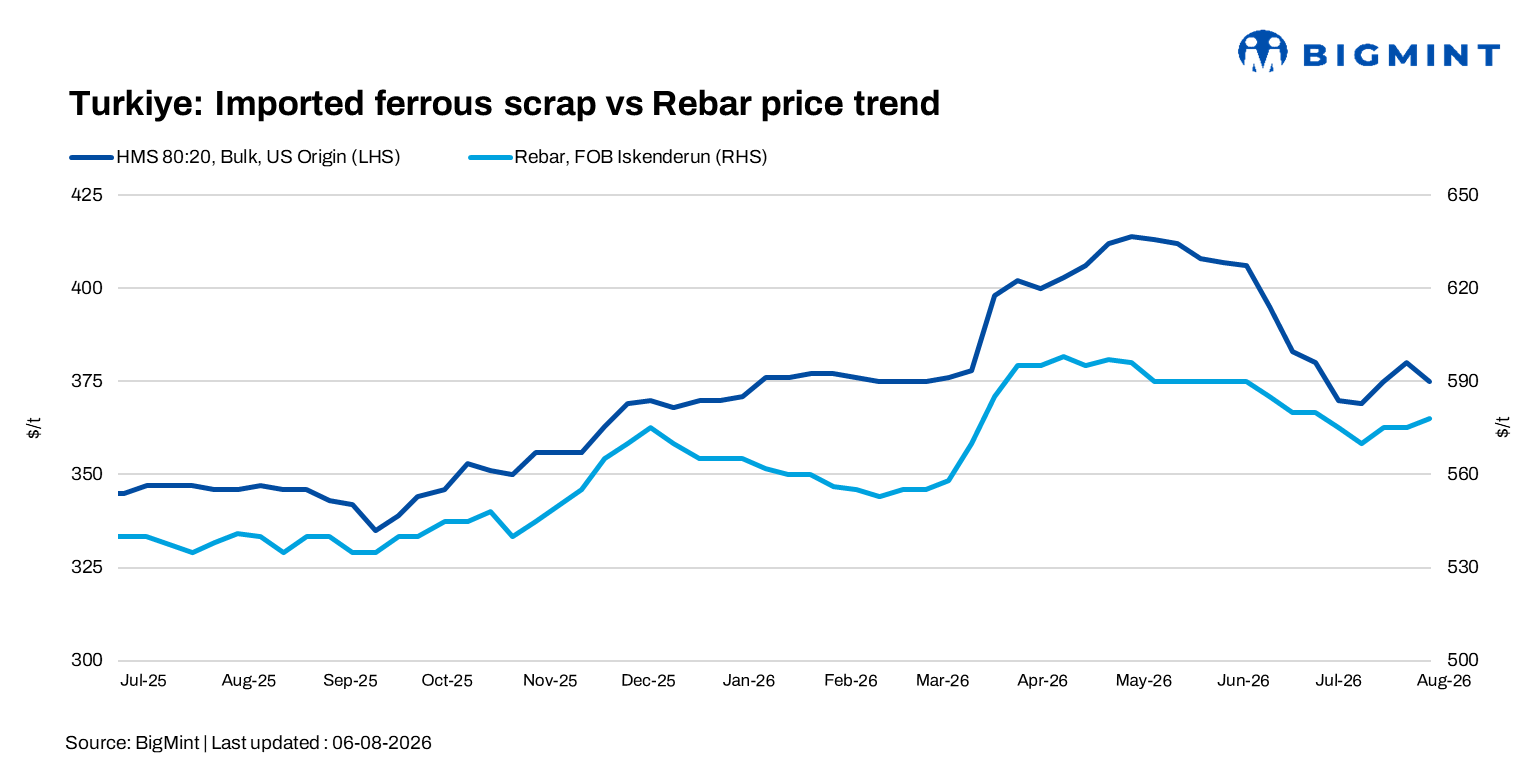
Turkiye’s imported deep-sea ferrous scrap prices declined during the week ended 6 August as cautious mill buying and weak finished steel demand outweighed support from constrained European scrap availability, elevated freight costs, and seasonal collection shortages. Weak export rebar sales and need-based procurement continued to limit buying interest despite tightening supply fundamentals.
Price assessments
- US-origin HMS 80:20 stood at around $375/t CFR Turkiye, down by $5/t w-o-w.
- US East Coast HMS 80:20 stood at around $343/t FOB, stable w-o-w.
Deep-sea trading remained active during the week, with around 5-6 trades heard. Several US-origin HMS 80:20 cargoes were booked at around $375/t CFR Turkiye, while a France-origin HMS 80:20 cargo concluded at $371/t CFR. UK-origin HMS 80:20 was also booked at approximately $368/t CFR. These transactions suggest that the market has stabilised around current price levels despite cautious mill buying.
A Baltic-based trader said the current tradable level prices are broadly in line with market expectations, with a couple of deals heard in the market. Tradable values for high-grade US-origin HMS 80:20 were largely heard at $375-377/t CFR, while participants described further price increases as possible but dependent on finished steel demand improving.
Suppliers continued to maintain firm offers, supported by restricted scrap availability in Europe. Low water levels on Germany’s Rhine River continued to disrupt inland transportation, limiting scrap flows to export yards. Seasonal summer holidays across Europe are also expected to reduce scrap collection volumes during August, further tightening supply.
According to a US-based scrap supplier, several exporters are targeting around $380/t CFR for September-loading cargoes, as limited export availability continues to support prices. The supplier noted that the market is gradually firming, with little scope for prices to decline under the current supply conditions.
However, Turkish mills remained cautious. Weak domestic and export demand for long steel products continued to limit procurement appetite, with many mills preferring to cover only immediate requirements. Some mills stated they had already secured sufficient August cargoes and were waiting for greater scrap availability resulting from temporary production cuts and logistical disruptions in Europe before returning to the market.
Domestic steel market
Domestic rebar sentiment improved marginally during the week, with several Marmara-based producers increasing rebar offers by $5-10/t to $578-605/t exw. However, market participants stressed that the increase reflected limited material availability rather than stronger domestic demand, as several mills prioritised export sales to Morocco and Algeria, reducing supply in the domestic market.
Even as rebar offers firmed to around $578/t FOB Turkiye, the scrap-to-rebar spread remained above $200/t, offering only limited support to mill margins. Consequently, weak finished steel demand kept Turkish mills cautious in their deep-sea scrap procurement.
Outlook
BigMint expects Turkiye’s imported scrap market to remain broadly stable in the coming week. Tight European scrap availability, Rhine River logistics disruptions, August holiday-related collection shortages, and elevated freight costs are expected to keep supplier offers firm. However, weak long steel demand, limited export rebar sales, and cautious mill procurement are likely to prevent any significant increase in import scrap prices unless downstream steel demand improves.

Leave a Reply