- Thermal coal imports remain on a steady growth path, supported by resilient power sector demand
- Indonesia continues to dominate Bangladesh’s coal imports, backed by competitive pricing and logistical advantages
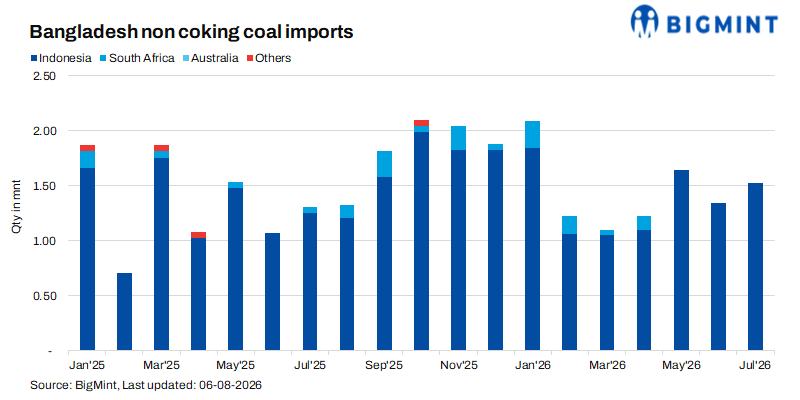
Bangladesh’s non-coking coal imports rebounded during July 2026, rising to 1.52 mnt, up 13.4% month-on-month and 16.9% higher year-on-year. The recovery extended the country’s import growth during 2026, with cumulative arrivals reaching 10.13 mnt during January-July, compared with 9.43 Mnt in the corresponding period last year, representing a 7.4% increase.
The latest trade data indicate that Bangladesh’s coal demand has remained resilient despite periodic monthly fluctuations. Indonesia further strengthened its position as the country’s dominant supplier, while Chittagong continued to handle the overwhelming majority of coal imports.

Imports recover during the second quarter
Bangladesh’s coal imports displayed a mixed pattern during the first half of the year before regaining momentum during May-July.

Although March witnessed a sharp year-on-year decline, stronger arrivals during the subsequent four months enabled Bangladesh to comfortably outperform last year’s cumulative import volumes.
Indonesia retains overwhelming market dominance
Bangladesh’s non-coking coal imports increased 7.4% y-o-y to 10.13 mnt during Jan-Jul’26, driven primarily by higher shipments from Indonesia, which supplied 9.55 mnt and retained a dominant 94.3% market share.
Meanwhile South African shipments almost doubled by 81.3% y-o-y to 0.58 mnt compared with the previous year, their contribution remained relatively modest. Indonesian suppliers continued to dominate owing to their competitive freight advantage, established trade relationships and suitability for Bangladesh’s coal-fired power plants.
Chittagong strengthens its position as Bangladesh’s coal gateway
Imports remained heavily concentrated at Chittagong Port.

The data indicate an increasing concentration of imports through Chittagong, while cargoes discharged at Payra declined sharply compared with last year.
Power generation continues to underpin import demand
The sustained growth in imports suggests Bangladesh’s coal demand remains closely linked to coal-fired power generation.
The recovery in imports during May-July coincides with the seasonal increase in electricity consumption across South Asia, when elevated temperatures and higher cooling loads increase thermal power generation. Indonesia continues to benefit from this demand owing to its proximity to Bangladesh, shorter voyage times and competitive pricing relative to alternative suppliers.
Unlike larger Asian importers such as India or China, Bangladesh’s procurement strategy remains relatively stable, characterised by a highly concentrated supplier base and limited diversification of import origins.
BigMint Insight
Bangladesh’s non-coking coal imports continue to exhibit steady structural growth rather than cyclical volatility. The country’s thermal coal demand remains firmly anchored by the power sector, while Indonesia has further consolidated its position as the dominant supplier, accounting for more than 94% of total imports.
The strengthening of imports during May-July indicates that utilities have maintained stable procurement despite fluctuations earlier in the year. Meanwhile, the increasing concentration of cargoes through Chittagong reflects the continued centralisation of Bangladesh’s coal logistics network.
Looking ahead, Bangladesh is expected to remain a stable and predictable source of seaborne thermal coal demand. Although its import volumes are significantly smaller than those of India or China, its consistent purchasing pattern provides an important baseload outlet for Indonesian exporters, particularly producers shipping medium-calorific coal from Tarahan, Tanjung Bara and Taboneo. If regional power demand remains firm during the second half of 2026, Bangladesh’s imports are likely to remain above last year’s levels, reinforcing Indonesia’s dominant position in the South Asian thermal coal market.
Leave a Reply