- Ferrous scrap imports decline around 50% y-o-y to a 5-year low in H1CY’26
- Sponge iron remains dominant metallic despite higher scrap consumption
- Mills optimise metallic mix as procurement shifts towards domestic raw materials
Morning Brief: India’s steel metallic mix continued to shift towards domestic raw materials in the first half of CY’26 as improving scrap collection reduced reliance on imports while sponge iron retained its position as the dominant metallic for the country’s induction furnace (IF) sector. Higher crude steel production, favourable domestic scrap availability and changing procurement economics enabled steelmakers to optimise their metallic charge without altering India’s broader steelmaking mix.
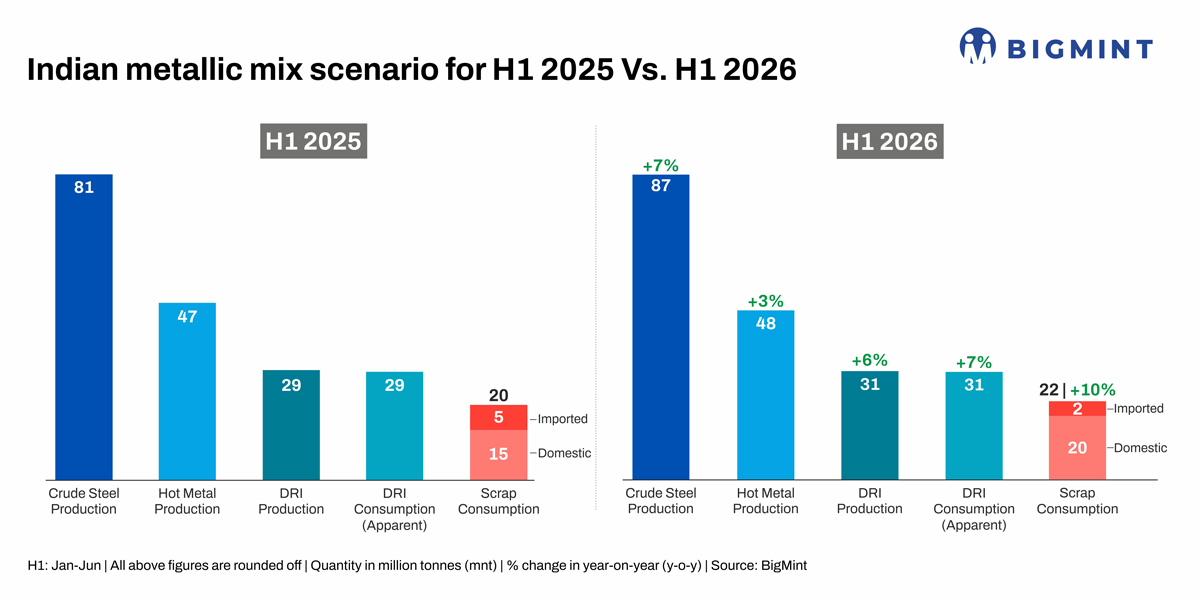
Crude steel production increased 7% y-o-y to 87 million tonnes (mnt) during January-June 2026. Scrap consumption registered the fastest growth among key metallics, rising 10% to 22 mnt, while direct reduced iron (DRI) consumption increased 7% to 31 mnt. Hot metal production rose at a slower pace of 3% to 48 mnt, indicating secondary producers increasingly balanced scrap and DRI consumption while integrated producers maintained steady blast furnace output.
Domestic scrap replaces imports
The biggest change in H1 came from scrap procurement. Domestic scrap consumption increased to 20 mnt from 15 mnt a year earlier, while imported scrap declined to 2 mnt from 5 mnt, reflecting improved domestic collection and processing as well as weaker import economics. The shift enabled mills to source a larger proportion of their scrap requirement locally, reducing exposure to volatile international prices and freight costs.

Improved domestic availability also supported higher scrap utilisation across electric arc furnace (EAF) and induction furnace producers, allowing mills to adjust their metallic mix according to prevailing economics. Organised recycling, better procurement networks and greater availability of industrial scrap strengthened domestic supply through the review period.
Sponge iron remains central to steelmaking
Despite the stronger growth in scrap consumption, sponge iron continued to dominate India’s metallic mix owing to its ample availability, competitive pricing and widespread use in the country’s induction furnace sector. DRI production increased 7% to 31 mnt during H1, broadly matching apparent consumption.
Procurement patterns, however, shifted through the second quarter as pellet price volatility, raw material shortages and fluctuating downstream demand influenced metallic selection. Capacity utilisation remained around 65-75%, with production aligned to billet demand. Towards the end of H1, improving billet bookings supported sponge iron demand, while pig iron emerged as an alternative metallic during May-June amid stronger overseas demand and easing geopolitical tensions.
Structural shift continues
India’s metallic mix continues to evolve gradually rather than undergoing a structural shift away from sponge iron. Faster growth in domestic scrap consumption reflects improving collection efficiency and organised recycling, but sponge iron remains indispensable to India’s expanding secondary steel sector because of its consistent availability and cost competitiveness. The combination of higher domestic scrap usage and stable DRI consumption indicates that steelmakers are increasingly optimising raw material procurement while relying less on imported metallics.
Outlook
India’s metallic mix is expected to become increasingly domestic in the coming quarters as improvements in scrap collection and processing continue to reduce import dependence. However, with crude steel production expanding steadily and domestic scrap availability still constrained relative to demand, sponge iron is likely to remain the country’s principal steelmaking metallic while scrap assumes a larger role in incremental steel production.
Leave a Reply