- Domestic sponge iron trade volumes rise by 24% m-o-m
- DRI exports climb 41% on improved overseas demand
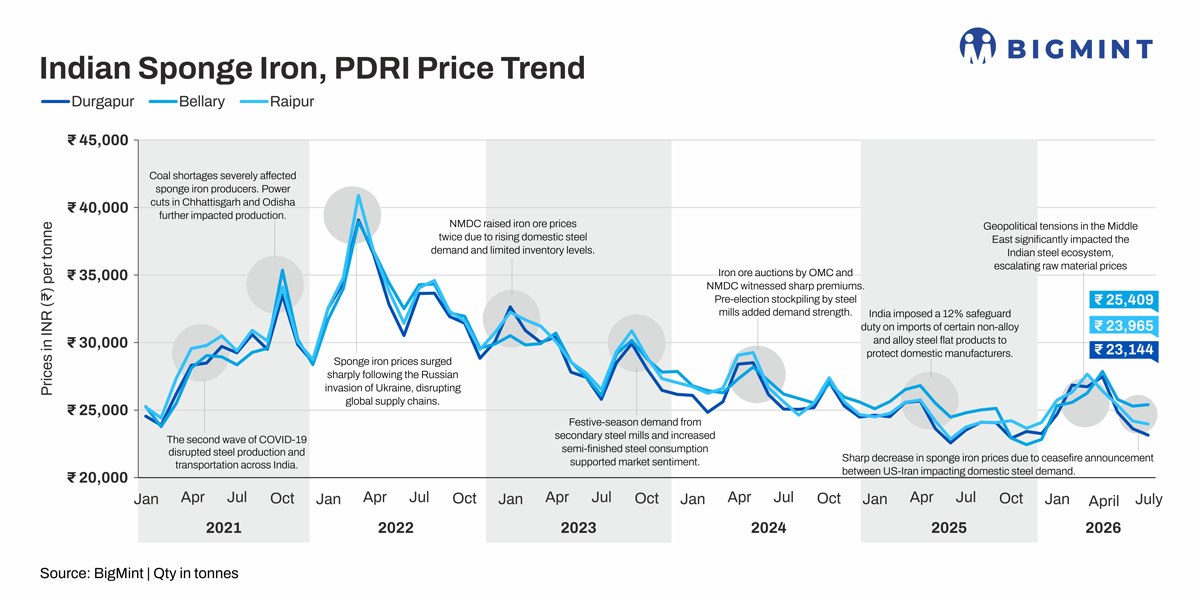
India’s sponge iron market witnessed a broad-based recovery in July 2026, with prices strengthening across major regions amid improved buying activity, tighter spot availability and higher raw material costs. According to BigMint’s monthly assessment, benchmark pellet-based sponge iron (PDRI) prices in Raipur surged by INR 1,350/t m-o-m to INR 25,300/t exw-Raipur as on 1 August 2026. Stronger domestic bookings during the first three weeks of July enabled producers to raise offers. However, buying momentum moderated towards the month-end as consumers turned cautious at elevated price levels and softer downstream steel demand.
Pellet-based sponge iron prices climb
Among pellet-based sponge iron (FeM 78-80 +/-1) markets, Raipur and Raigarh recorded the highest monthly gains of INR 1,350/t, with prices rising to INR 25,250/t and INR 24,400/t, respectively. In Jharsuguda, prices rose by INR 1,100/t, while Hyderabad and Bellary saw gains of INR 1,000/t each. Chennai also saw prices strengthening by INR 700/t. In contrast, Durgapur prices declined by INR 500/t, while Ramgarh witnessed prices easing by INR 150/t, reflecting relatively softer regional demand and adequate material availability.
Iron ore-based sponge iron follows same trend
The iron ore-based sponge iron (FeM 80-82 +/-1) segment also displayed mixed trends. Raigarh posted the strongest monthly increase of INR 1,350/t, followed by Bellary (INR 700/t) and Rourkela (INR 550/t). Meanwhile, Durgapur, Mandi Gobindgarh and Ramgarh registered declines of INR 400/t, INR 200/t and INR 100/t, respectively, amid comparatively weaker buying interest. (Price comparision considered from 1 July’26 to 31 July’26)
 DRI export bookings support price gains
India’s export market also strengthened during the month. Pellet-based DRI offers to Nepal increased by $4/t to $273/t CPT Raxaul, while CDRI/mix DRI offers edged up by $1/t to $300/t CPT Raxaul. Export offers to Bangladesh increased by $6/t to $309/t CPT Benapole, supported by firmer domestic replacement costs despite cautious buying from neighbouring countries.
Trade activity improved significantly during July. Domestic sponge iron transactions increased to 400,250 t, up 77,254 t (24%) from 322,996 t in June. Meanwhile, DRI export volumes rose to 37,250 t, an increase of 10,750 t (41%) from 26,500 t in June, suggests stronger overseas shipments.
Regional trends
Central India (Raipur and Raigarh) remained the key price-discovery centre, recording the strongest recovery in merchant trade. Improved billet production encouraged higher sponge iron procurement, allowing producers to increase offers steadily through the month. However, at month closing finished steel witnessed pressure from end user due to demand weakness resulting in slight corrections.
Eastern India (Rourkela and Jharsuguda) witnessed improved booking activity, supported by healthy demand from integrated and secondary steel producers. Production declined during the month as several sponge iron units underwent maintenance shutdowns, while others reduced operating rates owing to negative manufacturing margins of around INR 500-1,000/t. Material movement shifted towards central India, where realisations remained relatively better, while export demand from Nepal and Bangladesh weakened. Durgapur experienced a moderate recovery as demand from rolling mills improved, while merchant trading activity remained steady. Durgapur prices softened amid weakness in downstream demand and cautious buying. Trade volumes remained subdued as buyers limited procurement to immediate requirements.
Southern India, mainly the Bellary and Hyderabad markets recorded a price uptick, supported by higher production costs following the rise in imported coal and iron ore pellet prices. Despite only moderate demand from the rebar segment, limited merchant market availability, as several large producers withheld supplies for nearly 35-40 days. Most sponge iron manufacturers operated their kilns at around 50-60% capacity during July due to moderate finished steel demand. At the same time, lower merchant market supplies from major producers tightened spot availability, creating a supply-demand imbalance that supported domestic prices.
Northern India, Mandi Gobindgarh, sponge iron prices declined by around INR 400/t m-o-m in July amid a shortage of scrap in the market, which supported sponge iron demand as an alternative raw material. Buying activity remained need-based. Meanwhile, the scrap-to-sponge mix in furnaces shifted to around 70:30 from 80:20 previously, reflecting increased sponge iron consumption amid tighter scrap availability.
Comparative analysis: June vs July 2026
The market environment in July differed notably from June. During June, sponge iron prices remained under pressure for most of the month as weak billet and finished steel demand restricted procurement. Buyers largely adopted a need-based purchasing strategy, while producers competed aggressively to secure orders. This resulted in softer prices across several regions despite improved domestic trade volumes.
In contrast, July witnessed a significant improvement in market sentiment during the first three weeks. Higher billet production, improved bookings and tighter spot availability enabled sponge iron producers to raise offers steadily. Rising pellet prices also increased replacement costs, providing additional support to sponge iron prices. As prices moved higher, buyers accelerated purchases initially to secure material before further increases. However, towards the end of July, elevated offers and weaker finished steel demand prompted consumers to return to cautious, need-based procurement, leading to a moderation in transaction volumes despite prices remaining firm.
Outlook for August
The sponge iron market is expected to remain firm but range-bound through August. Producers are likely to maintain elevated offer levels, supported by higher pellet prices, constrained spot availability and firm replacement costs. If re-rolling mills witness a recovery in order inflows following the monsoon period, sponge iron procurement could improve, supporting prices further. Conversely, if finished steel demand remains subdued, buyers are expected to continue purchase against immediate production requirements, limiting upside despite tight supply conditions.
Leave a Reply