- Refined copper cathode exports drop 15%; finished product shipments surge
- Higher refined output, rising secondary feedstock could support exports ahead
Japan’s copper exports remained resilient during the first half of 2026 despite a challenging global manufacturing environment, with total shipments edging up 1.3% year-on-year (y-o-y) to 0.66 mnt. While the overall growth was modest, the composition of exports changed significantly, indicating that Japanese producers are gradually shifting their focus from refined copper cathodes towards higher-value downstream products amid tightening raw material availability and changing global demand patterns.
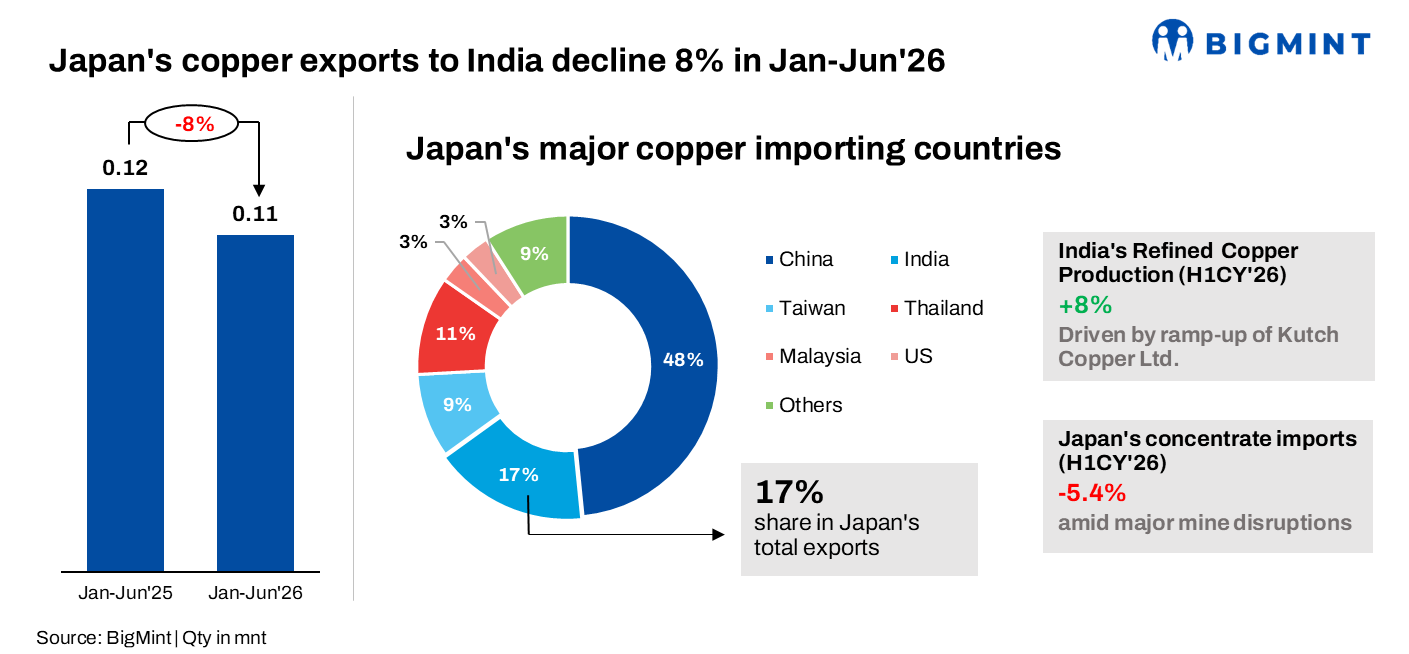
China remained Japan’s largest copper export destination during H1CY’26, accounting for nearly 48% of total shipments, while India strengthened its position as the second-largest buyer with a 17% share. The increasing importance of India reflects the country’s expanding demand for premium copper products across power infrastructure, renewable energy, electric vehicles (EVs), electronics, and precision manufacturing.

Why is Japan’s export basket shifting towards value-added products?
The most notable trend during H1CY’26 was the divergence between exports of refined copper cathodes and value-added semi-finished products.
Refined copper cathode exports declined 15% y-o-y to 324,786 t, while shipments of downstream copper products registered healthy growth. Total finished long products increased 20% to 32,938 t, whereas total finished flat products rose 15% to 85,781 t.
Among individual product categories, copper wire exports climbed 34% y-o-y to 20,630 t, rolled plates increased 12% to 55,718 t, copper foils rose 16% to 26,221 t, and pipes and tubes recorded the strongest increase, surging 78% to 3,842 t. Copper scrap exports also expanded 29% to 0.22 mnt, highlighting the growing role of recycled copper within regional trade.
The changing export mix reflects sectors such as power, construction, and EVs, AI and data centres are emerging as key growth drivers. A single hyperscale data centre is estimated to consume around 28-30 t of copper, supporting demand for premium copper wire, foils and precision flat products, where Japanese manufacturers maintain a strong competitive advantage.
Why are India’s cathode imports increasing despite higher domestic production?
India’s refined copper production has continued expanding, with major domestic producers collectively increasing output by 8% this year, largely driven by the successful ramp-up of Kutch Copper Ltd. following the commissioning of its new smelter.
However, higher domestic output has not translated into lower imports.
Instead, India’s refined copper cathode imports increased 19% y-o-y to 127,818 t, indicating that domestic consumption continues to expand much faster than local production capacity.
Japan continues to dominate this trade despite its lower cathode exports globally, accounting for nearly 70% of India’s total refined copper cathode imports and maintaining its position as the country’s largest overseas supplier.

Market participants attribute Japan’s continued dominance to more than product quality alone. Large Japanese trading houses source premium-grade cathodes from major producing countries such as Chile, Peru and the Democratic Republic of Congo before supplying Indian consumers.
These capabilities enable Indian buyers to secure reliable supplies with lower procurement risks while meeting the stringent quality requirements of cable, transformer, switchgear and electrical equipment manufacturers.
How is Japan changing its feedstock mix amid tight concentrate supplies?
During H1CY’26, Japan’s copper ore and concentrate imports declined 5.4% y-o-y to 2.43 mnt, indicating continued tightness in global concentrate availability. Major supply disruptions over the past two years and aggressive capacity expansion by Chinese smelters have intensified competition for available concentrates, further squeezing TC/RCs and increasing pressure on smelter margins worldwide.
Against this backdrop, Japanese smelters appear to be gradually diversifying their raw material mix.
Copper scrap imports increased 26.7% y-o-y to 0.2 mnt during H1CY’26 from 0.15 mnt a year earlier. Refined copper cathode imports also more than doubled to 9,338 t, up 135% y-o-y, although volumes remained relatively small.
The import pattern suggests Japanese producers are increasingly supplementing concentrate feed with recycled copper and refined metal to maintain smelter utilisation and secure raw material availability.
How are Japanese smelters positioning for future export growth?
Japanese producers are simultaneously expanding refined copper production to support both domestic consumption and export markets.
According to production plans released by major smelters, Japan’s refined copper output is expected to increase 3.3% y-o-y to approximately 0.76 mnt during the first half (April-September) of FY’27.
Pan Pacific Copper (PPC), the country’s largest producer, expects output to increase 7.5% to around 0.31 mnt as operating rates improve at JX Advanced Metals’ smelters.
Sumitomo Metal Mining plans to increase production 3.7% to 0.22 mnt, supported by stable operations at its Toyo smelter following maintenance disruptions last year. Mitsubishi Materials expects production of around 0.17 mnt, marginally lower than a year earlier.
Domestic demand within Japan also remains supportive. The Japan Copper and Brass Association projects a 1.2% increase in demand for copper alloy products during FY’27, driven primarily by strip products used in automotive and semiconductor applications.
Meanwhile, the Japan Electric Wire and Cable Makers’ Association expects copper wire shipments to rise 0.6%, supported by replacement of ageing electricity infrastructure and growing power demand from data centres.
The planned increase in refined production should strengthen Japan’s ability to maintain stable export volumes while meeting rising regional demand for value-added copper products.
Outlook
India is expected to remain a key market for Japanese copper products as demand continues to outpace domestic supply. India’s refined copper consumption is projected at around 1.6-1.7 mnt over the medium term, supported by investments in power infrastructure, renewable energy, EVs and electronics manufacturing.
Japan is well positioned to benefit from this demand under the India-Japan Comprehensive Economic Partnership Agreement (CEPA), which came into force in 2011 to promote bilateral trade by progressively reducing or eliminating customs duties on a wide range of industrial goods, simplifying customs procedures and improving market access between the two countries.

Leave a Reply