- India’s electricity demand remains elevated amid persistent cooling demand due to humidity
- Coal security increasingly depending on logistics efficiency, not just production
India’s electricity consumption sent an important signal in July 2026. Rather than easing with the advance of the southwest monsoon, consumption rose 10.9% y-o-y to 170.7 billion units (BU), while peak demand climbed to 270.2 GW, just short of the all-time national record. The increase surprised the market because July traditionally marks the beginning of a seasonal slowdown in electricity demand. Instead, persistently high humidity kept air-conditioners and cooling appliances running across much of the country, extending summer-like electricity consumption well into the monsoon.
For India’s power sector, July was far more than another month of strong demand. It raises an important question: Is India’s electricity consumption becoming structurally less seasonal? If so, the implications extend well beyond generators to coal procurement, railway logistics, inventory planning and long-term energy security.
Humidity reshapes India’s electricity demand profile
Historically, India’s electricity demand has been closely linked to temperature. Demand typically peaks during April to June before moderating as monsoon rainfall lowers temperatures and hydropower generation improves. July 2026 broke that pattern.
Although rainfall covered most parts of the country, persistently humid conditions kept “real feel” temperatures elevated, prolonging the use of cooling equipment in homes, offices and commercial establishments. This suggests that humidity, alongside rising air-conditioner penetration and urbanisation, is becoming an increasingly important driver of electricity consumption.
For planners and utilities, this could represent a structural shift rather than a one-off weather event. Electricity demand may no longer decline as sharply during the monsoon, making seasonal forecasting considerably more challenging.
Stronger consumption translates into higher generation
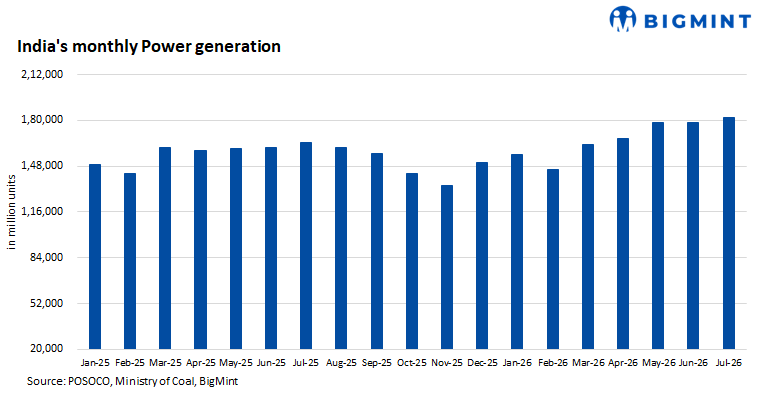
The sustained demand required a corresponding increase in electricity generation.
Gross generation rose to 181.8 BU (181.8 TWh) in July, up 10.6% y-o-y. Coal-fired generation increased to 116.9 BU, renewable generation climbed to 36.3 BU, while hydro generation declined sharply by 22.1% to 18.6 BU despite the monsoon season.
The generation mix tells an important story. Under normal monsoon conditions, stronger hydropower output would reduce reliance on thermal generation. Instead, weak hydro availability meant coal and renewable energy together met virtually the entire increase in electricity demand.
This reinforces an emerging feature of India’s electricity system: renewable energy is supplying an increasing share of daytime electricity, while coal continues to provide the dispatchable capacity required whenever renewable output weakens or hydro generation underperforms.
Sustained demand changes coal equation
The broader implication of July’s demand surge is not simply higher coal burn — it is the pressure placed on India’s coal supply chain if elevated electricity consumption becomes more frequent during the monsoon.
Observations from an NTPC fuel management and coal quality executive provide useful context. He notes that India is not facing an immediate shortage of coal reserves but rather a system operating with relatively thin inventory buffers and limited logistical slack. In his assessment, the principal vulnerability lies not in mining capacity but in coal movement — particularly rail logistics during the monsoon — when disruptions can quickly translate into lower plant inventories if electricity demand remains unexpectedly high.
This distinction is significant. India’s coal sector has historically relied on the monsoon months to rebuild inventories after the summer demand peak. If electricity consumption remains elevated throughout July and August, power plants continue burning coal at high rates precisely when logistics are most vulnerable to weather-related disruptions.
July’s operational data already reflects this pressure. Thermal power plant coal stocks declined from 44.1 mnt at the end of June to 38.0 mnt by 31 July, a drawdown of more than 6 mnt during the month. Although inventories remained sufficient to avoid any widespread fuel shortage, they finished almost 30% lower than a year earlier, reducing the system’s ability to absorb future supply disruptions.
Why SHAKTI reforms assume greater significance
Against this backdrop, the revised SHAKTI Policy assumes greater strategic importance.
The policy’s Window-II allows generators without long-term power purchase agreements to bid competitively for domestic coal linkages, enables imported coal-based plants to access domestic coal and permits existing linkage holders to procure additional quantities through auction. Collectively, these measures increase flexibility in domestic coal allocation and enable coal to move more efficiently towards plants that require additional fuel during periods of heightened demand.
However, policy flexibility alone cannot guarantee supply security. Sustained electricity demand during the monsoon will require parallel improvements in railway capacity, rake availability, mine evacuation infrastructure and inventory management if generators are to maintain adequate fuel buffers.
Outlook
July 2026 may ultimately be remembered not for setting another near-record demand level, but for signalling a structural shift in India’s electricity consumption pattern.
If humidity increasingly extends cooling demand beyond the traditional summer months, the distinction between summer and monsoon electricity consumption could gradually narrow. That would fundamentally alter assumptions that have long shaped India’s power sector — from generation scheduling and coal procurement to railway planning and inventory management.
For coal producers, the message is that domestic demand may become progressively less seasonal. For power generators, flexible coal-fired capacity will remain essential to complement growing renewable generation, particularly when hydropower underperforms. And for policymakers, July reinforces that India’s energy security will increasingly depend not only on producing sufficient coal, but also on ensuring resilient logistics, adequate inventory buffers and more flexible fuel allocation mechanisms.
The July numbers therefore tell a story that extends well beyond one month of strong electricity consumption. They suggest India’s power system is entering a new phase — one where demand remains resilient even during the monsoon, requiring coal, renewables and the supporting supply chain to operate with far greater flexibility than ever before.

Leave a Reply