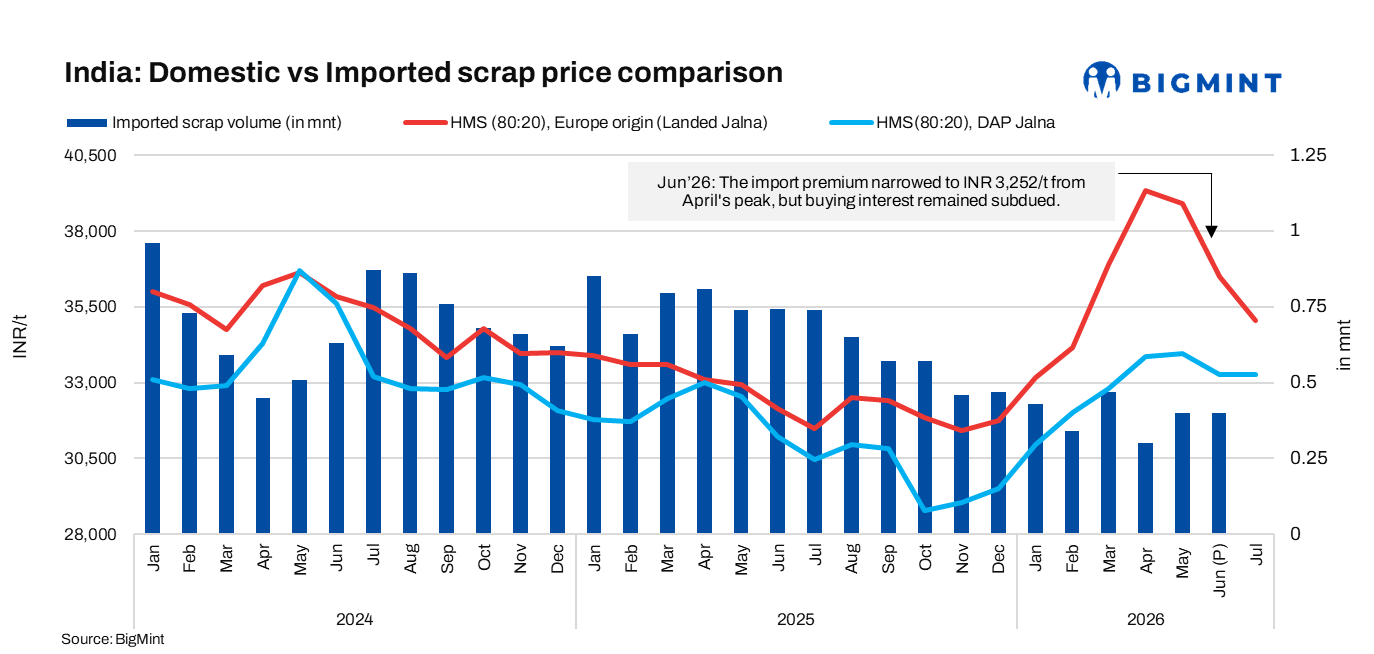
- Domestic scrap meets nearly 90% of India’s total consumption in H1CY’26
- Landed costs of European scrap rise 10% y-o-y, domestic prices up only 2%
India’s ferrous scrap procurement pattern is undergoing a structural shift as steelmakers increasingly favour domestic scrap over imports amid a widening gap between the landed cost of imports and domestic prices. Although total ferrous scrap consumption increased 16.7% to 21.93 million tonnes (mnt) in H1CY’26 from 18.79 mnt in H1CY’25, imported scrap accounted for a significantly smaller share of the metallic mix. Higher international scrap prices, elevated freights, currency depreciation and improved domestic scrap availability encouraged mills to rely more heavily on local material, signalling a broader transformation in India’s procurement strategy.
India’s scrap consumption shifts towards domestic sourcing
India consumes around 40-41 mnt of ferrous scrap annually, with domestic generation typically supplying about 32 mnt and imports accounting for the remaining 8-9 mnt. However, procurement patterns changed noticeably during H1CY’26.
Domestic scrap consumption increased to 19.59 mnt, accounting for 89.3% of total ferrous scrap consumption, compared with 75.7% in H1CY’25. Meanwhile, imported scrap consumption declined sharply to 2.34 mnt from 4.60 mnt a year earlier, reducing imports’ share of total consumption to 10.7% from 24.3%.

The shift reflects improved domestic scrap generation alongside stronger steel production. BigMint estimates domestic scrap generation increased to around 18.8 mnt during H1CY’26 compared with nearly 15 mnt a year earlier, allowing mills to meet higher production requirements while reducing dependence on imported material.
Global market dynamics keep landed costs elevated
Global market conditions reduced the competitiveness of imported scrap throughout H1CY’26. Turkish mills remained active in the deep-sea market, supporting international prices despite periodic corrections.
The average US-origin HMS (80:20) CFR Iskenderun price increased to $391/t during H1CY’26 from $352/t in H1CY’25, up 11.1% y-o-y. Prices strengthened steadily between March and May, exceeding $400/t in both April and May before easing to $397/t in June as finished steel demand softened.

At the same time, a weaker Indian rupee against the US dollar, together with elevated freight costs, pushed up the landed cost of imported scrap, making overseas cargoes increasingly uneconomical for Indian buyers.
Widening import premium discourages overseas purchases
The higher landed cost translated into a significantly wider premium for imported material over domestic scrap.
The average landed price of Europe-origin HMS (80:20) at Jalna increased by around 10% y-o-y, while domestic HMS (80:20) prices rose only about 2% over the same period.
As a result, imported HMS traded at an average premium of INR 3,600/t ($38/t) over domestic scrap during H1CY’26, compared with INR 1,100/t ($12/t) in H1CY’25. The premium widened by approximately INR 2,500/t ($26/t), reducing the commercial viability of imported cargoes and prompting mills to postpone bulk bookings.
Need-based procurement dominated throughout the period as buyers avoided inventory accumulation amid uncertainty surrounding global scrap prices and freight costs.
Domestic markets reinforce procurement shift
The widening price differential encouraged mills to source more material domestically while increasing the use of alternative metallics.
Average July HMS prices were around INR 30,900/t in Chennai, INR 31,450/t in Jalna and INR 34,600/t in Mandi Gobindgarh, all below the average landed cost of imported Europe-origin HMS at around INR 35,064/t.
Lower domestic scrap prices, combined with competitive sponge iron costs, enabled mills to maintain production while protecting steel margins. BigMint estimates sponge iron accounted for around 20-30% of the metallic mix among major mills and 40-45% among smaller producers during H1CY’26, further reducing reliance on imported scrap.
Untapped ELV potential could strengthen long-term domestic supply
Although domestic scrap availability has improved considerably, India continues to possess significant untapped recycling potential.
According to Ministry of Road Transport and Highways (MoRTH) deregistered vehicle data and BigMint analysis, India had the potential to generate around 10 mnt of ferrous scrap from End-of-Life Vehicles (ELVs) during FY’25. However, recoverable volumes remain well below this potential, highlighting the need for additional Registered Vehicle Scrapping Facility (RVSF) capacity and stronger policy implementation to improve domestic scrap availability over the longer term.
Outlook
India’s ferrous scrap market is expected to remain largely cost-driven over the coming months. Unless imported HMS prices decline sufficiently to offset freight costs and currency weakness, domestic scrap is likely to retain its competitive advantage.
The changing procurement pattern indicates that domestic scrap is becoming the benchmark for procurement decisions, while imported cargoes are increasingly serving as balancing volumes rather than the primary source of raw material. Domestic recyclers stand to benefit from stronger local demand, whereas importers may continue to face subdued booking activity unless international prices, freight costs or currency movements improve the competitiveness of imported scrap.
The market appears to be entering a new procurement cycle in which domestic availability, rather than overseas price movements alone, has become the primary determinant of buying behavior. Unless the landed premium narrows materially, imports are likely to remain below the country’s structural requirement, with domestic scrap and alternative metallics continuing to account for a larger share of steelmakers’ raw material mix.
To provide feedback on this index or if you would like to contribute by becoming a data partner, please contact – support@bigmint.co
Leave a Reply