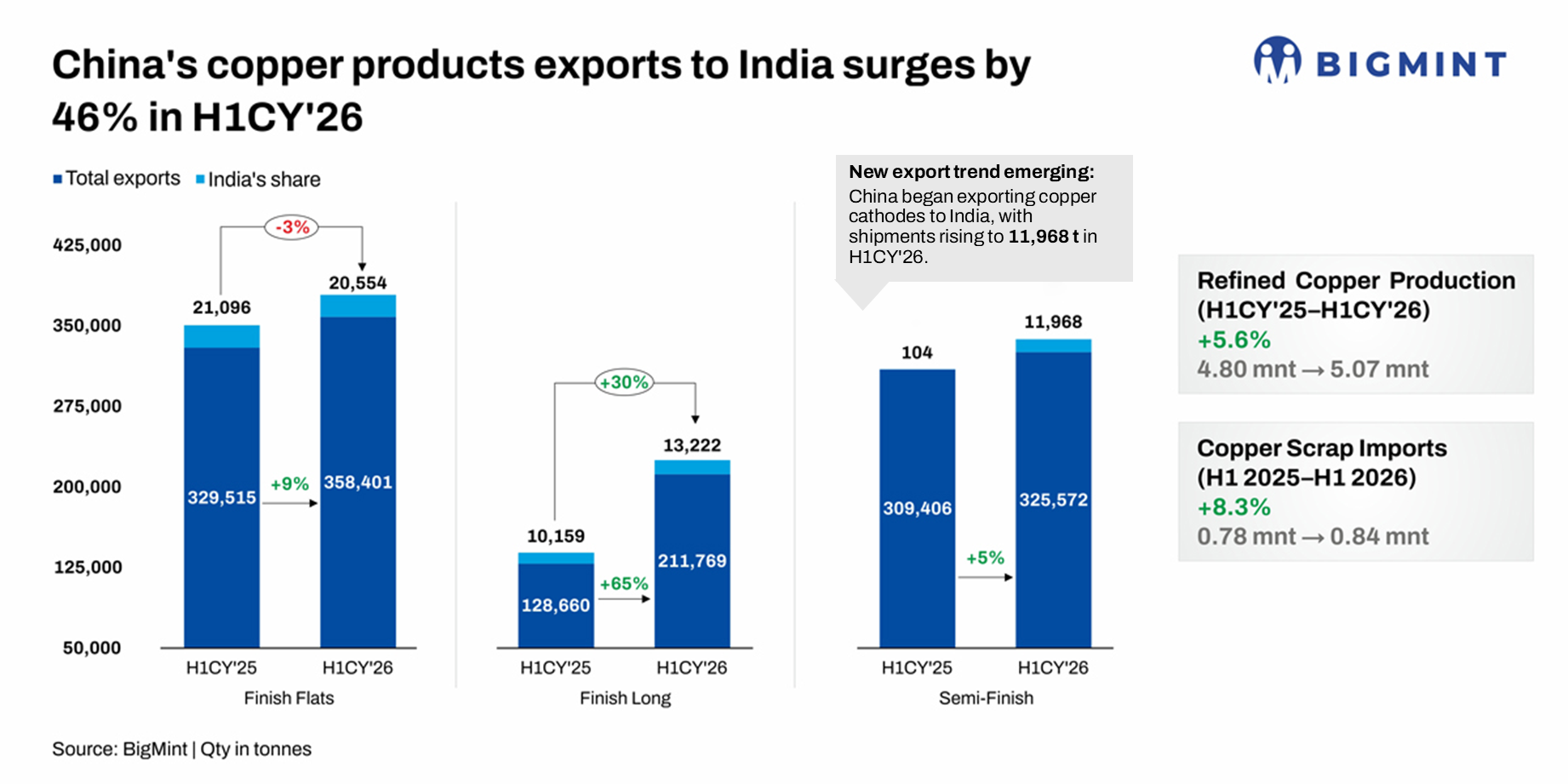
- Rising refined cathode production, scrap use support China’s export competitiveness
- India emerges as fastest-growing cathode destination, with exponential surge in imports
China’s copper exports rose 17.7% y-o-y to 0.88 million tonnes (mnt) during H1CY’26, supported by higher domestic refined copper production, improving raw material availability, and resilient overseas demand for downstream copper products. Meanwhile, June shipments surged 33.3% m-o-m to 0.15 mnt, signalling a sharp recovery after relatively subdued exports in May.
Notably, China continued to expand shipments of downstream copper products to India during the period. Exports of finished long copper products increased 30% y-o-y to 13,222 t, while shipments of finished flat copper products declined marginally by 3% y-o-y to 20,554 t. Despite the slight decline in flat products, China retained its position as India’s largest overseas supplier, highlighting its growing presence across India’s downstream copper value chain.
For India, however, the story extends beyond stronger Chinese exports. China’s growing refined copper surplus is increasingly being channelled into higher value-added products, strengthening its position in India’s downstream copper market at a time when domestic demand is accelerating across power transmission, renewable energy, electric vehicles (EVs), railways and electronics manufacturing.
Cathode exports rise as refined production expands
Refined copper cathode exports recorded the strongest growth among China’s copper exports. During H1CY’26, cathode exports reached 0.33 mnt, up 5% y-o-y. June shipments surged 144% m-o-m to 48,500 t from 19,900 t in May.
The increase was primarily driven by greater domestic refined copper availability as Chinese smelters continued operating at elevated utilisation rates despite benchmark treatment and refining charges (TC/RCs) falling to $0/t following the mid-year concentrate negotiations between Antofagasta and Chinese smelters, while spot treatment charges remained in negative territory.
China’s refined copper production increased to 5.07 mnt during H1CY’26 from 4.8 mnt in the corresponding period last year despite one of the tightest concentrate markets in recent years, reflecting the industry’s continued focus on maintaining output even under compressed smelting margins.
The country’s feedstock strategy has also been evolving. Copper scrap imports increased 8.3% y-o-y to 0.84 mnt, indicating China’s increasing reliance on recycled raw materials to offset concentrate shortages and weak smelter economics.
Looking ahead, China’s refined copper production is expected to receive further support from new smelting capacity currently under construction and scheduled for commissioning over the next few years. Several integrated smelting projects, together with continued investments in overseas mining assets and recycling infrastructure, are expected to strengthen China’s ability to maintain high refined output despite persistent tightness in global concentrate availability.

India emerges as fastest-growing cathode destination
India emerged as the fastest-growing destination for Chinese copper cathodes during H1CY’26, with imports surging from just 104 t in H1CY’25 to 11,968 t, an extraordinary increase of more than 11,400% y-o-y.
The sharp rise reflects strengthening trade linkages between the two countries as Indian manufacturers increasingly sourced copper from China to meet rising demand from the power, renewable energy and electrical equipment sectors.
Indonesia (+346% y-o-y), Taiwan (+84% y-o-y), and Thailand (+17% y-o-y) also recorded strong growth, while exports to Vietnam declined 35% y-o-y.
Finished copper products surge by 80%
Exports of finished long products reached 0.21 mnt during H1CY’26, increasing 65% y-o-y. Growth was led primarily by copper wire exports, which nearly doubled to 0.18 mnt, while bars and profiles increased 17.5%.
Finished flat products also maintained steady momentum. Total exports increased 9% y-o-y to 0.36 mnt, supported by a 32.7% rise in copper foil shipments and an 18.8% increase in rolled plates. Copper tube exports remained relatively stable, easing only 2.7% y-o-y.
June shipments remained equally robust. Finished long product exports increased 10.3% m-o-m, while finished flat products rose 10.4% over May levels, indicating sustained overseas demand despite softer global manufacturing activity.
Demand continued to be supported by investments in renewable energy, power transmission and electrical infrastructure. Saudi Arabia emerged as China’s fastest-growing destination, with shipments increasing 755% y-o-y. Thailand (+75%), South Korea (+144%) and Vietnam (+28%) also remained key buyers, while exports of finished copper products to India increased 36% y-o-y.

India’s downstream market faces growing competitive pressure
For India, the implications extend beyond rising import volumes.
Domestic copper demand remains structurally strong, driven by rapid investments in transmission infrastructure, renewable energy, EVs, railways and electronics manufacturing.
The increase in Chinese shipments was further supported by changes in regional trade flows. Imports from several ASEAN suppliers declined following stricter verification of Rules of Origin (RoO) under the India-ASEAN Free Trade Agreement (FTA), creating opportunities for Chinese exporters. Competitive pricing, abundant product availability and China’s well-developed downstream processing industry enabled exporters to gain market share in India.
More importantly, China’s export mix is gradually shifting towards semi-finished and finished products rather than refined metal alone. As domestic refining capacity continues to expand, a larger share of surplus copper is likely to be converted into higher value-added products before export, increasing competitive pressure on Indian manufacturers of wires, rods, strips, tubes and rolled products.
Outlook
China’s copper exports are expected to remain elevated during H2CY’26, although the pace of growth may moderate as exporters face a higher comparison base and intensifying competition.
The front-loading of export orders during H1 is expected to narrow export margins, while new overseas copper processing facilities, including Chinese investments in Saudi Arabia and other regions, may gradually shift a portion of downstream manufacturing closer to consumption centres rather than relying entirely on exports from China.
Supply-side risks also persist. Continued concentrate tightness, uncertainty surrounding the restart of Cobre Panamá, developments in Indonesia’s copper export policies and potential mining disruptions could affect raw material availability.
In addition, China’s copper cathode rod operating rates are expected to ease marginally by 0.35% as some producers reduce output despite maintenance-related restarts.
Nevertheless, continued investment in global power grids, renewable energy, electrification and electrical infrastructure is expected to keep overseas demand for Chinese copper products firm.

Leave a Reply