- BigMint’s benchmark rebar assessment edges up by INR 2,200/t w-o-w
- Mill price hikes, maintenance shutdowns, project demand support rebar
- Leading primary mills raise HRC, CRC list prices by INR 750-1,500/t
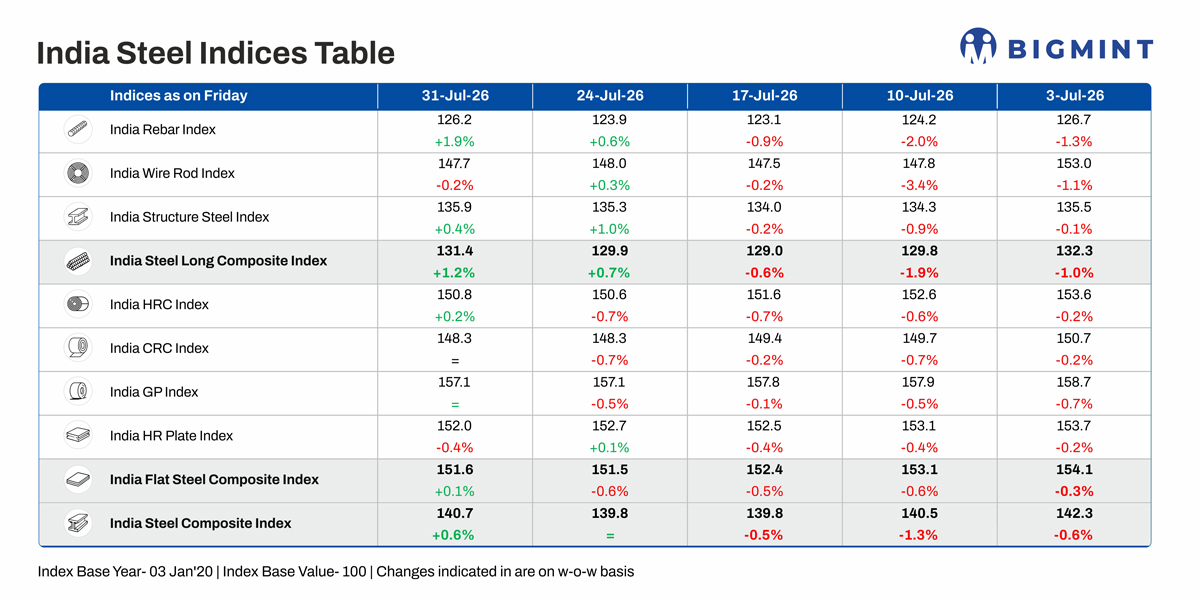
Morning Brief: BigMint’s India steel composite index gained 0.6% w-o-w, rising for the first time w-o-w in over two months, as domestic steel prices edged up following list price hikes announced by the major mills. The price hikes followed tightening availability in the market, with some primary mills taking maintenance shutdowns. Project procurement stayed healthy while trade market sentiment improved somewhat supporting prices.

Similar to last week, the longs index rose sharply by 1.2%, while the flats index gained 0.1% Even as the rebar index gained 1.9%, the HRC index rose by 0.2% on the week.
Highlights of price movements
BF-rebar prices edge up: BigMint’s benchmark assessment for rebar (IS 1786 Fe 550D, 12–32 mm, BF route) stood at INR 50,900/t as of 31 July 2026, up by INR 2,200/t w-o-w from INR 48,700/t recorded on 24 July. Prices are ex-Mumbai for the distributor-to-dealer segment and exclude 18% GST.
Leading Indian steelmakers increased their rebar list prices by INR 1,000-2,000/t for August deliveries. The price hike was driven by tightening domestic supply, as several integrated steelmakers entered scheduled maintenance shutdowns, reducing the availability of rebar in the spot market. A major south India-based PSU steelmaker has been under maintenance for more than a month, while another integrated producer is expected to begin maintenance in early to mid-August.
Infrastructure execution remained strong during June-July, with more than 80 projects worth over INR 1.70 lakh crore progressing across roads, railways, power, and urban infrastructure. Continued project execution sustained procurement by EPC contractors despite seasonal disruptions, providing steady support to rebar demand and helping mills maintain healthy order inflows.
Moreover, the primary producers continued to report healthy project bookings, with industry sources indicating confirmed project orders exceeding 300,000 t and order visibility extending beyond one month. Around 70% of August project allocations have already been booked, improving production planning and reducing dependence on spot market sales.
At the trade level, demand improved as tighter spot availability encouraged selective inventory replenishment. However, procurement continued to remain largely requirement-based rather than aggressive stocking. Lower distributor inventories and reduced primary supply supported market sentiment, though seasonal monsoon conditions continue to limit demand.

Mixed trends in IF-rebar markets: IF-route rebar prices displayed a mixed trend across major regions during the week, while overall trading activity remained limited. Price sentiment remained supported by higher offers from primary steel producers, enabling secondary mills to maintain firm quotations despite moderate buying interest.
Tier-1 mills raise HRC, CRC list prices: BigMint’s bi-weekly benchmark assessment for HRC (IS 2062, Gr E250, 2.5–8 mm/CTL) stood at INR 57,700/t as of 31 July. The benchmark assessment for CRC (IS 513, Gr O, 0.9 mm/CTL) remained stable at INR 64,900/t, unchanged w-o-w from the assessment recorded on 24 July. These assessments are ex-Mumbai for the distributor-to-dealer segment and exclude 18% GST.
The tier-1 steelmakers increased their flat steel list prices by INR 750-1,500/t for August deliveries, raising both hot-rolled coil (HRC) and cold-rolled coil (CRC) prices following improved market sentiment and expectations of a gradual demand recovery after the monsoon. At the trade level, however, price movements remained relatively muted.
The price increase was due to tightening domestic supply, as several major integrated steelmakers entered planned maintenance shutdowns, reducing the availability of flat steel in the domestic market. Expectations of lower production during the maintenance period improved market sentiment and encouraged mills to raise prices.
The anticipated supply constraint outweighed the impact of seasonally weak monsoon demand, with producers expecting tighter spot availability over the coming weeks. Market participants believe reduced supply could help improve realisations and support prices.

Despite the improved sentiment, trade activity remained largely need-based. Distributors continued to maintain comfortable inventory levels, while downstream demand from key consuming sectors remained subdued due to the monsoon. As a result, buyers remained cautious.
Imports continue but domestic market unaffected: Steel imports continued to remain elevated, as per vessel line-up data. Bulk HRC imports reached 261,618 t as of 24 July, with expected arrivals projected at another 137,137 t by 20 August. South Korea, China and Indonesia remained the leading suppliers. While shipments from South Korea continued to arrive under long-term contracts for subsidiary units in India, China’s higher HRC exports were driven by pipe and tube manufacturers sourcing under the Advance Authorisation Scheme for processing and re-export, rather than merchant trading.
HRC export activity weak: Bulk HRC exports stood at 230,517 t till 24 July. Indian HRC export activity stayed weak during the week ended 28 July, with no fresh bookings concluded. Buyers awaited clarity on EU tariff-free quota availability and CBAM norms, while geopolitical tensions hit Middle East offers and weak demand pulled down offers to Vietnam.
Outlook
Improved domestic trade sentiment and tightening of supplies signal a firm pricing outlook going forward. The continued support from infra projects is expected to offer support to rebar. HRC trade sentiment, on the other hand, is yet to improve significantly amid requirement-based procurement. However, tight supplies are expected to offer support to prices. With spot availability likely to remain constrained, distributors may gradually replenish inventories, enabling trade prices to align with higher mill offers.
Leave a Reply