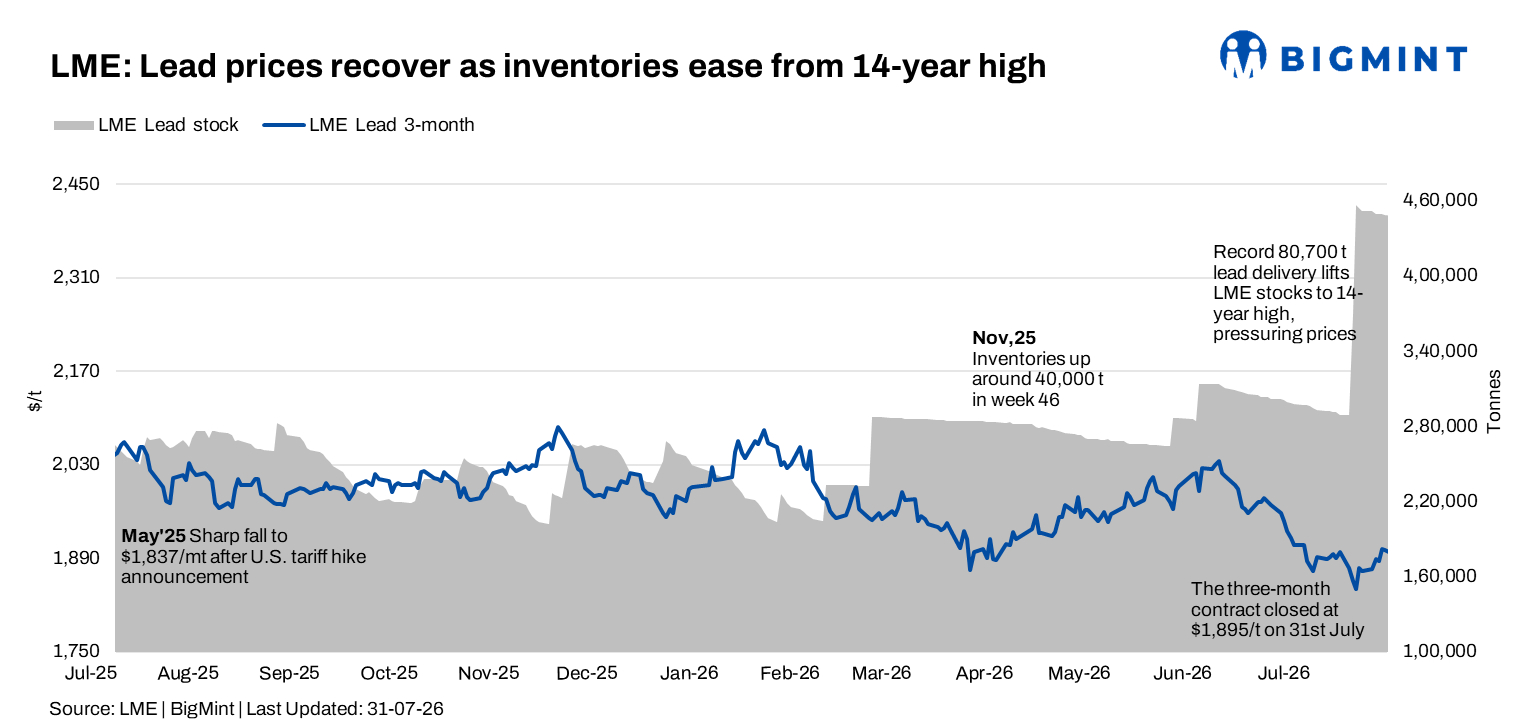
- Exchange stocks fall below 442,000 t, but weak demand limits gains
- Secondary lead transactions remain sluggish as buyers prefer primary metal
London Metal Exchange (LME) lead prices edged lower during the week ended 31 July 2026, as weakness in the secondary lead market and subdued demand sentiment outweighed support from declining exchange inventories. While warehouse stocks posted a sharp drawdown during the week, cautious downstream procurement and soft market activity kept prices under pressure.
LME lead cash settlement prices declined by 0.8% w-o-w to $1,852/t on 31 July from $1,866/t on 24 July. The three-month contract also eased to $1,895/t from $1,902/t over the same period. Despite the decline in prices, LME inventories fell by 7,575 t during the week, dropping from 448,850 t to 441,275 t, extending the recent drawdown trend. Stocks fell consistently throughout the week, although the decline in inventories failed to translate into stronger prices, highlighting the market’s concerns over underlying demand.
Weak secondary market weighs on sentiment
The secondary lead market remained under pressure during the week as downstream consumers increasingly shifted procurement towards primary lead. Although upstream suppliers maintained firm offers, spot transactions in secondary refined lead were limited, resulting in subdued trading activity.
Smelters showed little interest in raising scrap-battery procurement prices, while recyclers remained cautious about accumulating material at prevailing levels. Supply holders preferred to wait for a market recovery rather than sell aggressively, leaving both buyers and sellers in a wait-and-watch mode.
The lack of upward momentum in scrap-battery prices further reflected the subdued sentiment in the recycling market. Market participants largely refrained from building inventories amid uncertainty over near-term demand prospects, suggesting that the secondary lead segment may continue to consolidate in the coming weeks.
Meanwhile, Shanghai Futures Exchange (SHFE) lead prices mirrored the cautious sentiment. The contract declined from $2,374/t on 27 July to $2,351/t on 31 July, reflecting persistent concerns over the pace of demand recovery in China despite lower exchange inventories globally.
Long-term demand outlook constructive
While near-term sentiment remained weak, structural demand expectations for lead-acid batteries continued to provide some support to the broader market. Exide Industries recently reaffirmed its confidence in the long-term relevance of lead-acid batteries, even as it expands its presence in lithium-ion cell manufacturing.
The company expects lead-acid batteries to remain integral to India’s automotive, industrial and backup power sectors, particularly as the country’s energy transition gathers pace. However, these longer-term fundamentals have yet to offset the immediate weakness in secondary lead demand and cautious procurement trends.
Outlook
BigMint expects LME lead prices to remain range-bound over the next one to two weeks, as the market balances declining inventories against weak physical demand and subdued secondary-market activity.
Support is likely to emerge in the $1,840-1,850/t range, while resistance is expected around $1,880-1,900/t. In the near term, market participants will closely monitor scrap-battery prices, procurement trends in the secondary lead segment, Chinese demand indicators and further movements in LME inventories.
Unless downstream demand improves meaningfully, the ongoing inventory drawdown alone may not be sufficient to trigger a sustained rally in lead prices.

Leave a Reply