- Record electricity demand in 2026 keeps coal movement focused on thermal power plants
- Coal logistics, rather than availability, emerging as biggest challenge for industry
India’s coal logistics network has come under mounting pressure over the past three months as record electricity demand has forced the government and PSU mining major Coal India Ltd. (CIL) to prioritise uninterrupted fuel supplies to thermal power stations. While the strategy has helped maintain comfortable coal inventories at power plants and prevented electricity shortages during a period of peak demand, it has also posed a challenge for the non-regulated industries that rely on domestic coal.
Among the most affected is India’s coal-based sponge iron industry, where producers across major manufacturing clusters say domestic coal is available through auctions and linkages but deliveries have become increasingly unpredictable because railway rake availability has tightened. The issue highlights a structural challenge for India’s coal supply chain—not necessarily coal availability at the mine, but the ability to move coal efficiently to competing consumers when power demand accelerates.
Why sponge iron players increasingly favour domestic coal
India’s sponge iron industry has undergone a significant transformation over the past five years. Faced with volatile international coal prices, weak steel margins and improved domestic coal availability, producers have steadily replaced imported South African non-coking coal with domestic supplies.
Domestic coal now accounts for roughly 60-75% of the fuel mix across most sponge iron clusters, compared with only 25-35% in FY22. Imported coal, once contributing nearly three-quarters of fuel requirements, has gradually declined to about 25-40%, remaining an essential blending component because of its superior calorific value, lower ash content and better kiln stability.
The transition has been supported by CIL’s expansion of linkage auctions for the non-regulated sector. In 2026, the miner offered a record 35 mnt of linkage auction coal specifically for sponge iron manufacturers, alongside greater availability of suitable grades from SECL, MCL, WCL, BCCL and ECL.
As a result, coal costs for sponge iron producers have dropped significantly from the FY’23 peak. Fuel expenditure has declined to around INR 8,800-9,800/t of sponge iron from nearly INR 13,000-15,000/t during the international coal price spike following the Russia-Ukraine war, substantially improving production economics.
However, the industry’s growing dependence on domestic coal has also increased its exposure to India’s railway logistics network.

Rising power demand reshapes coal logistics
The past three months have seen India’s electricity system operate under exceptionally high demand conditions, requiring sustained coal-based generation despite rapid growth in renewable energy.
India’s electricity consumption increased by 5.5% y-o-y to 909 billion units (BU) during January-June 2026, driven by above-normal temperatures and strong cooling demand. During H1CY’26, India’s total electricity generation increased 6% y-o-y to 989 billion units (BU), while coal-fired generation rose 4% to 699 BU. Renewable generation expanded by 22% to 164 BU, but coal remained the backbone of the power system, contributing more than 70% of total electricity generation.
The dependence on thermal generation became even more evident in June and July.

In June, electricity generation increased almost 11% y-o-y to 178,395 MU, while coal generation surged more than 14%, accounting for around 85% of incremental electricity production as lower hydropower output forced thermal plants to compensate for the supply shortfall. Coal-fired stations consumed nearly 80 mnt of coal during the month, exceeding receipts by about 5 mnt and drawing down inventories to sustain generation.

The trend continued into July. Between 1 and 19 July, average peak demand reached almost 246 GW, while the national maximum touched 270.2 GW, nearly 23% higher than the corresponding period last year. Coal generation increased almost 13% y-o-y as weak hydropower output continued to place greater reliance on thermal stations.
Although renewable generation expanded rapidly, its variability meant coal remained the principal dispatchable fuel capable of responding to sudden changes in electricity demand. Coal became not only the country’s largest source of electricity but also the system’s balancing fuel.
Energy security needs keep coal moving towards power plants
Maintaining uninterrupted power supply has become a national priority as electricity demand continues setting new records.
According to the Ministry of Power, thermal power plants held around 42.8 mnt of coal inventory in mid-July, equivalent to approximately 14 days of consumption at 85% plant load factor (PLF). Authorities have repeatedly emphasised maintaining adequate coal stocks to avoid a repeat of previous supply disruptions.
Policy has increasingly focused on ensuring coal reaches generating stations before inventories fall to critical levels. The strategy has been supported by continuous monitoring of plant stocks, coordinated dispatch planning and prioritised coal evacuation for the power sector.
CIL has simultaneously increased production and dispatches to support this objective. During H1, India’s coal dispatches increased 2% y-o-y to 548 mnt despite production declining 2% to 555 mnt. Much of the dispatch effort has been directed towards sustaining thermal generation as electricity demand remained elevated.
The broader picture suggests India’s coal supply system has successfully maintained energy security. However, the same logistics network is also responsible for supplying coal to cement, sponge iron, captive power plants and other industrial consumers.
Coal available but logistics key hurdle for sponge iron industry
Unlike the regulated power sector, sponge iron producers procure coal through linkages, auctions and commercial purchases, with deliveries depending heavily on railway availability after priority requirements for power utilities are met.
Market participants indicate that domestic coal itself is not the principal constraint. Instead, delayed rake placement and longer delivery cycles have made inventory planning more difficult, particularly during the past three months when coal movement towards thermal power plants accelerated.
The challenge is most evident in West Bengal where sponge players actively source coal from ECL along with dependence on imports. In central India, Chhattisgarh-based producers rely heavily on SECL supplies, while plants in Odisha depend on MCL coal alongside imported material.
Several producers continue maintaining imported coal in their fuel blends despite its higher cost, using South African RB2 primarily to ensure kiln stability and reduce maintenance shutdowns.
Notably, India’s sponge iron production remained robust, rising 7% y-o-y to 60 mnt in FY’26 with the country maintaining its position as the world’s largest producer of direct reduced iron (DRI) via the coal-based route. The increase was due to stable operations at large coal-based DRI units. Steady raw material availability also facilitated strong production momentum. Higher sponge iron output and increasing capacities have continued to fuel demand for non-coking coal in FY’27.
Imported coal offers limited relief
Imports have become a less attractive alternative.
India’s non-coking coal imports declined 12.5% y-o-y during H1 as higher international prices, elevated freight costs and a weaker rupee discouraged overseas purchases.
South African RB2 and Indonesian coal remained substantially more expensive than domestic alternatives for much of the year, while geopolitical tensions in the Middle East increased shipping costs and disrupted trade routes.
The rise in international prices was also reflected in the Indian portside market. BigMint’s average ex-Paradip RB2 (5,500 NAR) price increased from INR 9,174/t in January to a peak of INR 11,802/t in March, before easing to INR 10,484/t in July. Despite the subsequent correction, prices remained well above January levels, keeping imported coal economically unattractive for most sponge iron producers.
For sponge iron producers operating with compressed steel margins during the monsoon season, increasing imported coal consumption simply to offset delayed domestic deliveries is often economically unviable.
Challenge shifting from production to logistics
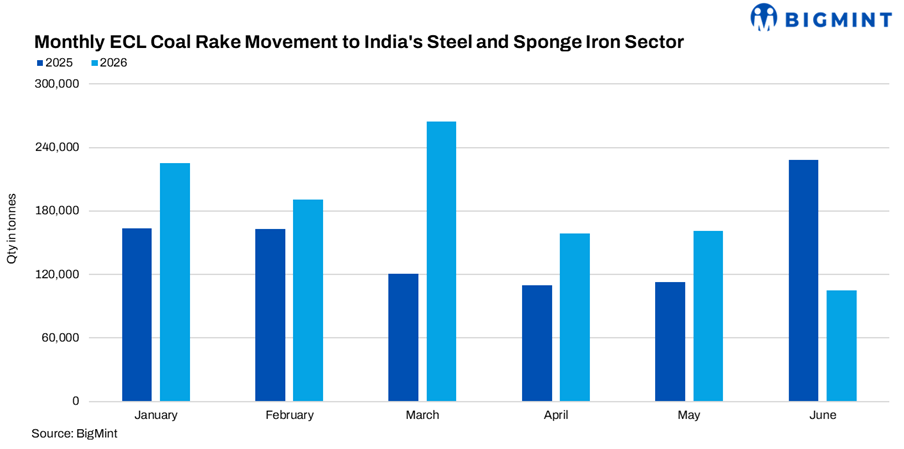
While CIL data shows domestic coal dispatches to the sponge iron sector increased 22.7% y-o-y during April-June FY’27, industry bodies argue that the key challenge is no longer coal availability but the timely materialisation of booked rakes. At Eastern Coalfields Ltd. (ECL), pending rake data as of 20 July showed significant backlogs, with 222 of 255 booked rakes pending at the PSBP (Sonpur) siding and 65 of 77 at POCP-1 (Jhanjra), indicating delays in loading despite confirmed bookings.
Concerns over domestic coal availability for non-power industries have intensified, with both the National Small Industries Corporation (NSIC) and the West Bengal Sponge Iron Manufacturers Association (WBSIMA) have urged CIL and the Ministry of Coal to improve coal supplies to support manufacturing competitiveness.
WBSIMA officials informed BigMint that recent railway prioritisation of coal movement to the power sector, while necessary for national power security, has further constrained availability for the non-regulated sponge iron sector. The association stated that delays in supplies under spot e-auctions and Fuel Supply Agreements (FSAs) have forced producers to rely on imported coal despite a weak domestic steel market and elevated import prices.
India’s coal sector has made significant progress in increasing domestic availability over recent years. CIL has expanded production capacity, improved linkage auctions and strengthened supplies to non-regulated industries, enabling sponge iron producers to reduce dependence on imported coal. However, logistics and timely delivery remain pressing concerns.
Leave a Reply