- Sellers remain silent amid bid-offer disparity
- Global fines weakness and low domestic dispatch, keeps market lull
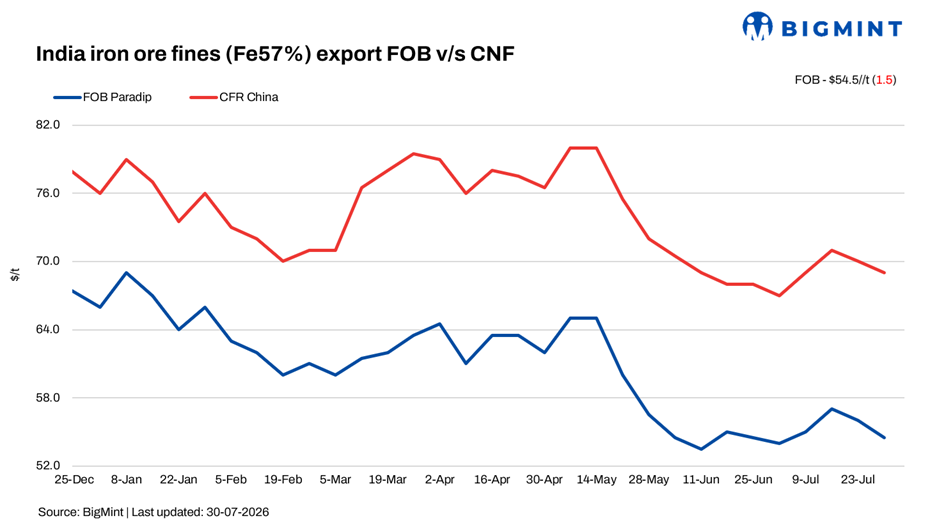
India’s low-grade iron ore fines export prices declined by $1.5/t w-o-w during the latest assessment period, reflecting subdued buying interest from China and limited trading due to wide bid-offer disparities. The fall was accompanied by lower material inventories with domestic sellers due to recent low-grade dispatch issue in the mining region, which has thus kept sellers confined to focus on above Fe 60% grade material sales for the meanwhile.
Rationale
- No deals for Fe 57% was recorded during this publishing window and was taken under prices calculation. Therefore, T1 trade was given 0% weightage in the index calculation. For the detailed methodology, click here.
- BigMint received thirteen (13) indicative prices in the current publishing window, and nine (9) were considered for price calculation as T2 inputs and given the rest 100% weightage.
Prices, deals
BigMint’s bi-weekly Indian low-grade iron ore fines (Fe 57%) export index decreased by $1.5/t w-o-w to $54.5/t FOB (equivalent to $69/t CFR China) east coast on Thursday, 30 July. No fresh deals for low grade ore was reported to BigMint during this publishing window.
Market scenario
Market participants said the continued weakness in the global iron ore market has kept pellet trading sluggish, with buyers and sellers remaining far apart on pricing. Most buyers have adopted a wait-and-watch approach as iron ore prices remain under pressure and demand from Chinese mills continues to be subdued.
According to traders, the market is now awaiting the announcement of discounts for Australian miners’ Special-grade Fines, which are expected to provide fresh pricing benchmarks for upcoming cargoes. However, participants do not expect any major changes in discount levels that could significantly alter buying sentiment.
An international trader said, “The spread between high-grade and lower-grade iron ore has widened, prompting mills to reassess their raw material mix. Some are choosing higher-grade fines to improve productivity, while others are looking at pellets to optimise feed costs. But overall buying remains slow as steel demand in China is seasonally weak and most mills, as well as ports, are carrying comfortable inventories.”
Another trader noted that sellers are currently seeking around $74-76/t CFR plus premium, levels that are still well above buyers’ workable price levels. As a result, the bid-offer gap remains wide, leaving little room for fresh spot deals. With neither side showing urgency to adjust prices, trading activity is expected to remain muted until clearer signals emerge from China’s policy announcements or sentiment in the iron ore market improves.
Domestic vs export market
The price gap between export and domestic realisations was recorded at INR 500/t this week. Export realisations (Fe 57%) were at INR 2,800/t ($30/t), reducing by INR 200/t (2$/t) this week, while domestic realisations (Fe 57%) remained stable at w-o-w at INR 3,300/t ($34/t) exw.
Chinese iron ore fines prices edge up w-o-w: The benchmark iron ore fines Fe 61% index gained slightly by $1/t w-o-w to $97/dmt CFR China on 29 July. Seaborne iron ore prices eased as weak spot buying and abundant medium-grade fines supply outweighed support from higher freight and energy costs.
DCE iron ore futures down w-o-w: Iron ore futures on the Dalian Commodity Exchange (DCE) for the September 2026 contract decreased by RMB 13/t ($2/t) w-o-w to RMB 734/t ($109/t) on 30 July.
Outlook
BigMint expects Indian low-grade iron ore export prices to remain largely stable in the near term. Trading activity is also expected to remain weak, amid domestic dispatch slow-down for low grade ore and weak international market.

Leave a Reply