- Domestic production slowdown may tighten supply after the monsoon
- Chinese inventory overhang continued capping regional thermal coal prices
India’s thermal coal market remains well supplied despite strong electricity demand. Domestic coal dispatches, improved linkage availability and comfortable inventories at power plants have reduced the urgency to import, allowing buyers to remain highly price-sensitive even as coal-fired generation stays elevated.
The market is therefore being shaped by a clear divergence: India’s underlying coal consumption continues to grow, but seaborne demand remains restrained because domestic supply is meeting a larger share of requirements.
This position should persist through the monsoon. However, the balance could tighten from October if post-monsoon industrial demand, high power generation and continued stock drawdowns coincide with a slower-than-expected recovery in domestic production.
Imports fall as domestic coal substitutes seaborne fuel
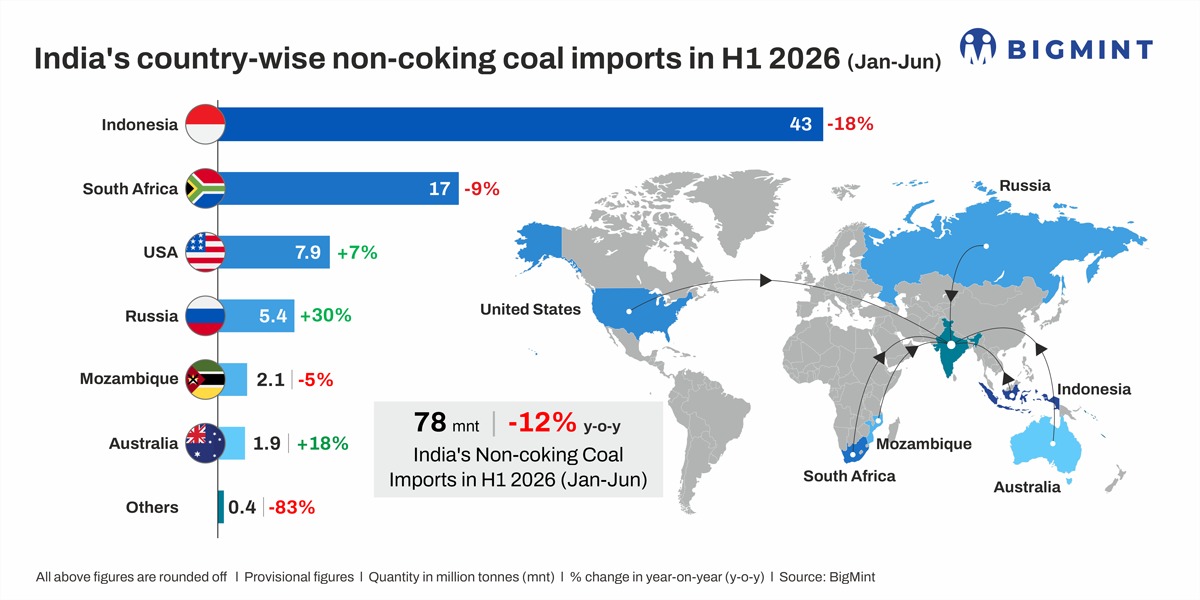
Thermal coal imports by Indian power plants fell 22% year on year to 12.28 Mnt during April-June 2026. Imports by plants designed to operate on imported coal declined 15% to 10.50 Mnt, while blending imports fell 39% to just 1.77 Mnt.
The sharper decline in blending volumes is significant. Imported coal is increasingly being used as an optional balancing fuel rather than a routine part of power-generation supply.
Coal India supplied 154.75 Mnt to the power sector during the first quarter, up 1.8% year on year, while supplies to non-regulated sectors increased 10% to 43.10 Mnt. Improved linkages, better rail movement and higher coal availability from commercial mines have allowed power and industrial consumers to reduce their exposure to international markets.
India is therefore importing less not because coal demand is weakening, but because more of that demand is being served domestically.
Power remains the main demand driver
Electricity consumption remains the strongest support for coal. Peak demand exceeded 260 GW during the summer, and coal-fired generation continues to carry much of the incremental load.
Renewables are increasing rapidly, particularly solar, but coal remains essential during evening peaks, low-wind periods and unexpected reductions in hydro or renewable generation. As solar capacity expands, coal plants will increasingly be required to ramp around renewable availability and provide grid stability.
Coal demand can therefore continue rising in absolute terms even as its share of total generation gradually declines.
Industrial consumption is currently being moderated by the monsoon. Cement production, construction activity and fuel offtake typically soften during this period, encouraging consumers to draw down inventories rather than procure aggressively.
Demand should improve from September as cement, sponge iron, steel and other industrial consumers prepare for stronger second-half activity.
Imported prices soften, but Indian buyers remain selective
BigMint’s delivered assessments show weakness across several Indonesian grades.
CNF Kandla 4,200 GAR Indonesian coal fell by $2/t week on week to $78/t, while 4,800 GAR declined by $1/t to $92/t. CNF Vizag 4,200 GAR also dropped by $2/t to $77/t, while 5,000 GAR remained unchanged at $96/t.
Russian 6,000 NAR coal delivered to Paradip decreased by $1/t to $119/t. Australian 5,500 NAR coal delivered to Mundra was steady at $115/t.
South African material remained broadly stable. CNF Gangavaram RB2, 5,500 NAR, was assessed at $108/t, while RB3, 4,800 NAR, stood at $88.50/t.
BigMint imported coal assessments
Portside prices show a similarly stable market. South African RB2 was assessed at INR 10,500/t at Vizag and Gangavaram, INR 10,850/t at Paradip and INR 10,900/t at Mangalore.
Indonesian 4,200 GAR coal was assessed at INR 8,700/t ex-Kandla and INR 8,600/t ex-Vizag, while 5,000 GAR stood at INR 10,500/t and INR 10,400/t respectively.
The lack of urgency among buyers is preventing softer international prices from translating into significantly higher import demand.
Supply risks remain beneath the surface
India’s market appears comfortable, but three risks deserve attention.
First, cumulative domestic coal production during April-June fell 5.88% year on year to 232.49 Mnt, even as dispatches increased 2.78% to 268.04 Mnt. This suggests that part of the supply improvement has come from inventory liquidation rather than production growth.
Second, coal stocks at thermal power plants have been declining from their end-March peak. Aggregate inventories remain adequate, but continued high generation could gradually reduce the buffer available ahead of the next demand season.
Third, coal quality remains an important variable. Lower calorific value or higher ash and moisture can raise specific coal consumption, tightening the effective supply balance even when headline stocks appear comfortable.
These risks are unlikely to generate an immediate import surge. However, they could bring selected coastal and non-pithead plants back to the seaborne market later in the year.
China remains the main constraint on Asian prices
China’s thermal coal market remains weak. Ex-Qinhuangdao 5,500 NAR coal was unchanged at RMB 642/t, compared with RMB 645/t one month earlier.
High port inventories, rainfall and stronger hydro generation have reduced the urgency to procure imported coal. Indonesian coal delivered to Tianjin also weakened: 4,200 GAR fell by $2/t to $73/t, while 4,800 GAR and 5,800 GAR declined by $1/t to $87/t and $111/t respectively.
As long as Chinese inventories remain high, China is unlikely to provide the buying momentum required for a broad Asian price rally.
Indonesia faces supply uncertainty but weak demand
Indonesian producers are waiting for greater clarity on production quotas, while some coal is being directed to the domestic market. This should theoretically support prices.
However, demand remains too weak to sustain firmer offers.
BigMint’s FOB Kalimantan 4,200 GAR assessment fell by $2/t to $63/t, while 4,800 GAR declined by $1/t to $77/t. Lower grades were stable, with 3,400 GAR at $40/t and 3,600 GAR at $46/t.
The market is therefore caught between potential supply constraints and limited buying interest. Prices could firm quickly if India and China return simultaneously, but the immediate outlook remains subdued.
Australia remains expensive for price-sensitive buyers
FOB Newcastle 5,500 NAR coal increased by $1/t to $95/t. Delivered to Mundra, the grade remained at $115/t.
Australian coal continues to attract selective demand from China, Japan, South Korea and Southeast Asia, but its premium limits its competitiveness in India’s power sector.
Unless Indian consumers require specific quality characteristics, Indonesian, South African and Russian coal remain more natural alternatives.
South Africa remains competitive into India
South African FOB Richards Bay RB2, 5,500 NAR, was assessed at $88/t, up from $86.80/t one week earlier but below $90.70/t one month ago. RB3, 4,800 NAR, stood at $68.50/t, while RB1, 6,000 NAR, remained at $102.50/t.
South African coal remains competitive into India, particularly for cement, sponge iron and industrial users seeking higher calorific value than typical Indonesian grades.
Improved rail performance could increase export availability, although the reliability of the rail system remains the principal supply risk.
Southeast Asia shows interest, but not enough to tighten the market
Vietnam and Thailand have shown some buying interest as utilities monitor LNG prices and energy-security risks. However, volumes remain modest and buyers continue to resist high offers.
Southeast Asia represents the clearest medium-term growth market for thermal coal, but it is not yet large enough to replace China as the principal driver of seaborne prices.
Japan and South Korea remain stable, quality-sensitive buyers. Their demand provides a floor for premium coal but is unlikely to generate substantial market growth.
Outlook: comfortable through the monsoon, tighter risks from October
India’s thermal coal market should remain adequately supplied during the monsoon. Domestic dispatches are strong, imports are discretionary and industrial demand is seasonally subdued.
The situation could tighten during the fourth quarter if post-monsoon industrial recovery, elevated electricity demand and lower power-plant inventories coincide with insufficient domestic production growth.
For now, Asian prices are likely to remain range-bound. Weak Chinese and Indian import demand will cap the market, while Indonesian supply uncertainty, freight volatility and geopolitical risks should limit the downside.
India’s import demand has become increasingly conditional. Seaborne purchases will rise only where domestic coal availability, quality or logistics fail to meet a specific requirement.
The performance of India’s domestic coal supply chain–not movements in international benchmarks–will remain the decisive factor shaping the market.

Leave a Reply