- Coal demand stayed firm as record power demand and weaker hydro output boosted thermal generation
- Power-plant coal stocks fell nearly 11% to 39.22 mnt amid sustained high consumption
India’s power sector experienced one of its most demanding operating periods of the year during the first 26 days of July 2026, with electricity demand substantially exceeding year-ago levels before moderating during the latter part of the month. Thermal generators responded by raising coal-fired output to record levels, offsetting a sharp decline in hydroelectric generation, while coal inventories at power plants continued to decline as consumption outpaced receipts during the period of highest demand.
The power system successfully met record electricity requirements despite the exceptionally strong demand environment. However, July also demonstrated how weather continues to influence India’s generation mix. Uneven monsoon rainfall and subdued reservoir levels constrained hydroelectric generation, requiring coal-fired stations to operate at higher plant load factors and increasing coal consumption across the thermal fleet.
While demand eased after the third week of July, coal inventories remained under pressure, highlighting the importance of sustained coal supplies and efficient logistics in maintaining generation reliability during periods of elevated thermal dispatch.
Demand remained elevated despite easing after mid-month
Average all-India maximum demand met during 1-26 July 2026 reached 243,514 MW, up 12.7% from 216,064 MWduring the corresponding period of 2025.
Demand accelerated sharply during the second week of July, reaching 256,966 MW on 13 July, 266,068 MW on 14 July, 266,291 MW on 15 July, before touching a record 270,203 MW on 16 July, approximately 22.5% higher than the corresponding peak recorded during the same period last year. Demand remained elevated at 269,537 MW on 17 July before gradually moderating during the final week of the review period.
Unlike the relatively stable demand profile witnessed in July 2025, the first half of July 2026 was characterised by an intense weather-driven demand spike. However, by 21-26 July, daily peak demand had eased into the 231-237 GW range, indicating that the exceptional stress experienced during mid-July had begun to subside.

The demand pattern also changed during the month. Peak demand, which normally occurs during the evening hours, increasingly shifted towards the afternoon during the period of highest temperatures. This enabled solar generation to contribute meaningfully towards meeting daytime demand, although the evening system continued to rely heavily on dispatchable thermal generation after solar output declined.
Coal and renewables together met higher electricity demand
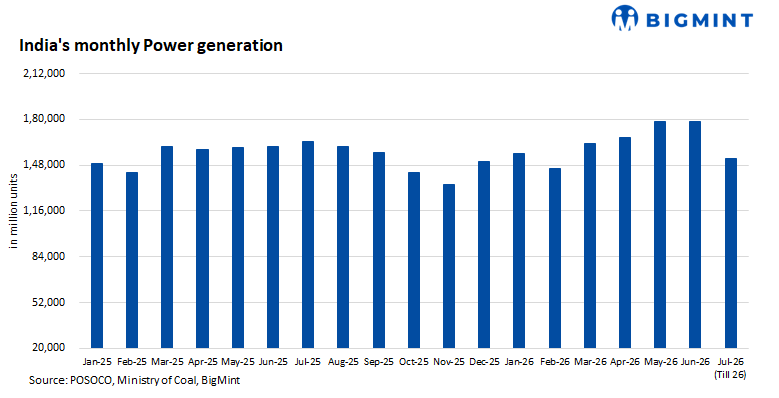
Total electricity generation during 1-26 July 2026 increased to 152,436 MU, compared with 138,092 MU during the corresponding period last year, representing a 10.4% year-on-year increase.
Coal-fired generation increased 12.0% to 98,157 MU, accounting for almost three-quarters of the increase in total electricity generation. Renewable generation expanded even faster, rising 32.7% year on year to 30,417 MU, while nuclear and lignite generation also recorded healthy increases.
The principal weakness within the generation mix came from hydropower.
Hydroelectric generation declined by 22%, falling from 19,791 MU to 15,436 MU, while generation from gas, naphtha and diesel also remained below year-ago levels.
Consequently, despite robust renewable growth, coal-fired generation was required to compensate for both higher electricity demand and reduced hydro availability. Coal’s share of India’s generation therefore increased marginally to 64.4%, despite the continued expansion of renewable energy.

The composition of incremental generation provides additional insight into the month’s generation response.
Coal generation increased by 10,537 MU, while renewable generation contributed another 7,493 MU. These gains, however, were partly offset by a reduction of 4,355 MU in hydro generation and 382 MU in gas-based generation.
The data therefore indicate that coal generation increased not because renewable output weakened — it expanded strongly — but because the decline in hydroelectric generation coincided with sustained growth in electricity demand.

Uneven monsoon delayed hydro recovery
Hydroelectric generation weakened despite an improvement in monsoon activity during the latter part of July.
After a subdued June and an uneven start to July, rainfall strengthened following successive low-pressure systems over the Bay of Bengal. Monthly rainfall consequently recovered to near-normal levels in several parts of the country. However, the distribution remained uneven. Western India and parts of central India received substantial rainfall, whereas several eastern, northern and southern states continued to experience seasonal deficits. Reservoir recovery therefore lagged the improvement in rainfall, particularly across southern India where storage levels remained well below last year’s position.
The subdued reservoir position constrained hydroelectric generation throughout much of July, increasing dependence on thermal generation during periods of peak demand. In several states, reservoir management also prioritised drinking water and irrigation requirements over power generation, further limiting hydro availability.
Coal inventories continued to decline
Higher thermal generation translated directly into stronger coal consumption at power stations.
Coal stocks across CEA-monitored thermal power plants declined from 44.11 million tonnes (mnt) at the end of June to 39.22 mnt by 26 July, representing a drawdown of 4.89 mnt, or approximately 11%, during the first four weeks of the month.
The drawdown accelerated during the period of highest electricity demand as coal consumption exceeded daily receipts across the generating fleet.

Coal logistics remained resilient despite sustained stock drawdown
Although coal inventories declined during July, the movement of coal to power plants remained broadly stable. Daily coal receipts consistently remained close to 2.5 Mnt, allowing generators to sustain elevated dispatch levels even as consumption temporarily exceeded replenishment during the period of peak electricity demand.
The number of critical thermal power plants—defined by the Central Electricity Authority as stations holding less than 25% of normative stock—improved from 32 plants at the end of June to 26 plants by 19 July, before increasing modestly to 29 plants on 26 July as inventories came under renewed pressure during the latter part of the month.
This trend suggests that while the system remained operationally secure, inventory buffers continued to narrow. The deterioration in physical stocks was largely a consequence of exceptionally strong coal burn rather than any significant disruption in coal production or transportation.
It is also important to distinguish between physical coal stocks and stocks expressed as a percentage of normative requirements. Although normative stock percentages appeared relatively stable during parts of July, this largely reflected the seasonal reduction in normative inventory requirements from 26 days to 22 days of consumption, rather than an actual improvement in coal availability. On an absolute basis, inventories continued to decline steadily throughout the month.
Electricity market reflected tighter system conditions
The tightening supply-demand balance during mid-July was also reflected in the electricity market. The average Day Ahead Market (DAM) clearing price on the Indian Energy Exchange (IEX) during 1-26 July increased to approximately INR 4,371/MWh, compared with INR 4,004/MWh during the corresponding period of 2025.
Market prices strengthened significantly during the week of peak demand, culminating in a monthly high of INR 7,723/MWh on 16 July, coinciding with India’s highest electricity demand of the month. Prices subsequently moderated as temperatures eased, demand softened and monsoon rainfall improved across several regions.

The market response illustrates the flexibility provided by India’s competitive power exchanges. While price volatility increased during periods of peak demand, the system successfully balanced supply and demand without widespread shortages, reflecting adequate generation availability despite the challenging operating conditions.
Coal remained the balancing fuel despite rapid renewable growth
One of the most notable features of July was that renewable energy and coal generation expanded simultaneously.
Renewable generation recorded the fastest growth among all generation sources, increasing by nearly one-third year on year. However, the strong renewable performance was insufficient to offset the significant decline in hydroelectric generation, which fell by more than 4,300 MU during the review period.
Consequently, coal-fired generation remained the principal balancing source for the power system. Thermal stations responded by increasing output by more than 10,500 MU, enabling the grid to meet record electricity demand while compensating for weaker hydro availability.
This illustrates the complementary nature of India’s evolving generation mix. Renewable capacity continues to expand rapidly and contributes an increasing share of daytime electricity requirements. However, during periods of weather-related variability — whether from subdued wind speeds, weaker hydro inflows or evening demand peaks — coal-fired generation continues to provide the flexibility and reliability required to maintain grid stability.
For coal producers, railway operators and fuel suppliers, July reinforced the importance of maintaining uninterrupted fuel logistics during periods of elevated thermal dispatch. Even with renewable generation at record levels, coal remained the largest contributor to incremental electricity supply during the month.
BigMint assessment
The first 26 days of July highlight three important developments for India’s power sector. First, electricity demand continues to establish new seasonal highs, reflecting structural growth in consumption despite the onset of the southwest monsoon.
Second, coal-fired generation remains the system’s principal balancing resource. Robust renewable generation alone was insufficient to compensate for weaker hydro availability, requiring thermal plants to operate at elevated utilisation rates to ensure grid stability.
Finally, although coal inventories declined by nearly 5 Mnt during the month, stable coal production, dispatch and rail logistics enabled generators to meet higher electricity demand without compromising overall system reliability. As reservoir levels improve through August, hydro generation is expected to recover gradually, allowing coal inventories to stabilise. However, until that recovery becomes more pronounced, thermal generation is expected to remain the backbone of India’s electricity system.
Outlook
Power demand is expected to moderate further into early August as monsoon conditions become more widespread and seasonal temperatures ease across much of the country. National Load Despatch Centre (NLDC) projections indicate daily peak demand will generally remain within the 240-250 GW range over the coming week, below the record levels observed during mid-July.
Improving rainfall should gradually support reservoir inflows and hydroelectric generation during August, reducing some of the pressure on coal-fired stations. Nevertheless, the recovery in hydro output is likely to be gradual rather than immediate, particularly in regions where cumulative rainfall deficits persist and reservoir storage remains below historical averages.
Coal inventories may begin to stabilise provided that daily coal receipts continue to broadly match thermal consumption. However, stock rebuilding is likely to remain a priority for utilities until reservoir levels improve sufficiently to allow hydro generation to recover more meaningfully.
Overall, the July experience demonstrates that while India’s electricity system successfully accommodated record demand without significant disruption, thermal generation — and the coal supply chain supporting it — continued to play the central operational role in maintaining grid reliability during periods of peak system stress.

Leave a Reply