- Sellers maintain firm offers despite slow downstream demand
- Buyers continue need-based procurement as replacement costs remain elevated
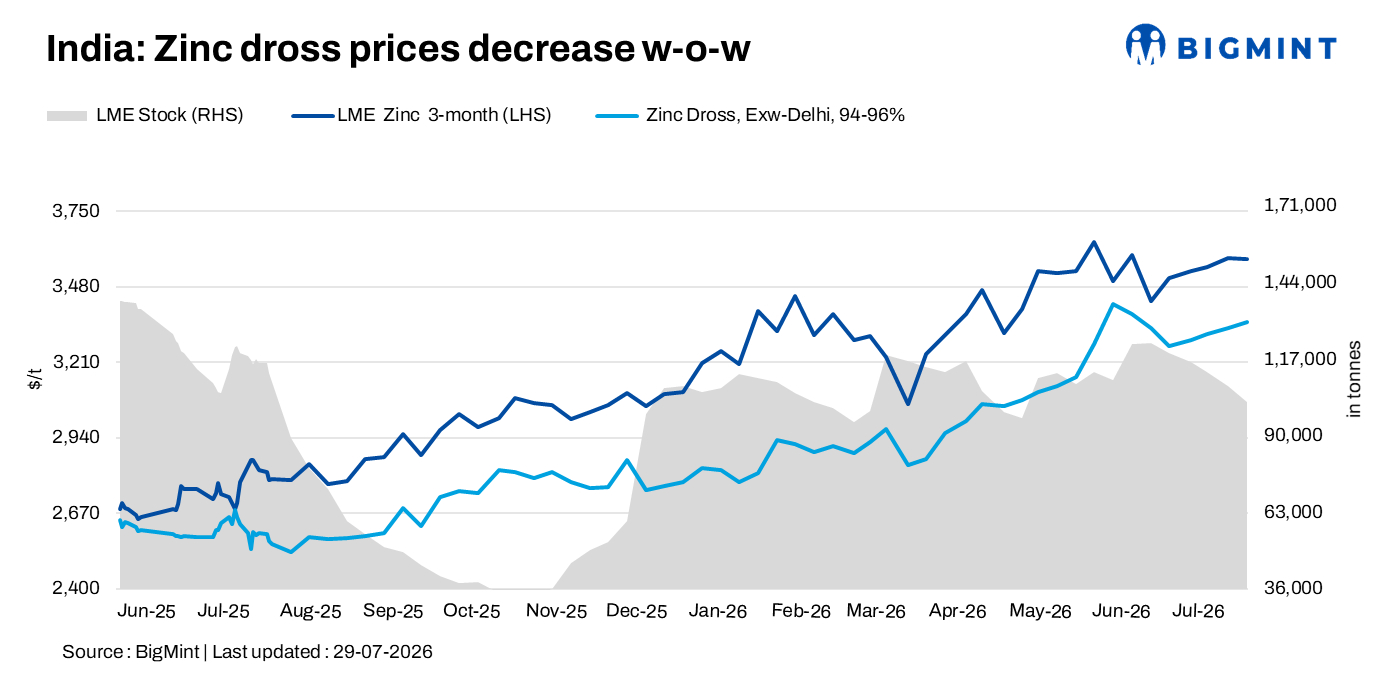
India’s zinc dross and zinc oxide prices extended their gains in the week ended 29 July 2026, supported by lower LME zinc inventories and firm replacement costs. Although downstream demand remained sluggish, suppliers maintained higher offers amid the recovery in benchmark zinc prices and the continued drawdown in exchange stocks.
Benchmark three-month LME zinc prices averaged around $3,596/t during the assessment week ended 29 July, compared with approximately $3,559/t in the previous assessment period. Prices recovered from $3,592/t on 24 July to $3,579/t on 29 July, after touching a weekly high of $3,621/t on 27 July. Meanwhile, LME zinc inventories declined further to 101,800 t on 29 July from 105,800 t on 24 July, marking a decline of 3.78% w-o-w.
The continued fall in exchange inventories supported replacement costs for secondary zinc products, encouraging suppliers to maintain firm offers. However, buying activity remained largely need-based, with consumers resisting sharp price increases amid weak downstream demand.
Zinc dross, oxide price movements
Domestic zinc dross prices increased by INR 500/t w-o-w to INR 320,500/t ex-Delhi, compared with INR 320,000/t in the previous assessment period.
Meanwhile, zinc oxide (99% Zn) prices rose by INR 900/t w-o-w to INR 309,700/t ex-Delhi, against INR 308,800/t a week earlier.
In the western market, zinc dross offers in Mumbai were heard at around INR 322,000-323,000/t.
The relatively moderate gains in domestic secondary zinc products reflected the disconnect between international zinc prices and physical demand, as market participants noted that dross and oxide prices have not fully aligned with the recent rally in LME zinc.
Scrap segment trends
In the north Indian zinc scrap market, big Tukdi (97-98% Zn) was heard at around INR 311,000-312,000/t ex-Delhi, compared with INR 310,000-311,000/t in the previous assessment.
Regular Tukdi (97-98% Zn) was assessed at INR 306,000-307,000/t, against INR 307,000-308,000/t a week earlier, while small-sized Tukdi was heard at approximately INR 304,000/t.
Market participants indicated that scrap quotations remained supported by replacement costs, although downstream consumers continued to procure only for immediate requirements. Suppliers largely maintained offers in line with prevailing zinc prices, but trading activity remained limited.
Market sentiment
Market sentiment remained cautiously balanced during the assessment period. Traders noted that, despite the strength in benchmark zinc prices and declining LME inventories, the zinc oxide market remained sluggish, limiting the extent to which higher international prices could be passed on to domestic buyers.
Participants highlighted that zinc dross and oxide prices are influenced by auction-based transactions and local demand dynamics, resulting in a weaker correlation with LME movements compared with primary SHG zinc prices.
Consumers continued to resist higher offers, preferring spot purchases rather than inventory accumulation. Although enquiries remained steady, downstream demand was insufficient to support aggressive price increases.
The availability of zinc-bearing scrap remained adequate, preventing any major supply-side disruptions despite firm replacement costs.
Outlook
In the near term, zinc dross and zinc oxide prices are expected to remain supported by replacement costs and the continued decline in LME zinc inventories. However, sluggish downstream demand and buyers’ resistance to elevated prices are likely to cap any sharp upside.
Market participants will closely monitor the sustainability of the recent recovery in benchmark zinc prices and whether stronger replacement economics eventually translate into improved physical demand. Unless buying interest strengthens meaningfully, further gains in the domestic secondary zinc market are expected to remain gradual and measured.
Leave a Reply