- Firm billet prices and tight scrap availability support offers
- Weak steel demand keeps mills on need-based buying
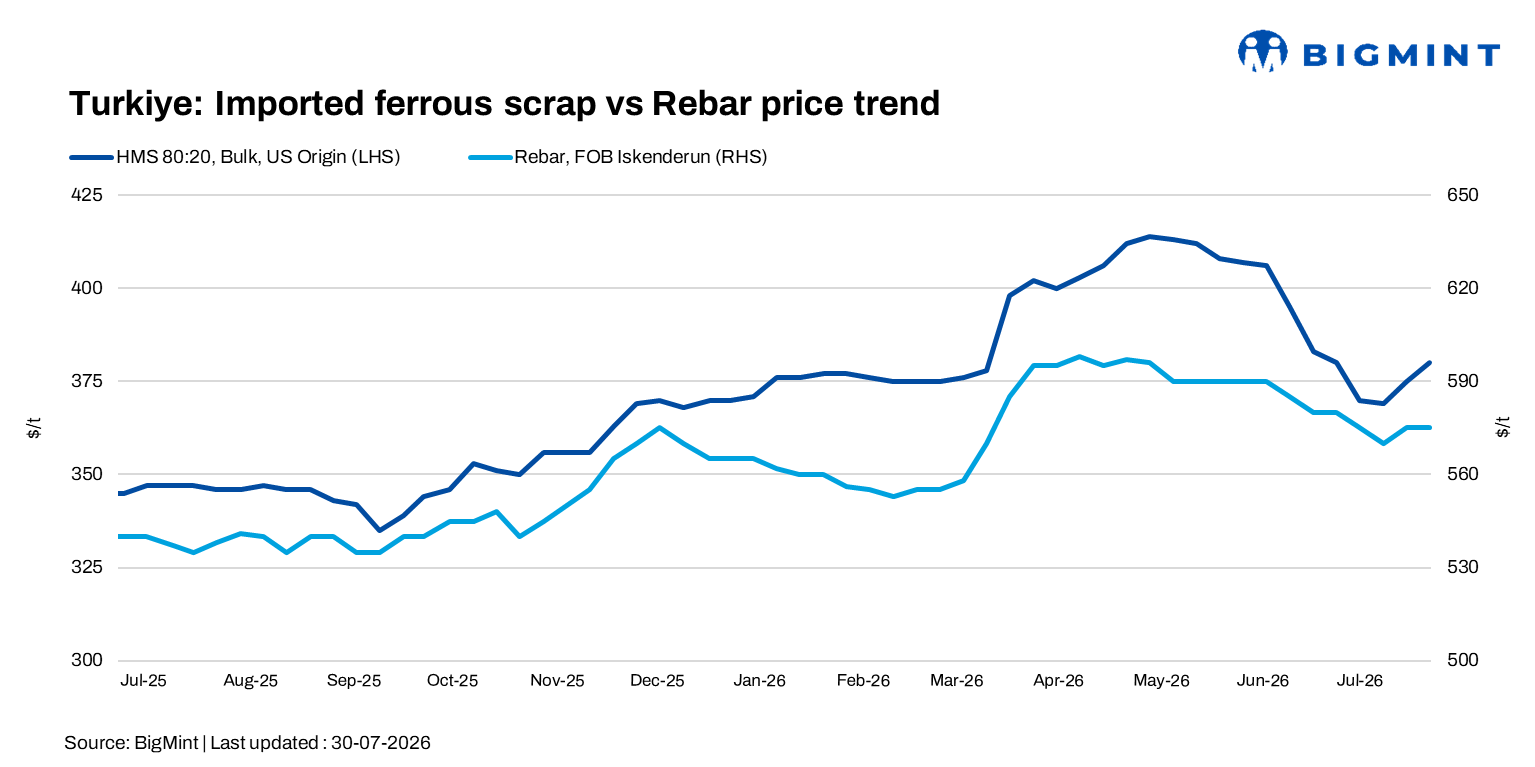
Turkiye’s imported deep-sea ferrous scrap price remained firm during the week ended 30 July as tight European scrap supply, stronger domestic billet prices, and improving steelmaking margins supported supplier offers. However, fresh trading activity remained limited, with mills staying cautious amid weak long steel demand and the seasonal summer slowdown.
Price assessments
- US-origin HMS 80:20 stood at around $380/t CFR Turkiye, up by $5/t w-o-w.
- US East Coast HMS 80:20 stood at around $343/t FOB, up by $4/t w-o-w.
Why did prices rise?
Deep-sea trading remained subdued during the week, with limited fresh bookings as buyers and suppliers maintained opposing price expectations. US-origin HMS 80:20 offers were heard at around $380/t CFR against mill bids of $365-370/t CFR, while tradable values were reported at $375-377/t CFR.
Suppliers continued to resist lower prices, citing limited export scrap availability, elevated freight costs, and expectations that Turkish mills would soon return to the market to secure September-shipment cargoes. European exporters also remained supported by restricted scrap flows, with low water levels on Germany’s Rhine River continuing to disrupt inland logistics and reduce export availability.
A Europe-based scrap supplier said the latest Baltic-origin HMS 80:20 booking at $376/t CFR Turkiye is likely to set the tone for firmer US-origin cargoes, with the next US-origin HMS 80:20 deal expected to be concluded above $380/t CFR. The supplier added that the Russia-origin 95:5 cargo sold to Kardemir at $397/t CFR should not be interpreted as a broader return of Russian scrap, as such cargoes are heard only occasionally. The transaction was also considered grade-specific, as Kardemir, an integrated blast furnace-based steelmaker, regularly procures 95:5 HMS, unlike most Turkish electric arc furnace (EAF) mills, which predominantly purchase HMS 80:20.
A Turkish trader said, “Suppliers are still targeting higher prices, but mills remain cautious because domestic rebar demand has yet to improve meaningfully.”
Another Turkish supplier added, “Several mills are currently focusing on domestic billet purchases after Kardemir’s successful sales campaign, reducing the immediate need to return to the deep-sea scrap market.”
Recent trades
- US origin to Aegean region-based mill: HMS 80:20 booked at $376/t CFR
- Baltic-origin to Aegean region-based mill: HMS 80:20 booked at $370/t CFR
- EU-origin to Aegean region-based mill: HMS 80:20 booked at $375/t CFR
- EU-origin to Aegean region-based mill:: HMS 80:20 booked at $375/t CFR
- UK-origin to East Marmara region-based mill: HMS 80:20 booked at $368/t CFR
- UK-origin to East Marmara region-based mill: HMS 80:20 booked at $368/t CFR
- Baltic-origin to West Black Sea region-based mill: HMS 80:20 booked at $376/t CFR
- Russia origin to West Black Sea region-based mill: HMS 95:5 booked at $397/t CFR
Domestic steel market
Domestic steel sentiment improved slightly during the week after Kardemir increased domestic billet offers by $10/t to $525-535/t exw and sold around 100,000 t within a few hours, highlighting limited billet availability in the local market. Market participants attributed the strong buying interest to the shortage of Russian and Iranian billet imports, prompting consumers to secure domestic supply. Other mills were heard offering billet at $535-550/t exw, although spot availability remained limited.
Domestic rebar prices remained stable at $570-590/t exw, while export rebar prices edged up to around $575-578/t FOB, supported by firmer scrap costs. As a result, the scrap-to-rebar spread narrowed to around $195-196/t as compared to $200/t last week. However, finished steel demand remained weak, and market participants reported no meaningful improvement in construction activity, keeping mills cautious despite stronger billet sentiment.
Outlook
BigMint expects Turkiye’s imported scrap market to remain largely firm in the coming week as limited European scrap availability, stronger domestic billet prices, and improved steelmaking margins continue to support suppliers’ offers. However, weak finished steel demand, the seasonal summer slowdown, and cautious mill procurement are expected to limit further price increases until fresh booking activity resumes.

Leave a Reply