- Tighter vessel space lifts container freights, limited enquiries weigh on bulk rates
- FOB Kakinada rice prices climb up to nearly 10-month high on supply concerns
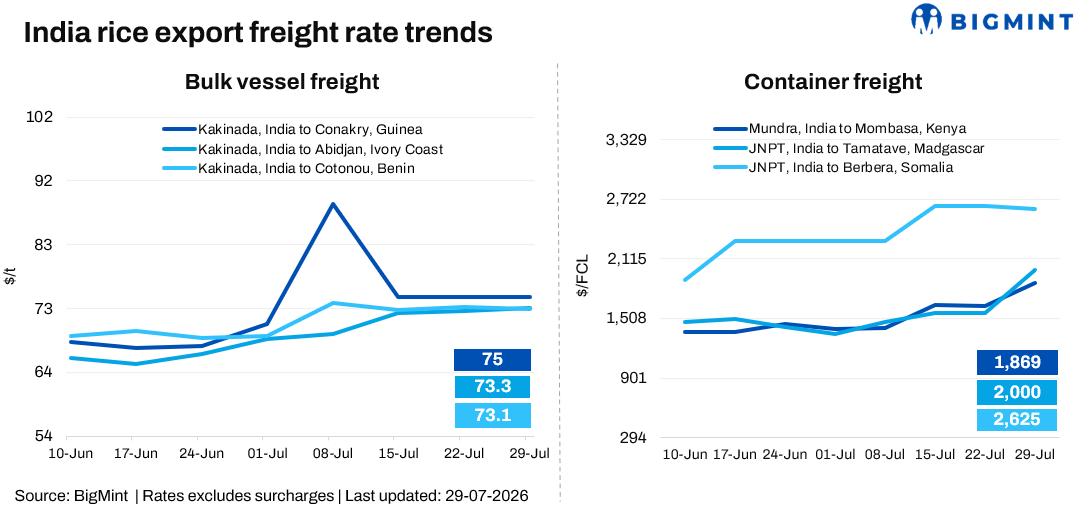
India’s rice freight market witnessed mixed trends in the week ended 29 July 2026, with contrasting dynamics across the bulk and containerised segments. Bulk freights remained largely stable on key West African routes as balanced vessel availability and limited cargo enquiries offset support from persistent destination port congestion and steady export demand.
Meanwhile, containerised freights firmed on the back of active booking enquiries, peak-season carrier rate revisions, tightening vessel space, and congestion across East African ports. At the same time, Indian non-basmati parboiled rice export prices climbed up to a near 10-month high, supported by tightening domestic paddy supplies, uneven monsoon rainfall raising concerns over the upcoming kharif crop, and adverse weather across major Asian rice-producing countries.
A shipbroker said, “The freight market has softened again after the Strait of Hormuz disruption. Although the conflict has paused, the canal situation continues to impact vessel schedules, and most carriers are expected to implement fresh rate revisions from August.”
West Africa bulk freights remains largely stable
India’s bulk rice freight market remained largely stable during the week, with rates holding steady across most West African trade lanes. Balanced vessel supply and muted fresh cargo enquiries kept freight indications broadly unchanged, while persistent congestion at Abidjan and steady export demand continued to provide underlying support.
A shipbroker said, “For West Africa, we are moving containers to Cotonou and Abidjan at around $72+/tonne (t). However, if container freight exceeds about $2,000/full container load (FCL) per box, shippers generally switch to breakbulk as it becomes the more economical option.”
Route-wise update

Space constraints, peak-season demand lift container freight
India’s containerised rice freight market strengthened during the week, supported by active booking enquiries, peak-season carrier rate revisions, and tightening vessel space across East African trade lanes. Congestion at Mombasa and stronger demand pushed freight higher on the Kenya and Madagascar routes, while rates to Berbera eased marginally amid weaker cargo enquiries and improved equipment availability.
A source told BigMint, “We are currently facing space constraints across several trade lanes as cargo demand remains strong, particularly for China and the US. Carriers are becoming more selective with bookings, making it difficult to secure space at current levels.”
Rice export prices hit near 10-month high
BigMint’s assessment for non-basmati parboiled rice (IR-64 5% PB), FOB Kakinada, increased by $5/t w-o-w to $370/t on 28 July from $365/t a week earlier. Export prices rose to a near 10-month high amid tightening domestic paddy supplies, concerns over the upcoming kharif crop due to uneven monsoon rainfall, and adverse weather across key Asian rice-producing countries, which kept market sentiment cautious.
Outlook
India’s bulk rice export vessel freight is expected to remain broadly stable over the coming weeks, underpinned by steady export programmes to West Africa and balanced vessel availability. While persistent congestion at select destination ports may continue to support freight levels, ample prompt tonnage and limited fresh cargo enquiries are likely to cap any significant upside.
However, freight could edge higher if export activity accelerates ahead of the peak shipping season or if rising container freight prompts more shippers to switch to breakbulk. Barring a meaningful tightening in vessel supply or a further escalation in port congestion, rates are expected to remain within the current range in the near term.
Leave a Reply