- Comfortable inventories keep mills cautious about procurement
- Monsoon disruptions weigh on steel demand and scrap imports
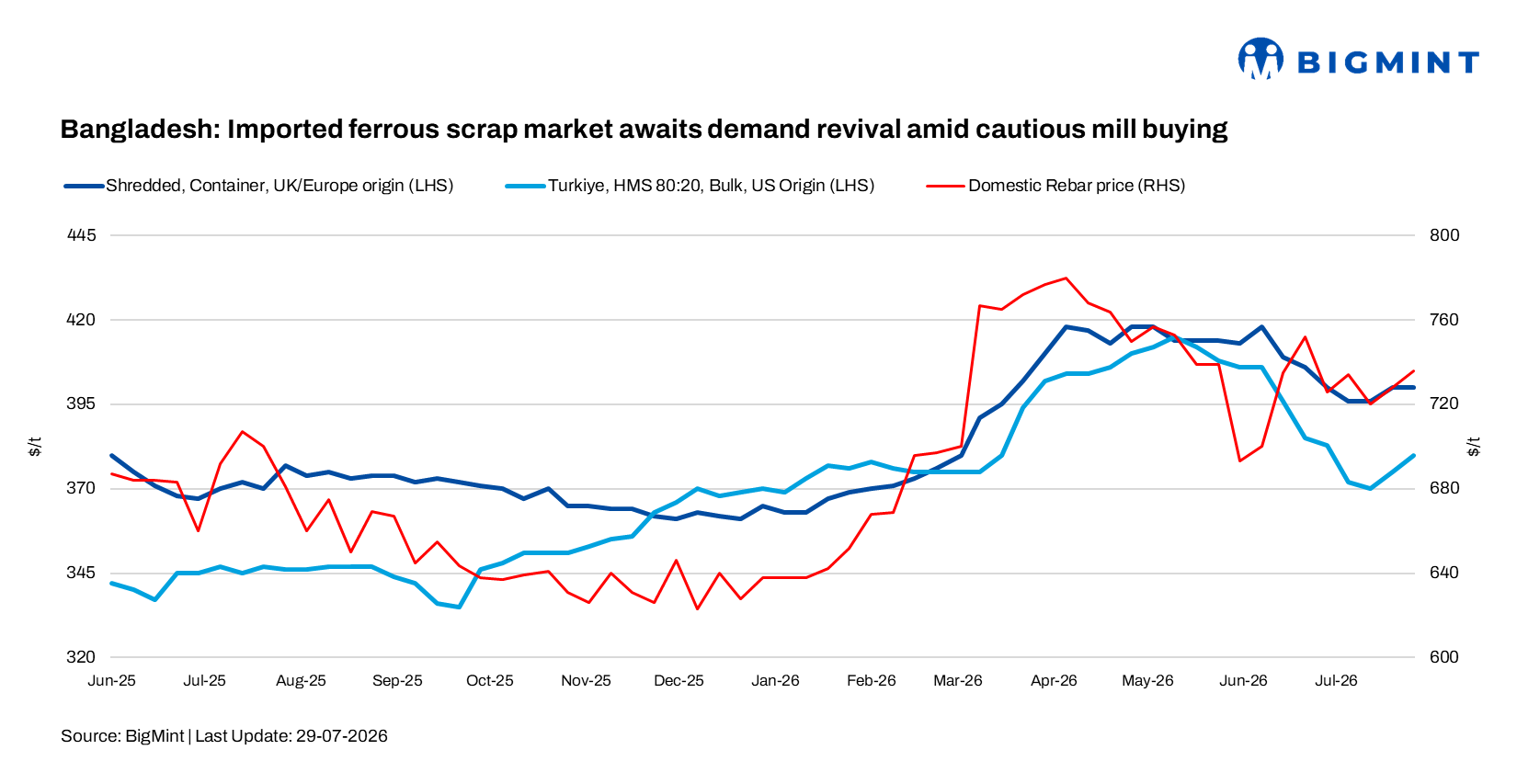
Bangladesh’s imported ferrous scrap market remained subdued during the week ended 29 July as weak finished steel demand, monsoon-related disruptions, and sufficient raw material inventories kept mills on the sidelines. Although buying interest showed early signs of recovery, most mills continued to procure only immediate requirements, while bid-offer gaps limited fresh deep-sea bookings.
BigMint’s weekly assessments, CFR Chattogram
- European-origin containerised HMS (80:20): $370/t, up by $4/t w-o-w
- European-origin containerised shredded: $400/t, stable w-o-w
- Japanese-origin bulk H2: $382/t, down by $9/t w-o-w
- US-origin bulk HMS (80:20): $400/t, inched up by $1/t w-o-w
Market updates
Deep-sea scrap trading remained subdued during the week, with buyers and sellers unable to bridge the gap on workable price levels. Sellers continued to seek $395-405/t CFR Chattogram for HMS 80:20 bulk, while mills’ buying interest remained limited to around $380-385/t CFR, resulting in no fresh bulk bookings.
The last reported deep-sea transaction was concluded last week for an Oceania-origin cargo, with HMS 80:20 booked at $382-385/t CFR and bonus-grade scrap at $392-395/t CFR, the latest market reference indicated.
Meanwhile, Japanese H2 scrap was offered at $380-385/t CFR, while buyers in Chattogram remained at around $370-375/t CFR. Demand from Vietnam and Bangladesh—Japan’s two largest export markets—also stayed subdued, with Vietnamese bids heard at $355-360/t CFR, limiting Japanese exporters’ ability to achieve higher prices.
Despite the subdued buying interest, suppliers largely maintained their offer levels, supported by elevated freight costs and firm replacement values. Mills, meanwhile, continued to procure cautiously, preferring to wait for more favourable prices before booking fresh cargoes.
Recent trades
- Australia-origin HMS 90:10: 2,000 t booked at $368/t CFR Chattogram
- Chile-origin HMS 90:10: 1,000 t booked at $372/t CFR Chattogram
- Australia/Canada-origin HMS 90:10: 2,500 t booked at $375/t CFR Chattogram
Containerised scrap trading also remained subdued. Brazil-origin HMS 80:20 was heard workable at $355-360/t CFR Chattogram, while Australia-origin HMS 80:20 traded at around $365/t CFR. Tradable values for containerised shredded scrap were assessed at $365-370/t CFR, although some suppliers continued to target higher offers.
Market participants said mills’ workable buying levels for imported HMS were around $360-365/t CFR Chattogram, compared with seller offers of about $375/t CFR. For shredded and PNS scrap, offers were heard at $400-410/t CFR, while buyer bids remained at $390-395/t CFR, highlighting a persistent bid-offer gap and cautious procurement sentiment.
A regional trader said, “There is some demand for scrap, but neither buyers nor sellers are in a hurry. Mills have sufficient inventories and are waiting for better buying opportunities.”
Another trader added, “Medium-sized mills have enough raw material to cover nearly four months of production and finished steel inventories for around two months, reducing the urgency to import.”
A representative of a global trading house noted that the last concluded Brazil-origin HMS 80:20 deal into India was heard at $325-330/t CFR, while Bangladesh is currently willing to pay $365-370/t CFR for comparable material. “It’s a matter of willingness to pay,” the source said. “Bangladesh needs scrap and is prepared to pay prevailing market prices, whereas Indian mills have access to alternative metallics and are under no pressure to buy. They are waiting for prices to soften and continue negotiating at lower levels.”
Domestic market
Domestic steel market conditions remained weak as monsoon rains continued to disrupt construction activity and suppress rebar demand. Grade-60 rebar from listed producers was heard at BDT 86,000-87,000/t ($697-705/t) Exw Dhaka and BDT 91,000-92,000/t ($737-745/t) Exw Chattogram.
However, market participants said retail rebar transactions were taking place at BDT 1,000-2,000/t ($8-16/t) below listed prices due to sluggish demand. Domestic melting scrap was heard at BDT 53,000-54,000/t ($429-437/t) Exy, while mills continued to operate cautiously amid weak sales and LC-related financial constraints.
Outlook
BigMint expects Bangladesh’s imported scrap market to remain range-bound in the coming week as monsoon disruptions, comfortable mill inventories, and weak finished steel demand continue to limit fresh bookings. While firm international offers may support import prices, mills are expected to maintain need-based procurement until construction activity and steel consumption recover.
Leave a Reply