- Geopolitics increasingly dictates global metals markets
- Scrap retention reshapes global supply chains
For nearly two decades, the global base metals market revolved around one dominant factor: China. Chinese demand, production, the intensity of its imports, and the size and timing of its fiscal stimulus dictated international prices, premiums, and the direction of global physical trade.
Although these drivers were somewhat of a “black box”– given the lack of transparency and communication from China — they still reflected the realities of the physical market of metals.
This changed quietly as China decisively shifted away from commodity-centric growth over the last few years. Targeted and measured fiscal support replaced broad-based stimulus. Prolonged weakness in the property sector and growing budget deficits at the provincial level reduced the scope for infrastructure-led demand that once fuelled the metals’ supercycles.
China also focused on reducing overcapacity and strengthening domestic self-sufficiency. A national capacity cap curbed new capacity build-up in aluminium smelting. Tax rebates on exports of aluminium products and refined zinc were withdrawn to encourage domestic availability. A massive expansion in copper smelting reduced reliance on imported refined copper.
Although China remains the world’s largest producer and consumer of base metals, its demand and supply surprises have diminished.
As the world looked beyond China, its focus shifted to a series of new drivers, namely trade policies and geopolitical risks. Moreover, the US dollar’s weakness attracted record investor interest in metals. This has brought about a structural transition in the way base metals are priced and traded, potentially marking the beginning of a new market regime.
Four years, two wars

Over the past four years, metals have witnessed two major geopolitical shocks: the Russia-Ukraine conflict (2022) and the Gulf conflict (2026). Both were centred around regions that are among the world’s largest exporters of energy and industrial commodities. The resulting sanctions, logistical disruptions, higher freight rates, and rising energy costs rippled through the global metals industry, affecting supply chains, trade flows, and procurement costs.
The impact ran deep into the Indian metal industry. Indian recyclers and consumers, due to their reliance on imported metal scrap and international benchmarks — such as the LME price and the Main Japanese Port (MJP) premium for pricing — experienced a direct impact.
While geopolitical risks have long been a feature of the metals industry, such disruptions have become more frequent and prolonged than before.
Policy shifts
Meanwhile, Western policies are changing.
The United States has introduced an increasingly protectionist trade framework, using tariffs and import restrictions as part of broader industrial and strategic objectives. At the same time, initiatives such as the Inflation Reduction Act (IRA), the Bipartisan Infrastructure Law, and the National Recycling Strategy are supporting domestic recycling infrastructure, expanding critical mineral recovery, increasing the use of secondary raw materials, and reducing reliance on imported metals.
The European Union has implemented policies aimed at strengthening its circular economy and reducing dependence on imported raw materials. Regulations such as the Carbon Border Adjustment Mechanism (CBAM), together with the European Green Deal and the Circular Economy Action Plan, encourage domestic recycling, improve resource efficiency, promote the use of secondary raw materials, and seek to retain more recyclable metals within the region.
These developments are gradually changing traditional trade flows.
Scrap that once moved freely across borders is increasingly being retained within domestic markets, reducing global availability. Indian recyclers, who have long relied on these flows, are likely to be deeply affected by this shift.
A “new normal”
The new forces shaping the metals market are closely aligned with the trade, foreign, and monetary policies of the United States. As a result, market movements increasingly hinge on policy decisions and day-to-day developments emanating from the US government and the Federal Reserve.
Further, Commitment of Traders (COT) reports from the Chicago Mercantile Exchange and the London Metal Exchange show that investors have significantly increased their stakes in every metal over the past few years. The collective stakes are 12% higher than those at the 2022 peak and contrast with a 63% rise in reported inventories. These financial flows have built a substantial “hope premium” into prices, making them increasingly sensitive to every headline that affects investor sentiment.
Taken together, these developments point towards a “new normal” in which prices increasingly respond to expectations rather than reality, trade and foreign policies rather than import and export flows, supply concerns rather than demand changes, and declining scrap flows resulting from increased recycling in the West.
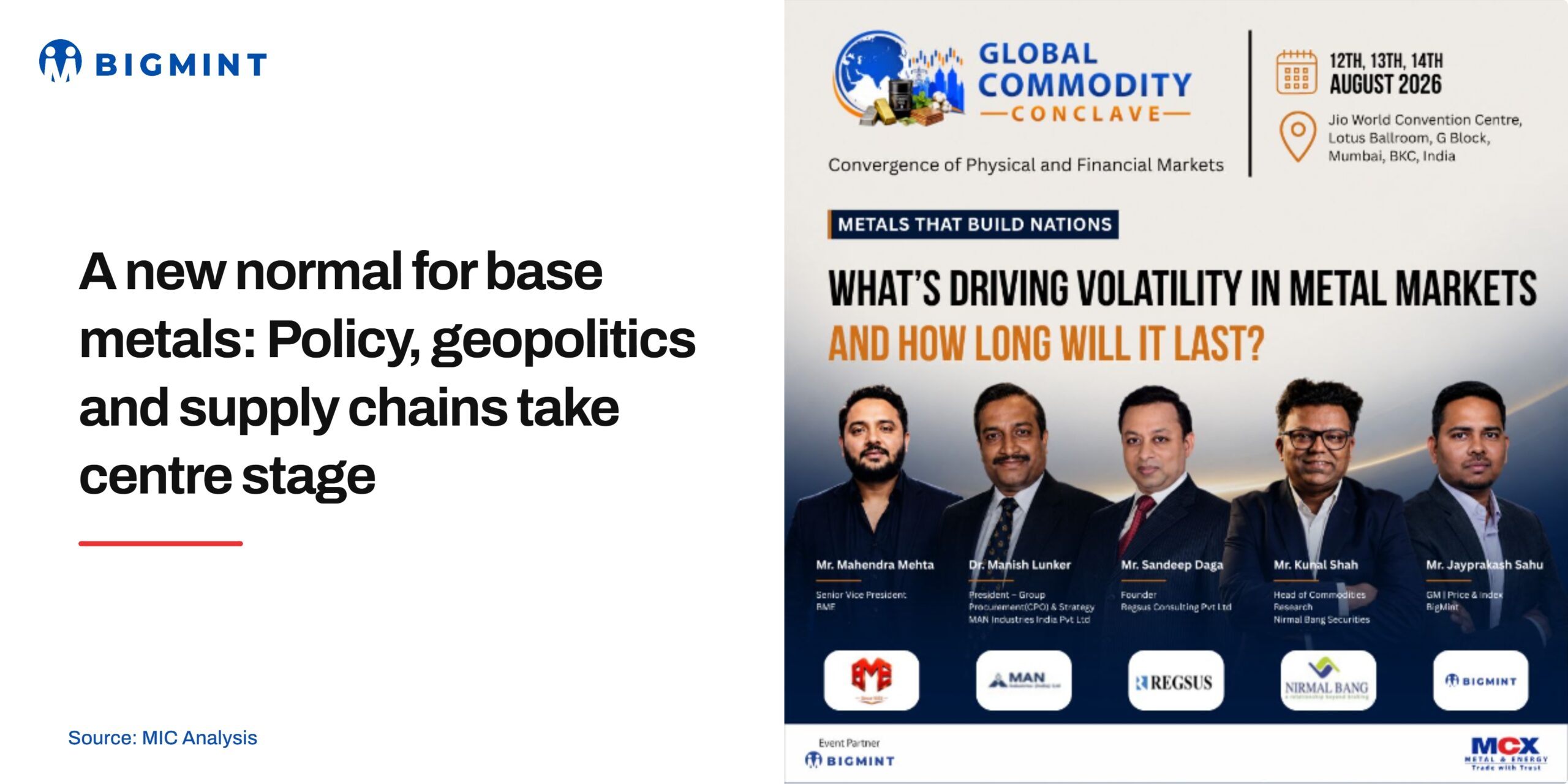
This article has been contributed by Mr. Sandeep Daga, Founder, Regsus Consulting Pvt. Ltd., and is published by BigMint as part of the Global Commodity Conclave (GCC) 2026 promotional knowledge series.
Continue the Discussion at GCC 2026
The evolving drivers of metal price volatility will be explored during the “What’s driving volatility in metal markets and how long will it last?” session at the Global Commodity Conclave (GCC) 2026, hosted by MCX with BigMint as the Event Partner, from 12-14 August 2026 at the Jio World Convention Centre, Mumbai. Join industry experts as they discuss the key forces reshaping non-ferrous metal prices and global trade dynamics.

Leave a Reply