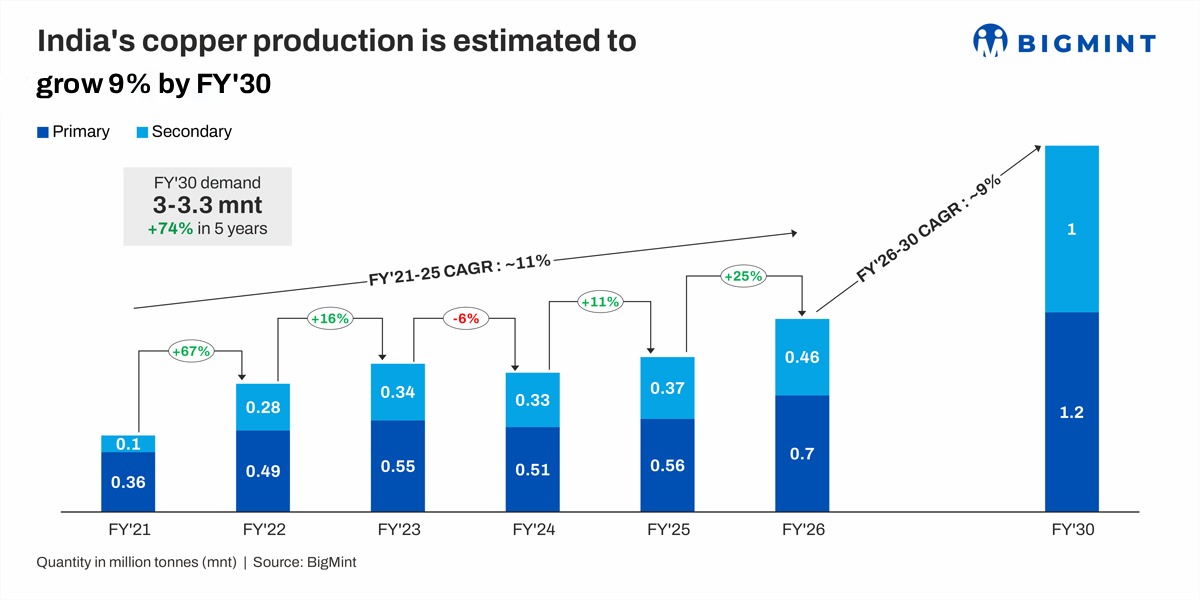
- Refined copper demand projected to reach 3.0-3.3 mnt by 2030
- Refining capacity expansion outpaces domestic mining growth
- Concentrate security and recycling emerge as strategic priorities
India’s copper industry is entering a structural growth phase. Refined copper demand is projected to increase from around 1.2 million tonnes (mnt) currently to 3.0-3.3 mnt by 2030, before rising further to 8.9-9.8 mnt by 2047, according to the Copper Vision Document 2025, released by the Ministry of Mines. The demand outlook appears increasingly assured. Securing sufficient raw material is likely to prove the industry’s defining challenge. How quickly India expands domestic mining, strengthens recycling and secures overseas concentrate supplies will determine whether it develops into a globally competitive copper manufacturing hub or remains structurally dependent on imported feedstock.
Demand growth shifts towards the energy transition
India’s next phase of copper consumption will be driven less by traditional construction activity and consumer durables than by the country’s energy transition and industrial modernisation agenda. Renewable energy, power transmission, electric mobility, electronics manufacturing and rail infrastructure are expected to account for an increasing share of future demand.
The opportunity remains substantial. India’s per-capita copper consumption is around 0.6 kg, well below the global average of approximately 3.2 kg, suggesting considerable scope for long-term demand growth as urbanisation, electrification and industrialisation continue.
Among end-use sectors, the power industry is expected to remain the largest consumer. India’s target of installing 500 GW of non-fossil fuel power capacity by 2030 will require extensive investment in transmission networks, substations, transformers and grid-balancing infrastructure, all of which rely heavily on copper.
Electric vehicles represent another major source of incremental demand. Battery electric vehicles require substantially more copper than conventional internal combustion engine vehicles, while nationwide charging infrastructure further increases copper consumption across the transport ecosystem. At the same time, expanding semiconductor manufacturing, electronics production and data centre construction are expected to create an additional layer of sustained structural demand.

Refining capacity expands, but concentrate dependence persists
To support rising domestic consumption, India is rapidly expanding its copper refining base. According to the Copper Vision Document 2025, installed refining capacity is projected to increase to around 2.8 mnt by 2030, before reaching 8.5-9.0 mnt by 2047.
Recent brownfield expansions and new refining projects have already increased domestic cathode production, reflecting growing investment in downstream value addition. The government’s objective is to build an integrated domestic copper ecosystem capable of supplying manufacturers of renewable energy equipment, electric vehicles, electrical machinery and electronic products.
Domestic mining remains the weakest link
India’s upstream copper sector continues to lag the rapid expansion taking place further down the value chain. Domestic copper ore reserves remain modest relative to projected demand, while economically mineable resources represent only a fraction of identified reserves.
Despite ongoing expansion plans by Hindustan Copper Ltd., domestic mine production continues to satisfy only a limited share of the country’s concentrate requirements. Imported concentrates have historically accounted for more than 90% of smelter feed requirements, leaving domestic refiners heavily dependent on overseas suppliers.
Recent increases in concentrate imports reinforce that structural dependence. India is steadily emerging as a major refining destination without developing a proportionate domestic mining base, increasing its exposure to increasingly competitive international concentrate markets.
Tightening global concentrate markets increase supply risk
India’s growing reliance on imported concentrates comes at a time when the global concentrate market is becoming increasingly competitive.
Supply disruptions across several major producing regions have periodically tightened concentrate availability. Operational challenges in Chile, export policy changes in Indonesia, flooding in the Democratic Republic of Congo and project uncertainties in Panama have all constrained global supply at various points, even as smelting capacity has continued expanding faster than new mine production.
The resulting imbalance has intensified competition for concentrate cargoes while contributing to increased volatility in treatment and refining charges (TC/RCs), directly affecting smelter profitability.
For India, where concentrate imports remain concentrated among a relatively small number of supplier countries, securing long-term feedstock is becoming less a matter of commercial procurement than one of strategic resource security.
Recycling offers the fastest opportunity to improve supply security
Alongside expanding mine production, the Copper Vision Document 2025 identifies secondary copper as one of India’s largest untapped sources of future supply.
Although India already processes substantial volumes of copper scrap, much of the material is remelted directly rather than upgraded through advanced secondary refining. Formalising scrap collection, improving material classification, strengthening traceability and expanding secondary refining capacity could significantly increase the availability of domestically sourced copper units.
Over time, the government expects recycling to supply a growing share of domestic copper requirements, reducing dependence on imported concentrates while supporting circular economy objectives and lowering the carbon intensity of copper production.
For a country facing structurally constrained mine output, recycling offers one of the fastest and most commercially viable opportunities to strengthen long-term supply security.
Policy focus shifts towards securing the upstream value chain
Recognising these challenges, the Copper Vision Document 2025 outlines a broad strategy aimed at strengthening India’s upstream copper ecosystem. Key priorities include accelerating mineral exploration, expediting auctions of copper-bearing mineral blocks, expanding domestic mining through brownfield projects and mine revivals, commissioning new concentrators and progressively increasing smelting capacity in line with projected demand growth.
The strategy also places considerable emphasis on overseas mine acquisitions and long-term concentrate offtake agreements to diversify feedstock sources and reduce exposure to disruptions in international concentrate markets.
Complementary reforms, including improved geological data availability, greater private-sector participation in mineral exploration and streamlined regulatory approvals, are intended to accelerate resource development and shorten project timelines.
Taken together, these measures reflect a shift in policy priorities. The objective is no longer simply to expand refining capacity, but to strengthen every stage of the copper value chain, from resource discovery and mining to concentrate procurement, recycling and downstream manufacturing.
Commercial implications
India’s copper market is entering a new phase in which supply security is becoming as important as demand growth. The rapid expansion of domestic refining capacity will increase value addition within the country, but it will also intensify competition for imported concentrates and recyclable feedstock. Unless domestic mining and secondary refining expand at a comparable pace, concentrate imports are likely to remain elevated, leaving Indian smelters increasingly exposed to tightening global supply and volatile treatment and refining charges (TC/RCs).
For market participants, the implications extend well beyond refining. Competition for long-term concentrate contracts is likely to intensify, strategic interest in overseas mining assets is expected to increase, and investment opportunities are emerging across scrap collection, recycling infrastructure and secondary refining as manufacturers seek to diversify raw material sources.
Downstream fabricators and manufacturers are also expected to place greater emphasis on supply-chain resilience. As copper assumes a more central role in India’s energy transition and advanced manufacturing ambitions, diversified sourcing strategies are likely to become an increasingly important component of long-term procurement and investment decisions.
Outlook
India’s copper demand appears structurally well supported through the remainder of the decade, underpinned by electrification, renewable energy deployment, infrastructure investment and the continued expansion of advanced manufacturing.
If domestic mining, overseas resource acquisition and secondary refining expand in parallel with refining capacity, India has the opportunity to establish an integrated copper value chain capable of supporting its long-term industrial ambitions. If upstream investment fails to keep pace, however, the country is likely to remain structurally dependent on imported concentrates, leaving the industry exposed to global supply disruptions, volatile treatment charges and intensifying competition for raw materials.
The Copper Vision Document 2025 provides a clear strategic roadmap for addressing those challenges. Its success, however, will depend less on the ambition of its targets than on the pace at which new mines are developed, overseas feedstock is secured and domestic recycling capacity is scaled.
Demand growth is no longer India’s principal constraint. The country’s ability to secure the raw materials needed to sustain that growth will determine whether it emerges as a globally competitive copper manufacturing hub or remains dependent on increasingly competitive international concentrate markets.

Leave a Reply