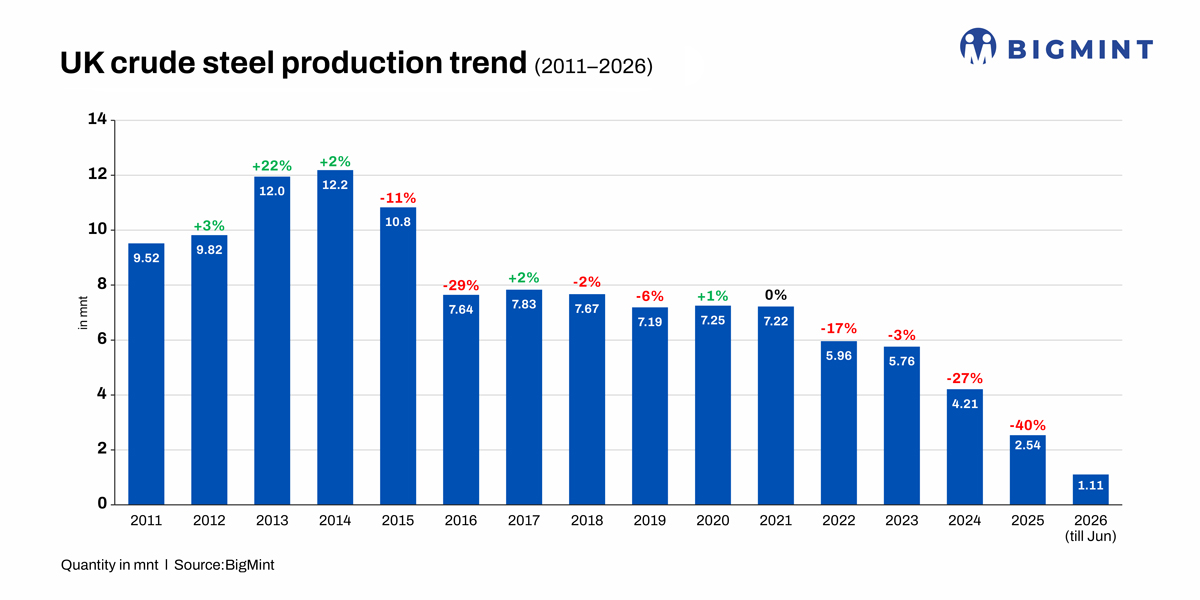
- Closure of Port Talbot steelworks removes bulk of UK’s BF capacity
- UK’s per capita steel use is half of EU’s, demand largely met through imports
The UK’s crude steel production has fallen to a historic low as the country transitions from blast furnace steelmaking to electric arc furnace (EAF) production, marking a fundamental shift for the birthplace of the Industrial Revolution and modern steelmaking.
According to a report published by Japan-based Steel Recycling Research, the UK’s crude steel production fell 29% y-o-y to 4.01 million tonnes (mnt) in 2024. Preliminary estimates suggest output declined further to 2.6 mnt in 2025, the lowest level since 1886, when production stood at 2.3 mnt. Current output is less than one-tenth of the record 27.83 mnt produced in 1970.
Blast furnace era draws to a close
The report attributes the sharp fall in production to the structural transition from blast furnace steelmaking to EAF production.
Tata Steel UK, the country’s largest blast furnace operator, shut down and began dismantling the ageing blast furnaces at its Port Talbot steelworks in South Wales in July and September 2024 after profitability deteriorated due to ageing facilities, competition from Chinese steel imports, high energy prices, and mounting pressure to reduce CO2 emissions. The closures have effectively removed most of the UK’s blast furnace capacity.
The company is investing several billion pounds to build a new 3 mnt-per-year EAF at the site. Construction began in July 2025, and commercial operations are targeted for the end of 2027. Once operational, the furnace is expected to reduce CO2 emissions by around 90%. During the transition period between 2025 and 2027, Tata Steel plans to import slabs to keep its rolling and galvanising operations running.
Meanwhile, British Steel’s integrated steelworks at Scunthorpe remains the UK’s only operating blast furnace facility. After its Chinese parent, Jingye Group, considered closing the furnaces in spring 2025, the UK government intervened through emergency legislation to keep production running and has since indicated it is seriously considering nationalising the company.
British Steel is viewed as strategically important because it supplies railway rails and supports national infrastructure and defence needs. The report notes growing concerns that the UK could become the only G7 nation without blast furnace capacity if the plant eventually closes.
Steel demand increasingly met through imports
Despite ranking among the world’s wealthiest economies with GDP per capita of around $56,700, the UK’s apparent steel consumption stood at just 133 kg per capita in 2024, ranking 67th globally and less than half the EU-27 average of 291 kg.
The report attributes the relatively low steel intensity to a services-led economy accounting for around 80% of GDP, manufacturing contributing only about 9%, mature infrastructure requiring mainly maintenance and renewal, housing construction dominated by brick and timber, and the long-term decline of shipbuilding and heavy industry.
Domestic steel demand totalled around 9.0-9.21 mnt in 2024, with construction accounting for about 40% of consumption. Imports supplied around 74% of domestic demand, while 64% of imported steel originated from the EU, highlighting the UK’s growing reliance on overseas supply.
World’s most prominent scrap exporter
The UK has also emerged as one of the world’s most significant ferrous scrap exporters.
The country exported 7.64 mnt of scrap in 2024, around nine times its domestic market scrap consumption of 840,000 tonnes (t). Approximately 90% of the country’s 8.48 million tonnes of annual scrap generation were exported, prompting the report to describe the UK as “an exceptionally extreme scrap exporting country” with few global parallels.

Turkiye accounted for 26.5% of scrap exports, while the EU-15 received 18.1%, taking Europe’s combined share to 45%. Africa accounted for 29.6%, followed by Asia, including India and Pakistan, at 23.1%.
The UK’s accumulated in-use steel stock was estimated at 790 mnt at the end of 2024. The recovery rate for obsolete scrap stood at 0.95%, compared with Japan’s 1.55% in the same year. Obsolete scrap accounted for 87% of total scrap generation, while prompt scrap represented only 13%, reflecting the country’s relatively small manufacturing sector.
Scrap policy debate gathers pace
The expansion of EAF steelmaking has intensified debate over whether the UK should retain more scrap for domestic steel production.
Steel industry association UK Steel has urged the government to restrict scrap exports outside the OECD and prioritise domestic use of high-quality scrap, arguing that future shortages could emerge as EAF capacity expands.
The recycling industry association British Metals Recycling Association (BMRA) disputes that assessment, arguing that even if all remaining blast furnaces were replaced with EAFs using 100% scrap, the UK would still require only around two-thirds of the scrap it generates domestically.
Both organisations, however, support greater investment in scrap upgrading technologies, including AI-based sorting and copper removal. The UK government’s 2025 Steel Strategy includes around £2.5 billion of support and identifies advanced scrap processing and sorting facilities as a policy priority.
Recovery expected, but industry will remain much smaller
The report projects the UK’s crude steel production will recover gradually to 4.5 mnt by 2030 and 5 mnt by 2050, although a return to the more than 25 mnt produced during the 1970s is considered highly unlikely.
The production mix is expected to reverse from 71.7% basic oxygen furnace steelmaking and 28.3% EAF production in 2024 to 35.6% and 64.4%, respectively, by 2030. By 2050, EAFs are projected to account for around 67% of production.
Scrap exports are expected to remain close to 6 mnt annually through 2050, suggesting the UK will continue to be a net exporter of ferrous scrap even after completing its steelmaking transition.
The report concludes that while import dependence may make economic sense, questions remain over how much domestic steelmaking capacity the UK should retain from the perspective of national security, infrastructure resilience, defence industries, and supply chain security.
It also proposes that the UK could position itself as Europe’s strategic supplier of pig iron and semi-finished steel, particularly after the EU lost access to Russian feedstock. The report argues that the UK’s geographical proximity gives it a freight advantage over Brazilian suppliers, with shipping distances to Italy of around 1,500-2,000 km compared with 8,000-9,000 km from Brazil.
Rather than attempting to reclaim its former position as one of the world’s largest steel producers, the report concludes the UK is evolving into “an indispensable steel nation for Europe” while becoming one of the first countries to confront the challenge of balancing decarbonisation with industrial competitiveness.
Note: This article has been published in accordance with a content exchange agreement between SteelDaily and BigMint.
Leave a Reply