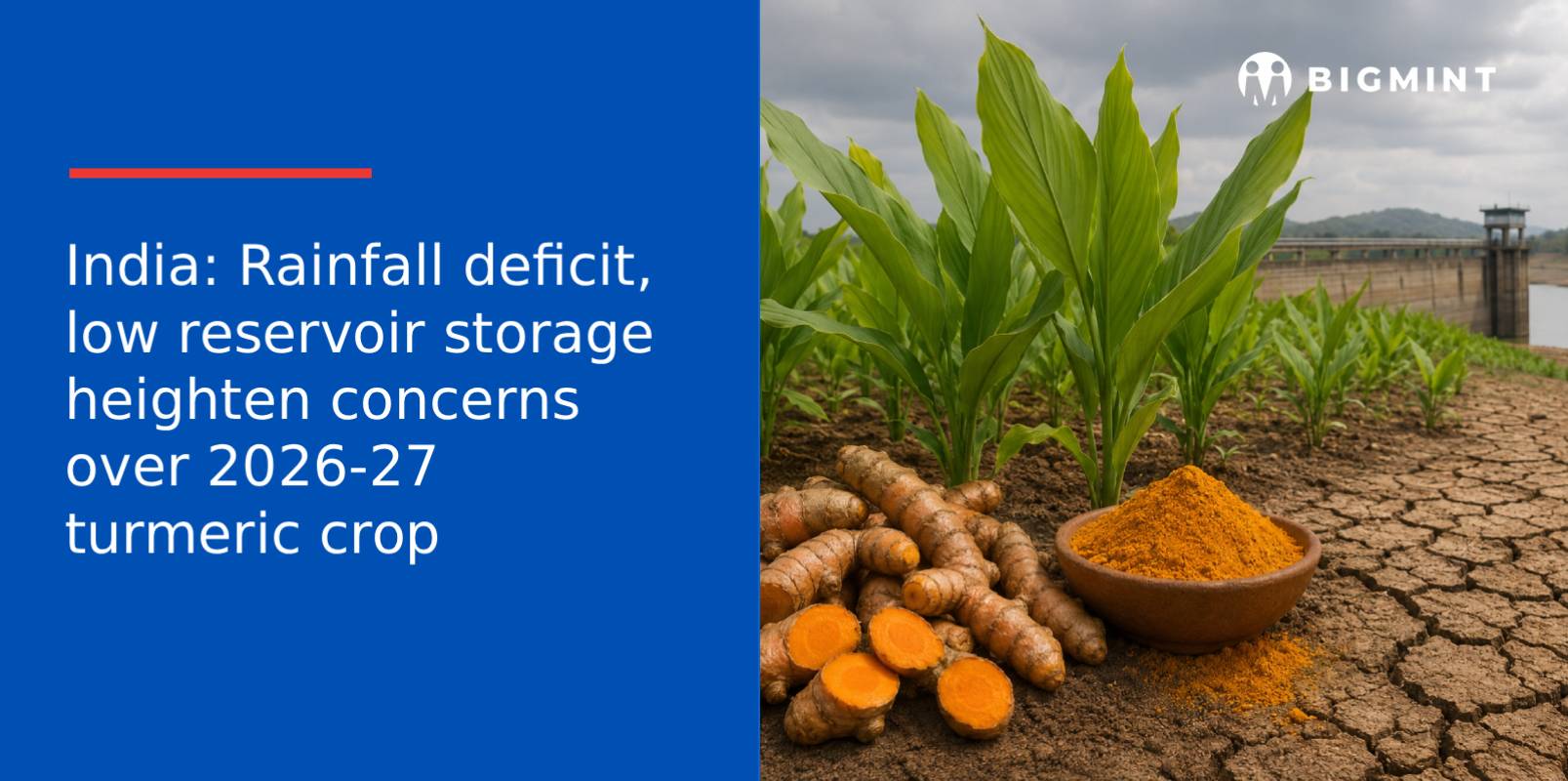
- Monsoon shortfall gives rise to uncertainty regarding soil moisture levels
- Market sentiment remains firm as weather risks dominate outlook
India’s 2026-27 turmeric sowing has largely been completed across major producing states, including Telangana, Maharashtra, Karnataka, Andhra Pradesh, and Tamil Nadu. While planting progressed broadly on schedule, market attention has shifted to crop establishment as below-normal monsoon rainfall and weak reservoir storage threaten soil moisture during the crucial early growth stage. Industry participants said timely and widespread rainfall over the coming weeks will be essential to sustain crop development and protect yield potential.
Rainfall deficit keeps crop under pressure
According to the India Meteorological Department (IMD), several major turmeric-producing regions continue to experience deficient monsoon rainfall. As of mid-July, cumulative rainfall was 39% below normal in Marathwada, 33% below normal in Telangana, 29% below normal in Rayalaseema, and 21% below normal in North Interior Karnataka — regions that collectively account for a substantial share of India’s turmeric production.
The prolonged moisture deficit has raised concerns over crop establishment, particularly in rainfed fields where adequate rainfall is critical for rhizome development. Although intermittent showers have supported planting operations in some locations, traders said consistent precipitation through August will determine final yield prospects.
Reservoir storage signals irrigation constraints
The rainfall shortfall is also reflected in reservoir storage across the southern region, comprising Andhra Pradesh, Karnataka, Kerala, Tamil Nadu and Telangana. As of 16 July, reservoirs in the region held only 28.37% of their live storage capacity, significantly lower than 65.27% during the corresponding period last year and below the 36.16% long-term average, highlighting constrained irrigation availability despite the ongoing southwest monsoon.
Among reservoirs serving key turmeric-growing areas, Sriram Sagar in Telangana was operating at 18.53% of capacity, while Singur stood at 15.44% and Kaddam at just 9.49%. In neighbouring Maharashtra, Jayakwadi was 31.42% full, whereas Majalgaon and Manjara were at 16.79% and 16.63%, respectively, underscoring continued irrigation stress across parts of the turmeric belt.
According to the latest estimates, India’s turmeric cultivation area is projected at 312,091 hectares in 2025-26, marginally higher than 310,963 hectares in 2024-25, while production is estimated to increase to 1.138 million tonnes (mnt) from 1.105 mnt. However, these estimates assume normal weather conditions and may be revised if monsoon performance remains weak.
Outlook
Market participants expect weather to remain the key price driver over the next few weeks. If rainfall improves and reservoir levels recover during August, production prospects could stabilise. However, continued rainfall deficits across major growing regions are likely to keep supply concerns elevated and support turmeric prices in the near term.
Leave a Reply