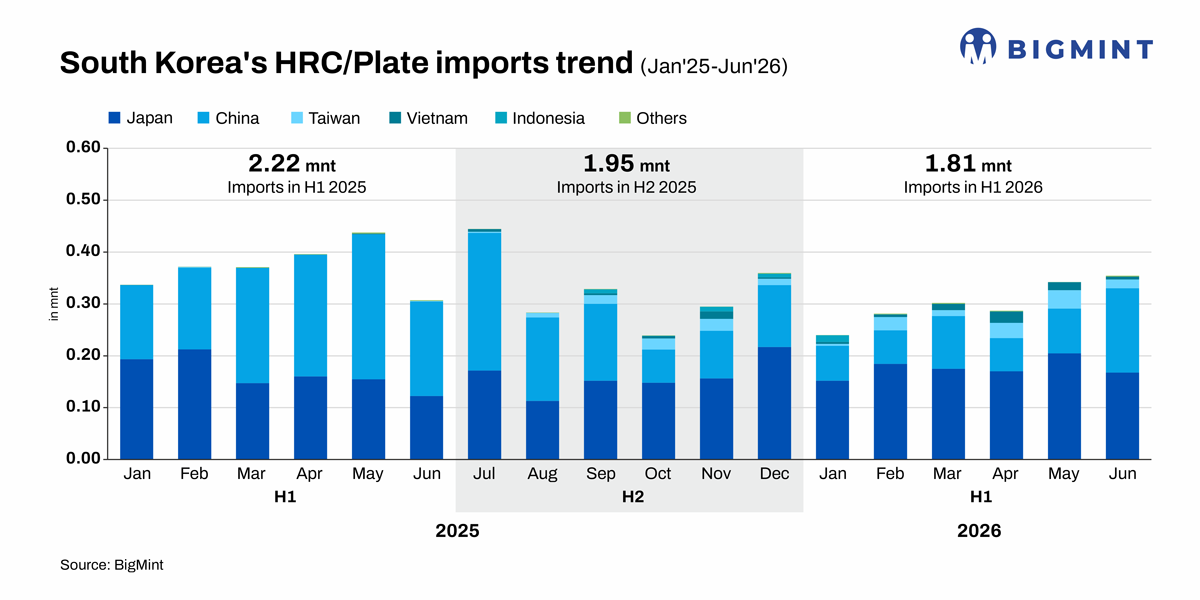
- Chinese HRC imports climb to highest level since Sep’25 anti-dumping duty
- Minimum import price mechanism helps control import prices, not volumes
South Korea’s hot rolled coil (HRC) market is facing renewed pressure as imports from China rebound and low-priced offers from Vietnam, Indonesia, and Taiwan gather pace, raising concerns that the country’s efforts to restore pricing discipline could face a fresh test.
The South Korean government earlier this year introduced anti-dumping (AD) measures and a minimum import price (MIP) undertaking on HRC imports from China and Japan to protect the domestic steel industry. The MIP undertaking has played a positive role in curbing ultra-low-priced Chinese dumping by ensuring import prices remain above an agreed threshold.
However, the price undertaking only restricts imports below the agreed price and does not control import volumes. Market participants note that if the gap between domestic and import prices widens, Chinese material meeting the MIP can still flow into the Korean market.
The risk has already started to emerge. South Korea imported around 210,000 tonnes (t) of HRC in June, of which approximately 80,000 t originated from China, an increase of more than 70,000 t from May. The June figure was the highest monthly Chinese import volume since provisional anti-dumping duties were imposed on Chinese HRC in September last year.
Industry participants said Chinese imports have increased as uncertainty surrounding the implementation of the MIP undertaking has largely eased. They added that even under the price undertaking, Chinese shipments could rise depending on domestic and overseas price differentials and contract conditions.
Third-country offers emerge as new competitive threat
Chinese material is not the only concern. HRC from Vietnam, Indonesia, and Taiwan is also becoming an increasingly important factor as competition among Asian steelmakers intensifies.
Offers from these countries to South Korea have increased in recent weeks, while prices have continued to soften. Indonesian HRC offers have reportedly fallen to $538/t CFR South Korea, while Vietnamese material has been offered at $555-556/t CFR.
Vietnamese steelmakers have also sharply reduced domestic selling prices and are offering additional discounts to large-volume buyers, with some transactions reportedly concluded in the low $530s/t. Market participants believe the recent price weakness could result in further reductions in export offers to South Korea.
Some products could eventually become more price competitive than both domestically produced HRC and Chinese material covered by the MIP undertaking.
The development has raised concerns over a so-called “third-country balloon effect”, whereby trade remedy measures on China and Japan could redirect low-priced exports from countries that are not currently subject to similar restrictions.
Industry participants said tighter regulations on one country could quickly encourage low-priced shipments from alternative suppliers such as Vietnam, Indonesia, and Taiwan.
Legitimate imports to be distinguished from dumping
Market participants stressed that fairly priced imports should be clearly distinguished from dumped imports.
They said restricting legitimate imports would not be desirable, given the need to ensure stable raw material supply and preserve the competitiveness of downstream manufacturing industries.
However, they argued that authorities should intervene if imports from a particular country rise sharply within a short period or if export prices fall to abnormally low levels relative to domestic prices or production costs in the exporting country.
Such monitoring would allow the government to act before material injury to the domestic industry becomes evident.
Market recovery remains at early stage
South Korea’s HRC market remains in the early stages of recovering from years of low-priced import competition and is attempting to restore more balanced pricing and supply-demand conditions.
Industry participants warned that a renewed increase in Chinese imports, together with growing volumes from Vietnam, Indonesia, and Taiwan, could undermine the fragile market recovery.
They said the government should continue assessing the effectiveness of existing trade remedy measures while closely monitoring import volumes and offer prices by country. In addition to ensuring compliance with the Chinese MIP undertaking, authorities should analyse import growth from Vietnam, Indonesia, and Taiwan alongside domestic and international price differentials, export prices, domestic prices, and production costs in exporting countries to enable timely intervention if required.
“This is not protectionism aimed at restricting legitimate imports, but the minimum level of market oversight needed to prevent unfair market disruption caused by dumping and circumvention exports,” an industry source said. “Continuous monitoring of import patterns is necessary to ensure domestic producers and downstream industries can compete on a level playing field.”
Note: This article has been published in accordance with a content exchange agreement between SteelDaily and BigMint.
Leave a Reply