- EBITDA per tonne declines 16% y-o-y amid higher input costs
- JP Cement acquisition supports capacity expansion to 67 mnt/year by Q3FY’28
Dalmia Bharat reported a strong operational performance in Q1FY’27, supported by higher cement sales, improved product mix, and stable prices across key markets. The 9% increase in the company’s dispatches outpaced overall industry demand growth of 7-8%, driven by steady infrastructure activity and a recovery in construction following temporary disruptions from state elections.
Although higher imported fuel, raw material, and packing material costs continued to pressure margins, better cement realisations, rising premium product sales, and ongoing cost optimisation helped offset part of the increase. The company strengthened its long-term growth strategy through the acquisition of JP Cement assets and continued progress on multiple expansion projects, reinforcing its ambition of becoming a pan-India cement producer.
Operational performance
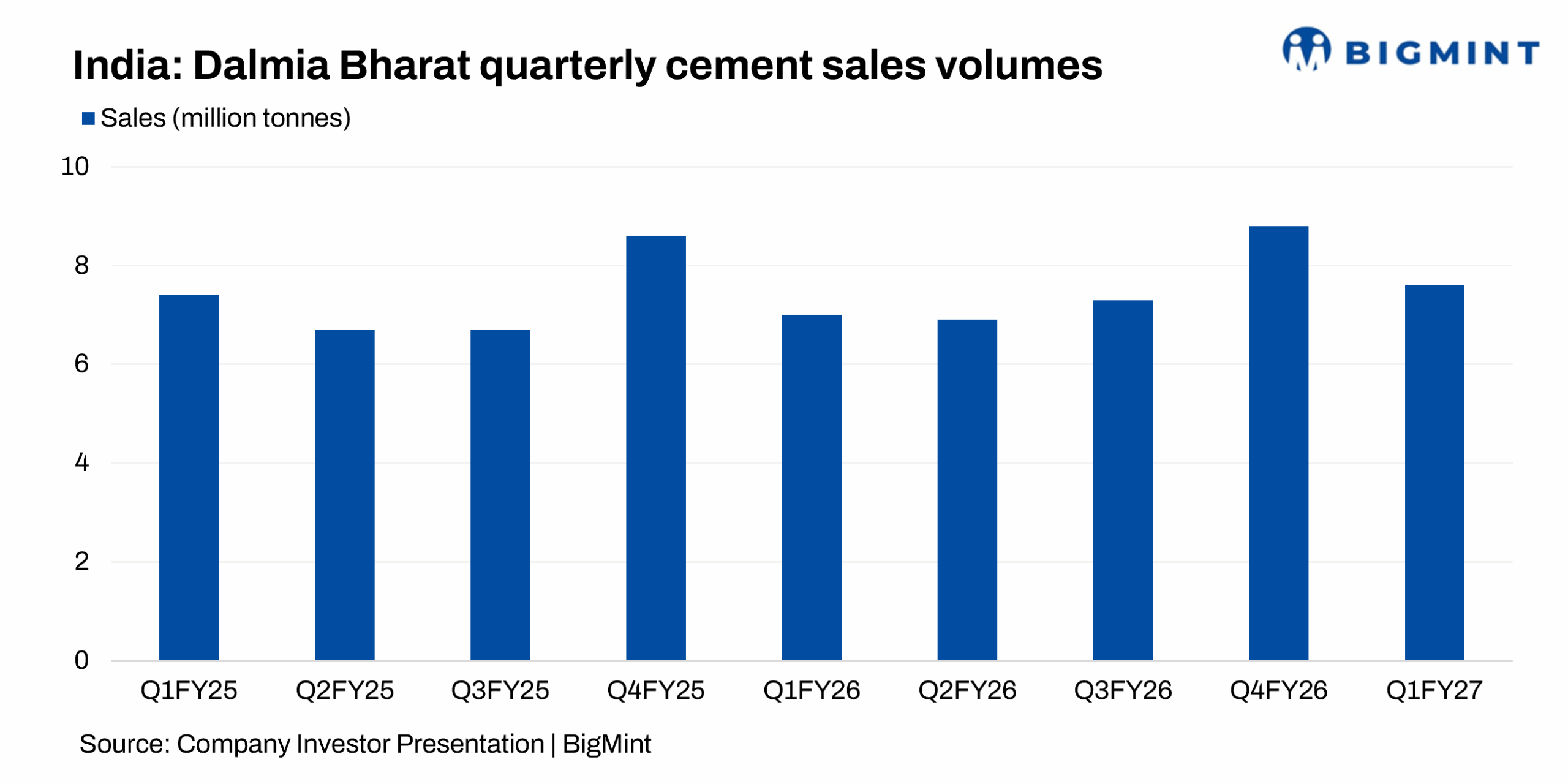
Dalmia Bharat’s cement sales volume increased 9% y-o-y to 8.8 million tonnes (mnt) in Q1FY’27. The company estimated that it gained around 2-2.5 percentage points in market share during the quarter, supported by its extensive distribution network and strong execution across key markets.
The company’s premiumisation strategy continued to strengthen sales quality, with premium cement contributing around 25% of total sales during the quarter, supported by the launch of its Weather 365 brand. A better product mix and improved cement prices helped increase net sales realisation (NSR) by nearly 6% q-o-q.
Revenue from operations increased 7% y-o-y to INR 3,890 crore. The company’s EBITDA per tonne declined 16% y-o-y to INR 1,055 from INR 1,261 in Q1FY’26 due to higher input costs. However, the same improved 3% q-o-q from INR 1,023 in Q4FY’26, supported by better realisations and continued cost optimisation initiatives.
The company also expanded its use of renewable energy, which accounted for 48% of total power consumption during the quarter. Additional renewable energy projects are expected to further increase green power utilisation and improve long-term cost competitiveness.
Regional cement prices remain firm
Regional cement prices remained supportive during Q1FY’27, improving industry realisations and profitability. South India recorded one of the strongest recoveries, with prices increasing by around INR 10-15 per bag following improved construction activity after election-related disruptions. East India also witnessed price gains of around INR 15-20 per bag, supported by improving demand and better market discipline.
Prices in Central and Western India remained largely stable, while North India witnessed limited price volatility. Entering Q2FY’27, prices remained broadly stable across most regions, although West Bengal experienced some correction, while South India continued to witness positive pricing momentum.
The company continues to focus on premium products and brand-led pricing to improve long-term realisations rather than relying solely on industry-wide price increases.
Higher input costs continue to pressure margins
The company continued to face inflation across key cost heads during the quarter. International pet coke prices increased to nearly $160/t amid geopolitical tensions before moderating to around $130-135/t. Consequently, the company’s blended fuel cost increased to INR 1.47/kcal from INR 1.36/kcal in Q4FY’26, resulting in a 10% y-o-y increase in power and fuel costs to INR 1,045/t.
Raw material costs increased 12% q-o-q to INR 823/t, mainly due to higher limestone raising expenses and input cost inflation. High-Density Polyethylene (HDPE) bag prices also increased sharply from around INR 9.5 per bag to nearly INR 14 per bag owing to higher crude oil-linked polymer prices. Freight costs remained largely stable, although clinker transportation expenses increased because of greater reliance on road transport.
The company generated structural savings of over INR 150/t through fuel optimisation, procurement efficiencies, and logistics improvements, helping offset a significant portion of cost inflation. However, production costs are expected to increase by another INR 70-75/t during Q2FY’27 due to higher diesel and imported fuel prices, although easing packing material costs may provide some relief.
Expansion pipeline supports long-term growth
The acquisition of JP Cement’s assets marked the company’s key strategic development during the quarter, strengthening its presence in central India and supporting future capacity expansion.
Project updates
- Completed the acquisition of JP Cement’s cement business, adding 5.2 mnt/year of cement capacity and 3.3 mnt/year of clinker capacity across Madhya Pradesh and Uttar Pradesh at an enterprise value of INR 2,850 crore.
- Commenced commercial production at the 2.5 mnt/year Chunar grinding unit in June 2026, while the 3.3 mnt/year Rewa clinker unit entered trial production in July 2026.
- The Belgaum grinding unit remains ahead of schedule and is expected to begin commercial operations within the next six months.
- Construction continues at the Kadapa and Pune expansion projects, with the Pune project back on schedule.
- Installed cement capacity is expected to increase to around 67 mnt/year by Q3FY’28, while an additional grinding unit under evaluation in eastern India could increase total capacity to nearly 70 mnt/year.
Dalmia Bharat’s installed cement capacity stands at 54.7 mnt/year, with clinker capacity at 30.4 mnt/year. Ongoing expansion projects at Belgaum, Pune and Kadapa are expected to increase cement capacity to 66.7 mnt/year and clinker capacity to 37.6 mnt/year by Q3FY’28, strengthening the company’s presence across western and southern India.
Capex and renewable energy remain key priorities
The company maintained its FY’27 capital expenditure guidance of INR 3,200-3,400 crore to support expansion and operational improvements.
- Around INR 2,200 crore allocated towards ongoing expansion projects.
- Remaining expenditure to support maintenance, operational efficiency initiatives and integration of the acquired JP Cement assets.
- Around INR 550 crore earmarked for phased refurbishment of the acquired facilities.
- Continued investment in hybrid renewable energy projects to increase green power utilisation and improve long-term cost efficiency.
Dalmia Bharat remains focused on expanding its cement capacity to 110-120 mnt/year over the long term while maintaining disciplined capital spending and a healthy balance sheet.
Outlook
The company is expected to maintain healthy operational performance through the rest of FY’27, supported by stable cement prices, higher premium product sales, and continued cost optimisation initiatives. The integration of the JP Cement assets and commissioning of the Belgaum, Kadapa, and Pune projects are expected to improve capacity utilisation, operational efficiency and market presence, while increasing renewable energy usage should help moderate production costs.
Leave a Reply