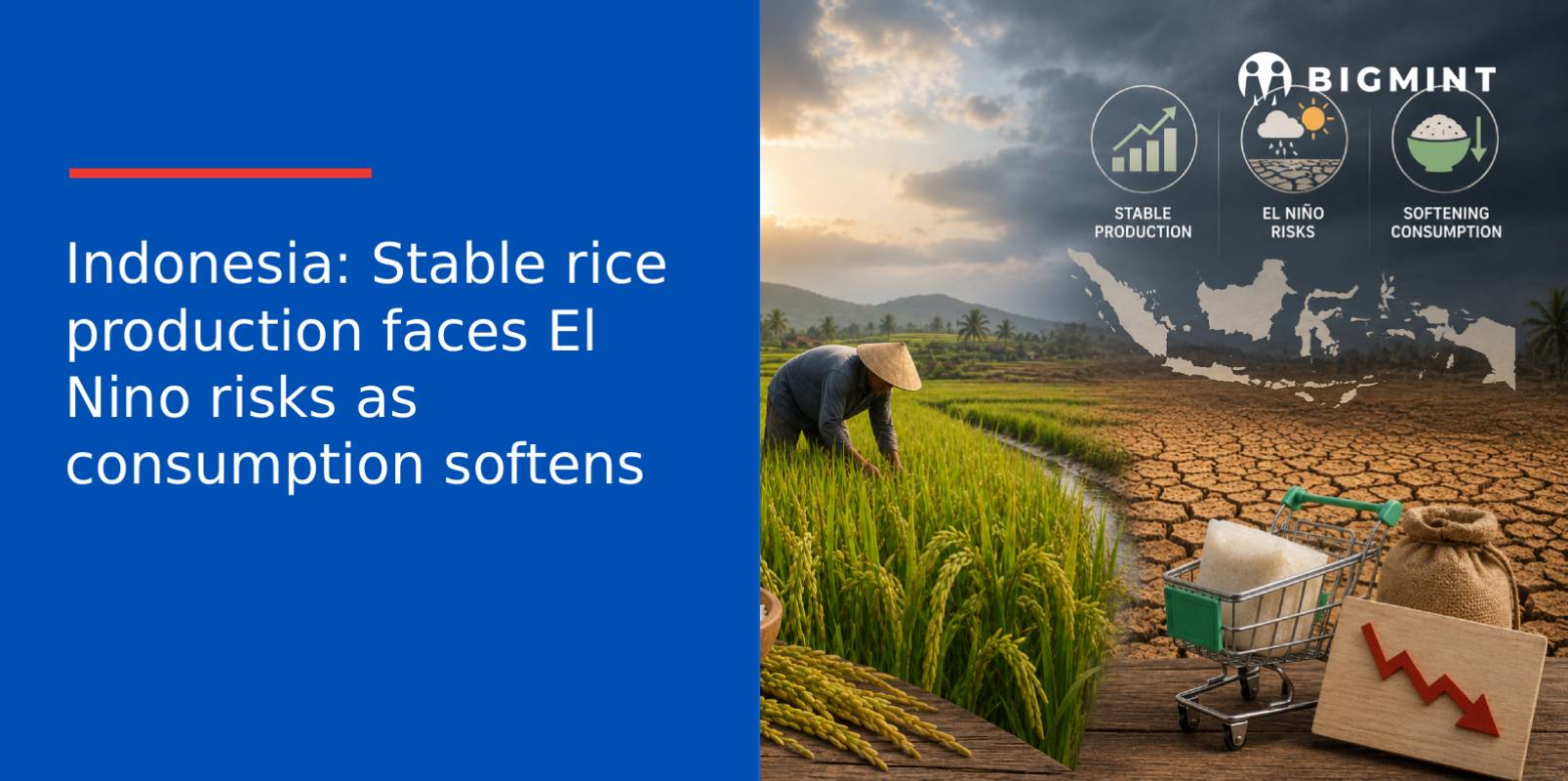
- Delayed planting may affect the 2026/27 crop cycle
- Paddy production remains stable despite emerging El Niño concerns
Indonesia’s rice production remains largely supported by its irrigated farming system, with around 85% of national rice output coming from irrigated paddy fields. The first crop cycle (October-February) accounts for 50-55% of annual production, followed by the second crop (30-35%) and the third crop (15-20%). Farmers in Central Java and West Java are currently harvesting the 2025/26 second crop while preparing land for the third crop. However, water availability has started to tighten in semi-irrigated areas, prompting some farmers to use pumps for irrigation. The anticipated El Niño-induced prolonged dry season is expected to delay the 2026/27 first planting season from its normal October schedule to late November or early December 2026, pushing the main harvest to March-April 2027.
Water shortages may also encourage farmers in semi-irrigated lowland areas to shift from paddy to corn, which requires less water and offers better returns than other secondary crops. Despite these weather-related concerns, BPS estimates the January-August 2026 paddy harvested area at 8.4 million hectares, up 0.4% YoY from 8.3 million hectares, while paddy production is projected at 43.89 MMT, a marginal increase from 43.86 MMT during the same period last year, indicating broadly stable production.
Consumption and Prices
The Indonesian government continues to stabilize domestic rice prices through BULOG’s Food Supply and Price Stabilization (SPHP) program. For 2025/26, the government has allocated 828,000 tonnes of rice under the program, lower than the 1.5 MMT allocated in 2024/25, with 678,870 tonnes already distributed as of mid-July 2026. In addition, the government has expanded its rice assistance program, distributing 662,860 tonnes during February-March 2026 and approving another 997,300 tonnes for July-September 2026, bringing total food aid allocations to 1.7 MMT for the year. Supported by continued SPHP distributions and food aid, rice consumption in 2026/27 is forecast to decline by 0.8% to 35 MMT from an estimated 35.3 MMT in 2025/26, reflecting both government intervention and a gradual shift in consumer diets toward flour-based foods. Maximum retail price ceilings remained unchanged in 2025 compared with 2024, helping maintain price stability. Regulated prices range between IDR 13,500-15,500/kg for medium rice and IDR 14,900-15,800/kg for premium rice, with higher price ceilings in eastern provinces such as Maluku and Papua due to higher transportation and distribution costs.
Trade
Indonesia is expected to maintain minimal rice imports in 2026/27 as ample domestic production and strong government procurement have significantly increased public rice stocks. By the end of June 2026, BULOG had procured 3.24 MMT (81% of its 4 MMT target), lifting government rice reserves to 5.2 MMT, well above the required year-end buffer of 1.5–2.0 MMT.
Consequently, the government has not authorized BULOG to import rice, while private-sector imports remain limited to specialty rice varieties such as basmati, japonica, fragrant, and rice for diabetic consumption. Rice imports are forecast to rise modestly to 500,000 MT in 2026/27 from 200,000 MT in 2025/26, driven primarily by demand for specialty rice and rice for further processing rather than staple rice.
Stocks
Post forecasts for 2026/27 rice ending stocks to decrease by 21.3 percent to 3.3 MMT compared to 4.2 MMT in 2025/26. The decrease is due to lower production and imports. The same reasons are behind the estimated 31.9 percent decrease of 2025/26 ending stocks compared to 5.6 MMT in 2024/25. Approximately 68 percent of stocks are with households, 10 percent with rice mills, 11 percent with traders, and the rest are in BULOG warehousing.
Policy
The Indonesian government continued its rice price stabilization measures through BULOG’s SPHP rice distribution program, helping keep retail rice prices broadly stable despite higher paddy prices. In June 2026, average wet paddy prices rose 4.9% YoY to IDR 6,951/kg, while medium- and premium-quality rice prices increased marginally by 0.2% YoY to IDR 13,823/kg and IDR 15,498/kg, respectively. However, both retail rice categories remained above the government’s maximum retail price (HET) set under NFA Regulation No. 299/2025, indicating continued price pressure in the domestic market.

Outlook
Indonesia’s rice market is expected to remain stable in the near term, supported by steady harvested area, irrigated production, and continued government price stabilisation measures. However, the expected prolonged dry season could delay the 2026/27 planting season and constrain paddy cultivation in water-stressed areas, while sustained food aid distribution and gradual dietary diversification may keep domestic rice demand subdued.
Leave a Reply