- Bangladesh crude steel production increases by around 10% in H1CY’26
- Ship-breaking imports tonnage decline 21% y-o-y, raising reliance on imports
- Power shortage and higher production costs lead to lower DRI imports
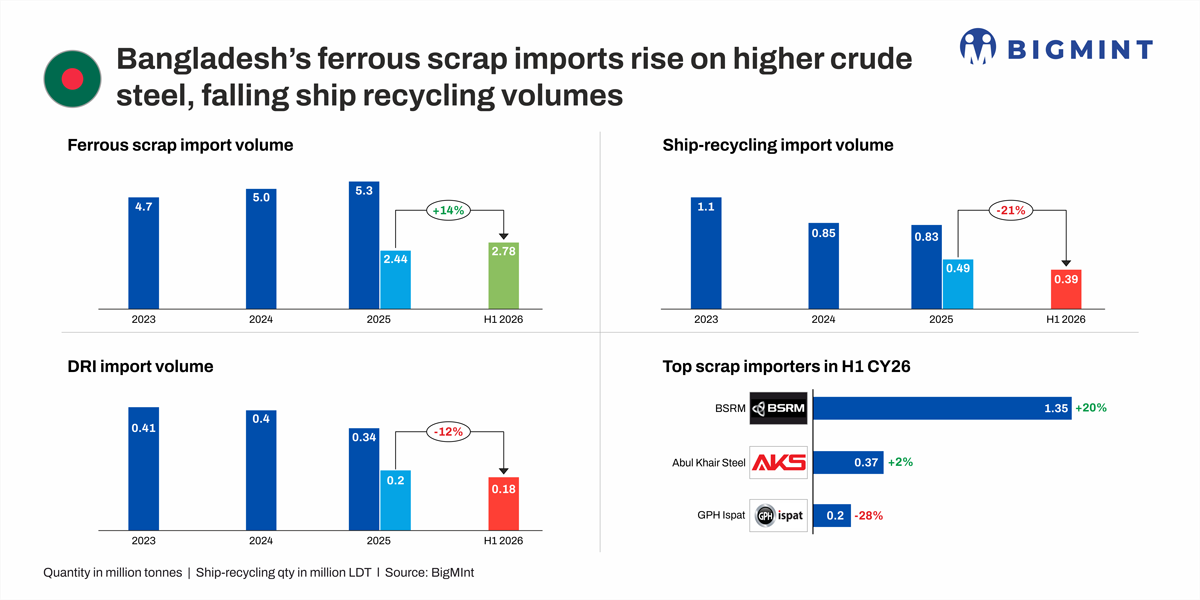
Morning Brief: Bangladesh’s ferrous scrap imports, including bulk and containerised cargoes, increased 14% y-o-y to around 2.78 mnt in H1 CY’26 from 2.44 mnt a year earlier. Bulk scrap imports rose 8% y-o-y to around 1.78 mnt from 1.65 mnt during the corresponding period.
Japan remained Bangladesh’s largest scrap supplier in H1CY’26, with exports rising 31% y-o-y to 0.77 mnt. Singapore and Australia also recorded strong growth, with shipments increasing 78% and 72% y-o-y to 0.32 mnt and 0.31 mnt, respectively.
In contrast, imports from the US declined 56% y-o-y to around 0.14 mnt due to higher freight costs and weaker competitiveness, while New Zealand-origin shipments fell 17% y-o-y to around 0.10 mnt.

Factors supporting scrap imports in H1CY’26
Lower ship recycling activity deepens import reliance
Bangladesh’s ship recycling industry remained subdued during the period, reducing the availability of domestically generated melting scrap. Ship imports for recycling declined 21% y-o-y to around 392,000 light displacement tonnes (LDT) from 498,000 LDT in H1 CY’25, while the number of vessels imported fell 9% to 49 from 54.
The slowdown was due to limited availability of ageing vessels amid firmer global freight and energy markets following the US-Iran crisis that encouraged owners to keep ships in service longer, and cautious buying by recyclers amid tight financing conditions. The supply of tankers, especially, declined due to the surge in energy prices. Another factor is the low number of HKC-compliant shipyards in Bangladesh, which limits the country’s ability to receive and dismantle more vessels after the convention came into full force in mid-2025.
With fewer vessels arriving at local yards, the supply of ship-breaking scrap tightened, prompting steel mills to increase reliance on imported scrap.
Moderate growth in crude steel production
As per BigMint data, Bangladesh’s crude steel production was estimated at around 5-5.2 mnt in 2025, with output reaching approximately 2.8-3 mnt in H1 CY’26. This is estimated to be an increase of roughly 10% y-o-y. Therefore, the marginal rebound in steel production after the restoration of political stability in Bangladesh led to higher scrap imports, with the country wholly dependent on imports (around 90%) for operations.

However, the growth in imports was not significant as the mills continued to operate at only 50-55% of capacity amid weak construction demand, elevated production costs, and persistent liquidity and power constraints, resulting in selective raw material procurement. Bangladesh’s crude steel capacity stands at around 10-10.5 mnt, with nearly half of it underutilised.
Power shortages, higher electricity costs affect DRI imports
Towards the end of June, Bangladesh’s steel sector came under additional pressure with power shortages of 600-3,350 MW and outages lasting up to 8-12 hours, coupled with higher electricity tariffs and revised VAT increasing steel production costs by an estimated BDT 4,000/t ($32/t). While the large mills continued operating by and large without disruption due to availability of imported scrap, smaller re-rollers and induction furnace mills, largely based in Dhaka, were more vulnerable to prolonged load shedding.
This had an impact on metallics consumption patterns. Bangladesh’s sponge iron imports declined 12% y-o-y to around 178,000 t from 201,000 t in H1 CY’25. The rerolling and induction furnace mills reduced sponge iron consumption because of its relatively higher energy requirement during steelmaking. This supported the demand for scrap.
According to industry estimates, around 10% of Bangladeshi steel mills’ metallic input comprises direct reduced iron (DRI), also known as sponge iron, while the remaining 90% is ferrous scrap.
Although imported scrap prices increased by 1-6% y-o-y during H1 CY’26 due to higher freight costs, driven by shipping disruptions and elevated fuel prices amid geopolitical tensions in the Middle East, this did not deter procurement.

Outlook
LC availability, US dollar liquidity, domestic steel demand, and global scrap price movements will determine Bangladesh’s import dynamics going forward. Freight and energy volatility amid geopolitical conflicts in the Middle East will impact the scrap import market.
However, with the return of political stability under the new government, steel demand is set to reemerge from the construction and infra sectors. Industry sources estimate that Bangladesh consumes around 8 mnt of steel annually, with nearly 80% used in construction. Crude steel production in 2026 may remain within the range 5-5.5 mnt. Therefore, BigMint expects Bangladesh’s scrap imports to remain slightly higher for the full year compared with 5.3 mnt in 2025.
However, as per sources, proposed higher VAT on steel sales and locally sourced scrap, along with increased duties on ferroalloys, refractory materials, and spare parts, could raise steel production costs by BDT 11,000-12,000/t, potentially affecting operations and import scrap demand.

Leave a Reply