- Prices rise on stronger forward buying, spot trading remains thin
- South African, Colombian FOB prices strengthen, freights stable
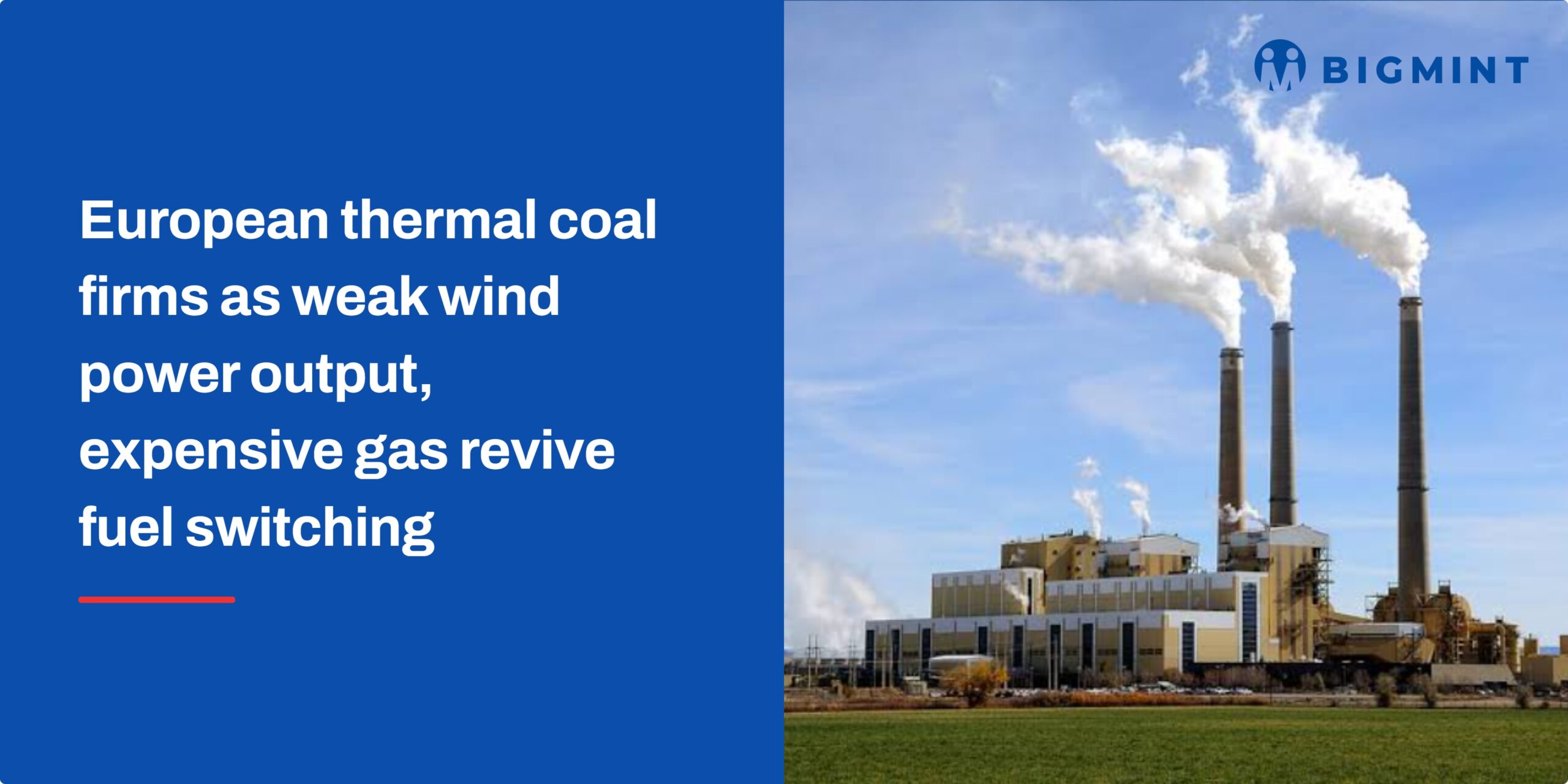
European and Atlantic thermal coal prices have strengthened in the last few days as geopolitical risks kept gas and oil markets elevated, while weak wind generation increased coal and lignite use across parts of Europe.
A broad surge in physical coal procurement did not drive the move. Instead, it reflected stronger power-market economics and renewed recognition of coal’s value as a dispatchable alternative when renewable generation falls or gas supplies become more expensive and uncertain.
The CIF Amsterdam-Rotterdam-Antwerp (ARA) 6,000 kcal/kg NAR benchmark rose to $119.95/t on 22 July, up $1.5/t from 20 July. The European Blended Price increased more sharply by $3.25/t to $115.4/t, narrowing its discount to CIF ARA from $6.3/t to $4.55/t. Atlantic-origin prices also strengthened, with Richards Bay, Baltimore, and New Orleans assessments moving higher.

ARA gains despite selective physical demand
The improvement in CIF ARA indicates that European coal values were responding to stronger energy-complex fundamentals, although physical liquidity remained relatively thin.
On 20 July, an August non-Russian CIF ARA cargo was offered at $118.5/t against a bid of $110.5/t, while September buying interest was heard at $120.25/t. By 22 July, an August offer was reported at $120/t and a September bid at $124.5/t.
The stronger September interest suggests that buyers were placing a premium on forward availability and energy-security protection rather than competing aggressively for prompt cargoes. The faster rise in the European Blended Price also showed the broader basket of coal available to European consumers catching up with the premium ARA benchmark.
Weak wind restores coal’s dispatch value
European power-market conditions provided the strongest immediate support.
German day-ahead electricity prices averaged EUR 119.06/MWh ($ 136/MWh) in the week ended 19 July, rising 21% w-o-w and 34% y-o-y. Day-ahead gas prices increased by 14% to an average of EUR 54.506/MWh ($ 62/MWh).
At the same time, German wind generation plunged by more than 60% to 7.7 GW. Coal-fired output rose 39% to 3.2 GW, while lignite generation increased 30% to 8.2 GW. Renewables’ share of the power mix consequently fell by eight percentage points to 68.1%.
Poland showed a similar pattern. Despite record solar generation in June, weak wind lifted coal and lignite’s combined share of generation to 58.5%, seven percentage points higher y-o-y. Hard-coal generation increased 24.5%, lignite output rose 19.5%, and wind generation fell 52.4%, while electricity demand grew 4.9%.
The German and Polish data underline coal’s increasingly flexible role in European power generation. Solar additions can reduce daytime thermal generation, but they do not eliminate the need for coal and lignite when wind output weakens or demand remains elevated outside peak solar hours.
Heat raises demand risk, but weather remains volatile
Temperatures in Germany were around 2°C above historical norms on 16 July, supporting cooling demand, although forecasts pointed to a subsequent fall below the seasonal average.
A sustained European heatwave could increase electricity consumption while creating additional operational pressure on thermal plants and inland fuel logistics. However, rapidly changing weather conditions mean heat is currently more of an upside risk than evidence of a sustained rise in coal demand.
Gas prices revive fuel-switching potential
Gas remains the most important external support for European coal.
On 20 July, UK NBP month-ahead gas stood at 141.18 pence/therm, while year-ahead Dutch Title Transfer Facility (TTF) gas was assessed at EUR 42.13/MWh ($ 48/MWh). Brent month-ahead was at $87.84/barrel and front-December European carbon allowances at EUR 83.13/t ($ 95/t). The CIF ARA year-ahead coal contract stood at $123.25/t.
High carbon prices continue to disadvantage coal relative to gas because coal-fired generation produces more emissions.
The same mechanism is visible in other import-dependent power markets. Rising gas prices and geopolitical uncertainty have encouraged utilities in Japan and South Korea to increase coal-fired generation, demonstrating how quickly fuel-switching economics can change when gas becomes expensive or less secure.
Geopolitics reinforces coal’s security value
Middle East tensions and uncertainty surrounding international LNG flows have increased the strategic importance of alternative fuels.
Even without an immediate shortage of coal, uncertainty surrounding LNG shipping routes increases the value of diversified Atlantic supply and coal inventories. Utilities may therefore be willing to maintain a degree of forward coal coverage as protection against further gas-market volatility.
Atlantic suppliers gain pricing support
The wider Atlantic supply complex strengthened during the period.
FOB Colombia 6,000 NAR rose by $3.25/t w-o-w to $94.5/t, while the 75,000-t Mediterranean delivered assessment increased by $5/t to $118/t. The stronger movement in larger cargoes indicates firmer support for mainstream utility-sized shipments.
FOB Richards Bay 5,500 NAR increased to $88/t on 22 July from $87/t on 20 July, with an August trade indication reported at $89/t. Over the same period, FOB Baltimore increased by $2.50/t and FOB New Orleans rose by $3.5/t.
Freight into Europe remained broadly stable. US East Coast-Rotterdam Panamax freight held at $19.75/t, Mobile-Rotterdam remained at $24.75/t, and Bolivar-Rotterdam increased only marginally from $18.2/t to $18.4/t.
The rise in delivered European coal prices, therefore, appears to have been driven primarily by firmer underlying commodity values rather than a sharp escalation in freight.
Outlook
European thermal coal prices are likely to remain supported but volatile. Near-term direction will therefore depend on the interaction between European wind generation, heat-related electricity demand, TTF gas prices, and geopolitical risks to LNG supply.
Coal’s structural share in European power generation may be declining, but its marginal value rises quickly whenever renewable output weakens and gas becomes more expensive or less secure.

Leave a Reply