- LME Prices remain above US$13,000/t despite a 221,000 t refined surplus
- Falling mine output, collapsing TC/RCs shift pricing power upstream from smelters to miners
- Recycling, refining expansion, feedstock security shift focus on mine production
For decades, copper has earned the nickname “Dr. Copper” for its ability to reflect the health of the global economy. Weak industrial activity has traditionally resulted in softer demand, rising inventories and lower prices, while stronger growth has tightened supplies and lifted prices. The first five months of 2026 have broken that relationship.
According to the International Copper Study Group (ICSG), the global refined copper market recorded a preliminary surplus of 221,000 tonnes (t) during January-May 2026, nearly double the 117,000 t surplus reported during the corresponding period of 2025. Combined inventories across the London Metal Exchange (LME), COMEX and Shanghai Futures Exchange (SHFE) climbed to 1.1 million tonnes (mnt) by the end of June, their highest level since 2003. Under normal market conditions, a widening surplus and rising inventories would weigh on prices. Instead, copper has remained comfortably above US$13,000/t.
The contradiction reflects a market where refined metal and raw material availability are moving in opposite directions. While exchange inventories have increased, copper concentrate supply has tightened, treatment and refining charges (TC/RCs) have fallen to historically low levels and demand from electrification, grid expansion and power infrastructure has continued to support physical consumption.
Mine supply emerges as the weakest link
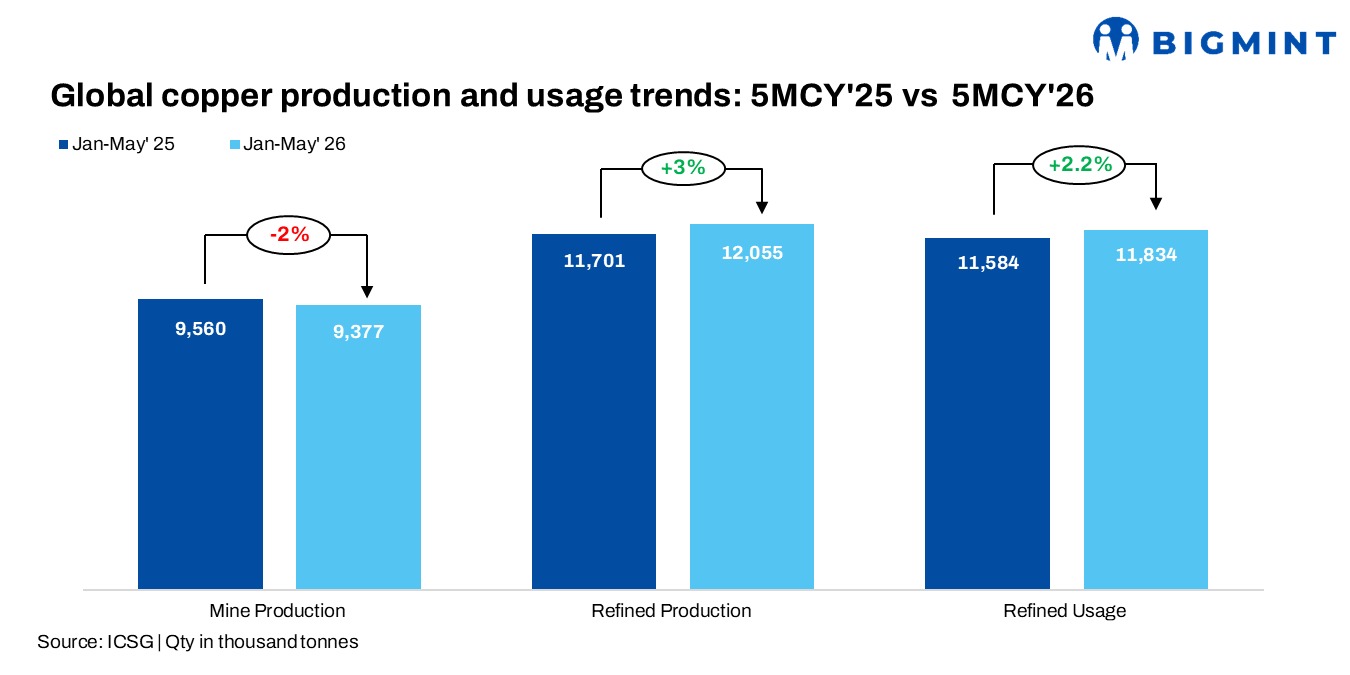
Preliminary ICSG data shows global mine production declined 2% year on year (Y-o-Y) during January-May 2026 to 9.4 mnt, despite global mine capacity increasing to 12.25 mnt over the same period. Consequently, mine capacity utilisation fell to 76.6%, down from 81.0% a year earlier, highlighting the widening gap between installed capacity and actual production.
The figures suggest the industry’s challenge is no longer expanding capacity, but converting that capacity into consistent output. Declining ore grades, operational disruptions, maintenance, permitting delays and increasingly complex mining conditions have collectively constrained production across several major producing regions, according to market sources.
The slowdown has been broad-based rather than concentrated in a single producer. Chile, which accounts for an estimated 23% of global mine production, saw output fall 8.8% owing to weaker production at El Teniente, Escondida, Los Pelambres and Spence, reducing concentrate production by 10.7%.
The Democratic Republic of Congo (DRC), representing around 11% of global mine production, illustrates how headline output can obscure tightening concentrate availability. Overall production remained broadly unchanged, as a 7.2% increase in SX-EW output offset a 31% decline in concentrate production following the seismic disruption at the Kamoa mine in 2025. While total mine production appeared stable, less concentrate was available to feed the global smelting industry.
The tightening concentrate market has pushed TC/RCs to exceptionally low levels, signalling intense competition among smelters for limited feedstock. Under normal conditions, abundant concentrate supply raises treatment charges as miners compete for refining capacity. Today, the opposite is true. Smelting capacity has expanded faster than mine production, forcing refiners to accept sharply lower margins to secure raw material.
Despite deteriorating processing economics, smelters have continued operating. Industry estimates suggest integrated operations, long-term concentrate contracts and revenues from sulphuric acid and precious metal by-products have helped offset weaker treatment charges, while newly commissioned plants have prioritised maintaining utilisation over short-term profitability. As a result, refining capacity has continued expanding even as concentrate availability has tightened.
The divergence explains why refined copper can accumulate in exchange warehouses while the upstream market remains constrained. The industry’s bottleneck has shifted from refining capacity to concentrate supply, making mine production, rather than refining, the defining constraint on the global copper market.
LME price trend

Beyond mining: Refining adapts as recycling gains strategic importance
While mine production has weakened, the refining sector has continued to expand. Global refined copper production increased 3% (Y-o-Y) during January-May 2026 to 12 mnt, supported by a 2.5% increase in primary refined production and a stronger 5.5% rise in secondary refined output. Rather than relying solely on freshly mined concentrate, refiners are increasingly supplementing feedstock with recycled material, allowing refined production to grow despite tighter mine supply. The result is a market where refined metal remains available even as competition for concentrates intensifies.
That shift is evident in the treatment and refining charge market. Benchmark TC/RCs have fallen sharply over the past year, with spot charges in some instances turning negative, reflecting severe concentrate scarcity rather than weak refining demand. The traditional relationship has reversed. Instead of miners competing for smelting capacity, smelters are competing aggressively for limited concentrate, giving miners greater bargaining power over available feedstock.
Yet refining capacity has not contracted. Integrated operations, long-term concentrate contracts and revenues from sulphuric acid and precious metal by-products have allowed many smelters to absorb lower treatment charges, while recently commissioned facilities have prioritised maintaining utilisation and securing long-term concentrate relationships over short-term profitability. The result is a refining industry that continues expanding despite increasingly constrained raw material availability.
Recycled copper moves into the mainstream
Recycled copper is becoming a structural source of supply rather than a cyclical supplement. Global secondary refined copper production increased from 4.15 mnt in 2022 to 5.35 mnt in 2025, a cumulative increase of almost 29%. During January-May 2026, secondary production reached 2.14 mnt, rising 5.5% (Y-o-Y), more than double the growth recorded by primary refined production. Consequently, secondary copper’s share of global refined output increased from 16.4% in 2022 to 18.6% in 2025, before settling at 17.8% during the first five months of 2026.
The trend reflects more than environmental considerations. Producing copper from recycled material requires significantly less energy than processing primary ore while reducing emissions, making scrap increasingly attractive as governments pursue decarbonisation and manufacturers seek lower-carbon supply chains. High copper prices have also improved the economics of scrap collection, while concerns over resource security are encouraging countries to view recyclable copper as a strategic domestic resource.
Although recycled metal cannot fully replace primary mine supply, particularly in rapidly growing economies where demand exceeds available scrap, it is becoming an increasingly important means of easing pressure on concentrate markets. Future supply growth is therefore likely to depend as much on improving copper recovery and recycling as on developing new mines.
Refining power shifts east
The divergence between mining and refining is also reshaping the geography of copper production. China and the Democratic Republic of Congo (DRC), which together account for nearly 58% of global refined copper production, increased combined output by 6.3% during January-May 2026, with China’s refined production rising 6% and the DRC’s increasing 7%.
The shift highlights an increasingly concentrated refining industry. While copper deposits remain geographically dispersed, refining capacity is consolidating in countries able to secure concentrate supplies, invest in large-scale processing infrastructure and integrate refining with downstream manufacturing. For consuming nations, securing refined metal alone is no longer sufficient. Access to concentrates and recyclable feedstock is becoming equally important.
India reflects both the opportunity and the challenge. Domestic producers manufactured 223,000 t of refined copper cathodes during January-April 2026, an 8% increase from 207,300 t a year earlier, supported by higher utilisation and new smelting capacity. Much of the increase came from Adani Group’s Kutch Copper Ltd., which produced 31,000 t compared with 2,300 t during the corresponding period of 2025, as its newly commissioned smelter continued ramping up production.
India’s expanding refining capacity strengthens its position in the global copper value chain, but it also increases dependence on reliable concentrate supplies. As competition for feedstock intensifies, securing long-term access to raw materials may prove as important as building additional smelting capacity.
A surplus unlike previous cycles
Previous copper surpluses have typically reflected weak demand, rising inventories and falling prices. The current cycle presents a different picture. Demand from electrification, renewable energy, transmission infrastructure, electric vehicles, battery storage and the rapid expansion of data centres continues to support long-term copper consumption.
At the same time, mine supply has struggled to keep pace with refining capacity, recycled metal has become an increasingly important source of feedstock and concentrate scarcity has emerged as the principal constraint across the value chain. Headline refined balances therefore mask a deeper structural shift.
The defining question for the copper industry is no longer whether sufficient refining capacity exists, but whether enough raw material can be secured to keep that capacity operating. The first five months of 2026 may therefore be remembered less for recording a 221,000 t refined surplus than for marking a turning point in the industry’s supply dynamics.
Leave a Reply