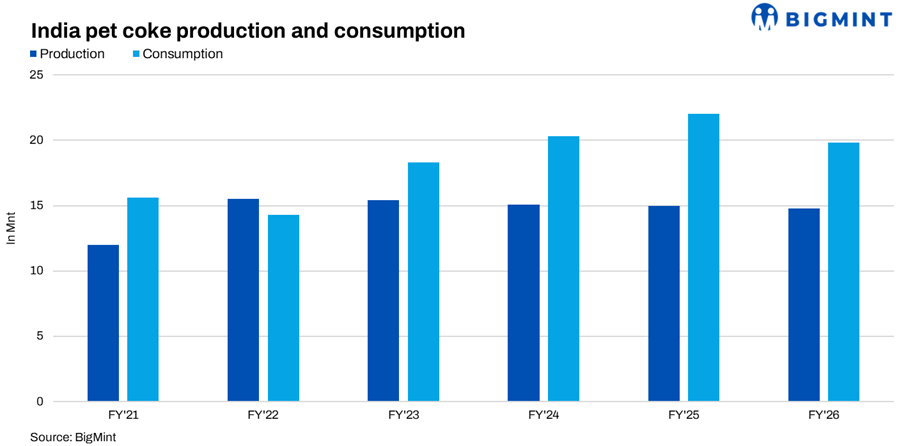
- Domestic petcoke output rises more than five-fold since FY’11
- Consumption yet to recover to FY’18 peak amid regulatory curbs
India’s petcoke industry has undergone a significant structural transformation over the past decade, driven by refinery capacity expansions and the commissioning of delayed coker units (DCUs). While domestic production has increased steadily and remained close to record levels in FY’26, consumption has yet to recover to its historic peak as regulatory restrictions and changing industrial fuel dynamics continue to influence demand.
Production expands on refinery capacity additions
Domestic petcoke production increased from 2.8 mnt in FY’11 to 14.8 mnt in FY’26, reflecting more than a five-fold increase over the period. Output was supported by the commissioning of new refineries equipped with delayed coker units, particularly at Bathinda and Paradip, along with capacity expansions at existing refineries.
Production reached an all-time high of 15.5 mnt in FY’22, following a strong post-pandemic recovery. During FY’21, output had declined nearly 18% to 12.04 mnt due to nationwide COVID-19 restrictions that disrupted refinery operations. The subsequent recovery enabled production to surpass pre-pandemic levels before moderating slightly in the past two financial years.
Despite the increase in volumes, petcoke continues to account for only a small share of India’s overall petroleum product output. Its contribution rose from 1.4% in FY’11 to a peak of around 6.1% in FY’22, before easing to nearly 5.2% in FY’26, reflecting refiners’ continued focus on optimising higher-value petroleum products.
Regulatory changes reshape consumption
Petcoke consumption has followed a different trajectory. Domestic demand increased sharply from just 0.4 mnt in FY’01 to a record 25.7 mnt in FY’18, supported by rising cement sector demand, greater domestic availability, and increasing imports.
However, the market underwent a structural shift after regulatory restrictions on petcoke imports and usage were introduced from late 2017. While limited relaxations were subsequently granted for industries such as cement, aluminium, lime kilns, carbide, and gasification, consumption never returned to earlier highs.
The COVID-19 pandemic further weakened industrial fuel demand, reducing consumption to 15.6 mnt in FY’21. Demand recovered gradually over the following years before easing again to 19.8 mnt in FY’26, remaining well below the FY’18 peak.
Market implications
The divergence between production and consumption highlights the structural evolution of India’s petcoke market. While refinery investments have significantly strengthened domestic supply, consumption growth has been constrained by environmental regulations governing petcoke usage and imports.
The cement industry continues to remain the largest consumer, while demand from other permitted sectors has supported a gradual recovery in recent years. Going forward, domestic petcoke production is expected to remain linked to refinery operating rates, crude processing and product mix optimisation, whereas consumption will continue to depend on industrial fuel demand and the prevailing regulatory framework governing petcoke use.

Leave a Reply