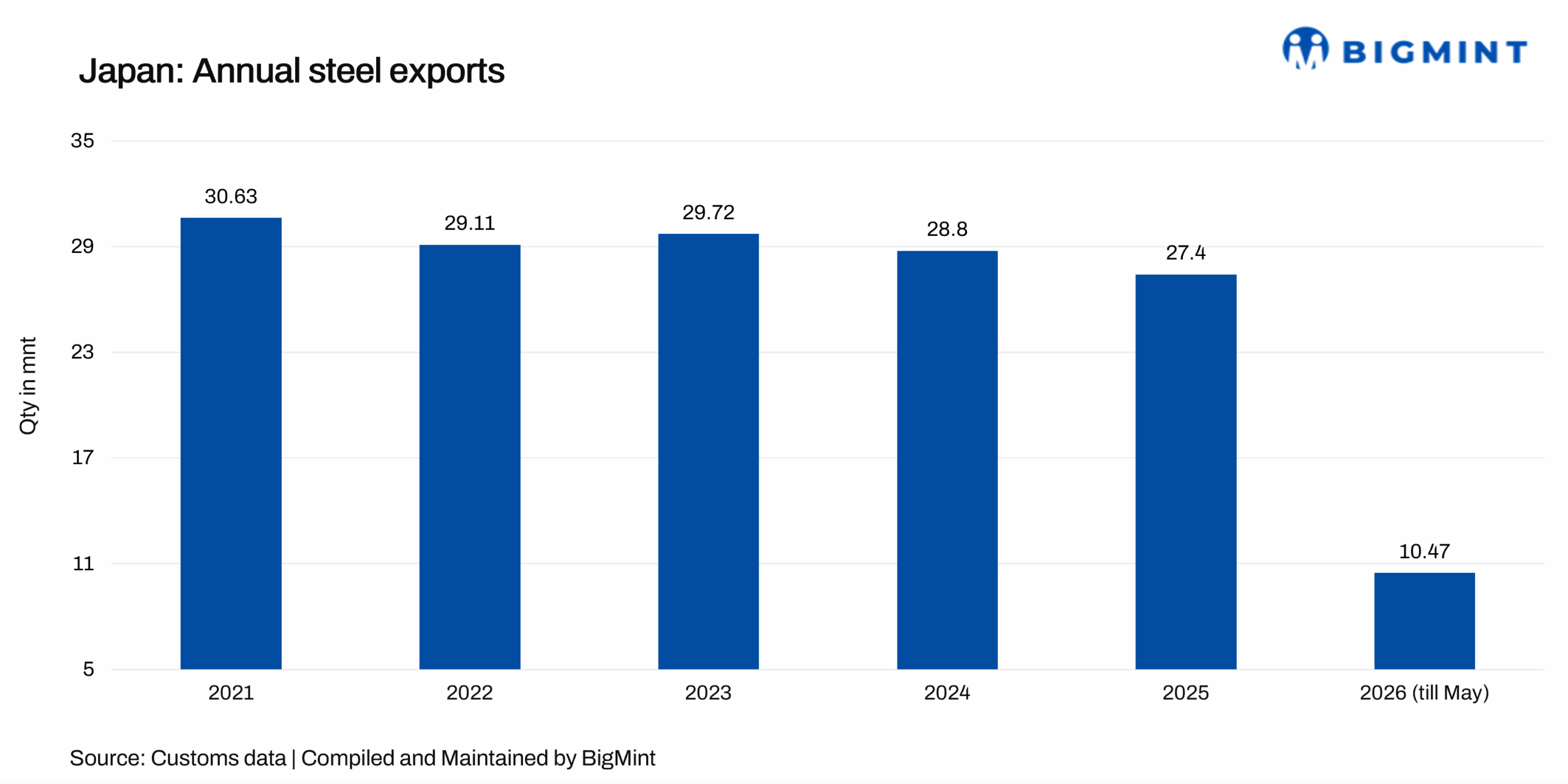
- Exports fall 7% in H1CY’26 amid intensifying trade measures
- Chinese competition shrinks Japan’s export opportunities globally
Japan’s steel exports are expected to fall below 30 million tonnes (mnt) in CY’26, marking the first below-30 mnt annual total in 26 years, as expanding trade measures and intensifying competition from Chinese steel limit overseas opportunities. The decline comes despite the yen weakening to JPY 163 against the dollar on 21 July 2026, a level not seen since 1986.
Japan’s steel exports totalled 14.07 mnt during January-June 2026, down 6.9% y-o-y, according to data announced by the Ministry of Finance on 22 July. This was the lowest first-half export volume since 13.59 mnt in 2009, immediately after the Lehman Shock.
The current market environment differs from 2009, when China’s economic expansion supported a sharp recovery in Japan’s exports during the second half of the year, lifting the annual total to 34.15 mnt. This time, Chinese steelmakers facing weak domestic demand are increasing exports, intensifying competition, and contributing to growing trade frictions.
Trade measures are also expanding across global markets. According to the Japan Iron and Steel Federation, 19 new anti-dumping investigations into steel products had been launched worldwide as of 21 July 2026. The figure is expected to surpass the 31 cases recorded last year, following a record 41 cases in 2024.
India has also initiated anti-dumping investigations involving Japanese hot-rolled steel sheets and grain-oriented electrical steel sheets. In addition, the European Union introduced an additional 50% tariff on steel imports from July, while reducing the duty-free allowance under its previous safeguard measures. The changes are expected to have a sustained impact on steel exports to Europe.
The global steel market is increasingly becoming divided into regional blocs, with countries adopting measures to protect domestic industries. As export destinations narrow, competition is intensifying in markets that remain accessible.
Indian companies that have traditionally targeted Europe are increasing sales efforts in Southeast Asia and Latin America. Chinese steelmakers are also establishing bases in Southeast Asia and Central America to expand sales, increasing competition for Japanese exporters.

The export decline highlights the growing difficulty of leveraging currency competitiveness alone. Despite the yen’s historic depreciation, the global steel market is increasingly shaped by local production, regional supply chains, trade barriers, and competition from Chinese materials. Against this backdrop, annual Japanese steel exports below 30 mnt could become a new benchmark for the country’s export market.
Note: This article is published as part of a content exchange agreement between Japan Metal Daily and BigMint.
Leave a Reply