- Indonesian prices drop by $6/t w-o-w, domestic prices remain stable
- Lower coking coal prices, weaker Chinese sentiment exert pressure
India’s imported met coke market remained largely inactive despite increasingly competitive overseas offers. Persistent uncertainty surrounding the government’s decision on extending the anti-dumping duty discouraged fresh bookings, with most consumers preferring to delay purchases until policy clarity emerges.
BigMint assessed Indonesian-origin BF-grade metallurgical coke (65/63 CSR) down by $6/t w-o-w to $312/t CFR India, pressured by weak spot trading activity, muted steel demand, and continued policy uncertainty surrounding the extension of the anti-dumping duty.
Market participants indicated that Indonesian suppliers have largely allocated August cargoes and are expected to announce September offers by the end of July. Although Indonesian FOB offers have softened to around $275-285/t, expectations of further declines in coking coal prices could exert additional downward pressure on export coke prices in the coming weeks.
Policy uncertainty, sluggish demand keep domestic prices stable
India’s met coke market remained largely stable during the assessment week ended 23 July 2026, as subdued domestic steel demand, muted spot transactions, and continued uncertainty over the extension of the anti-dumping duty on imported metallurgical coke kept both buyers and sellers on the sidelines.
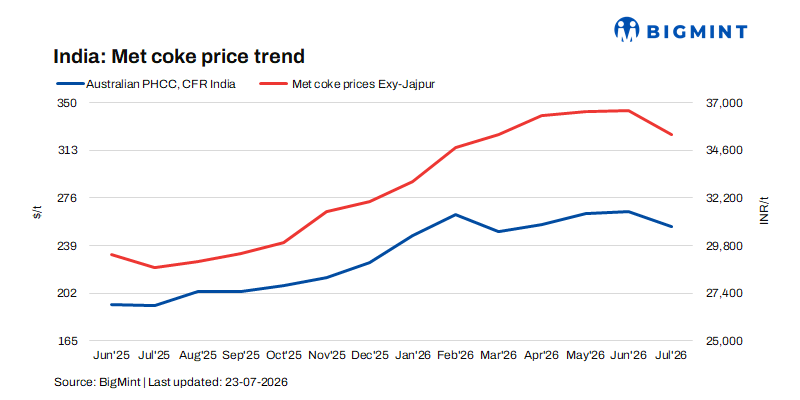
Domestic BF-grade metallurgical coke prices remained unchanged across key markets, with eastern India holding at INR 35,150/t ex-Jajpur and western India at INR 34,000/t ex-Gandhidham. Foundry-grade coke also remained stable at around INR 36,400/t ex-Rajkot, supported by relatively resilient demand from foundry units.
Market participants noted that steelmakers continued to procure only for immediate requirements amid weak finished steel demand, resulting in limited spot activity and stable price levels.
While lower coking coal prices eased production costs, limited purchasing interest and cautious market sentiment prevented any significant movement in domestic coke prices.
Declining coking coal prices reduce cost support
Australian premium hard coking coal (PHCC) prices declined by $7/t w-o-w to $222/t FOB, easing input costs for coke producers. However, the decline in raw material prices has not yet translated into lower domestic coke prices, as producers continued to balance softer production costs against subdued demand and cautious inventory management.
China’s weaker coke market weighs on global sentiment
China’s coking coal and coke markets remained under pressure during the week, with the first round of coke price reductions of RMB 50-55/t ($7-8/t) taking effect amid weak steel demand and shrinking mill margins. Although Shanxi’s proposed stricter mine safety regulations could tighten coking coal supply, improving mine production and cautious procurement by steel mills continued to weigh on market sentiment. The softer Chinese market has further reinforced bearish expectations across the international coke trade.
Pig iron auctions reflect mixed domestic demand
India’s steel-grade pig iron market continued to display mixed demand trends. Spot prices in Durgapur eased marginally by around INR 100/t w-o-w to INR 37,700/t ex-works, reflecting cautious buying during the monsoon season.
Outlook
BigMint expects India’s met coke market to remain stable to slightly weak in the near term. Continued uncertainty over the extension of the anti-dumping duty, subdued steel sector demand, and the seasonal slowdown during the monsoon are likely to keep spot transactions limited.
Lower international coking coal prices and weakening Chinese coke sentiment may exert further pressure on imported coke offers, although limited near-term cargo availability from Indonesia could prevent a sharp decline. Domestically, prices are expected to remain largely stable until policy clarity on the anti-dumping duty emerges and steel demand improves after the monsoon season.

Leave a Reply