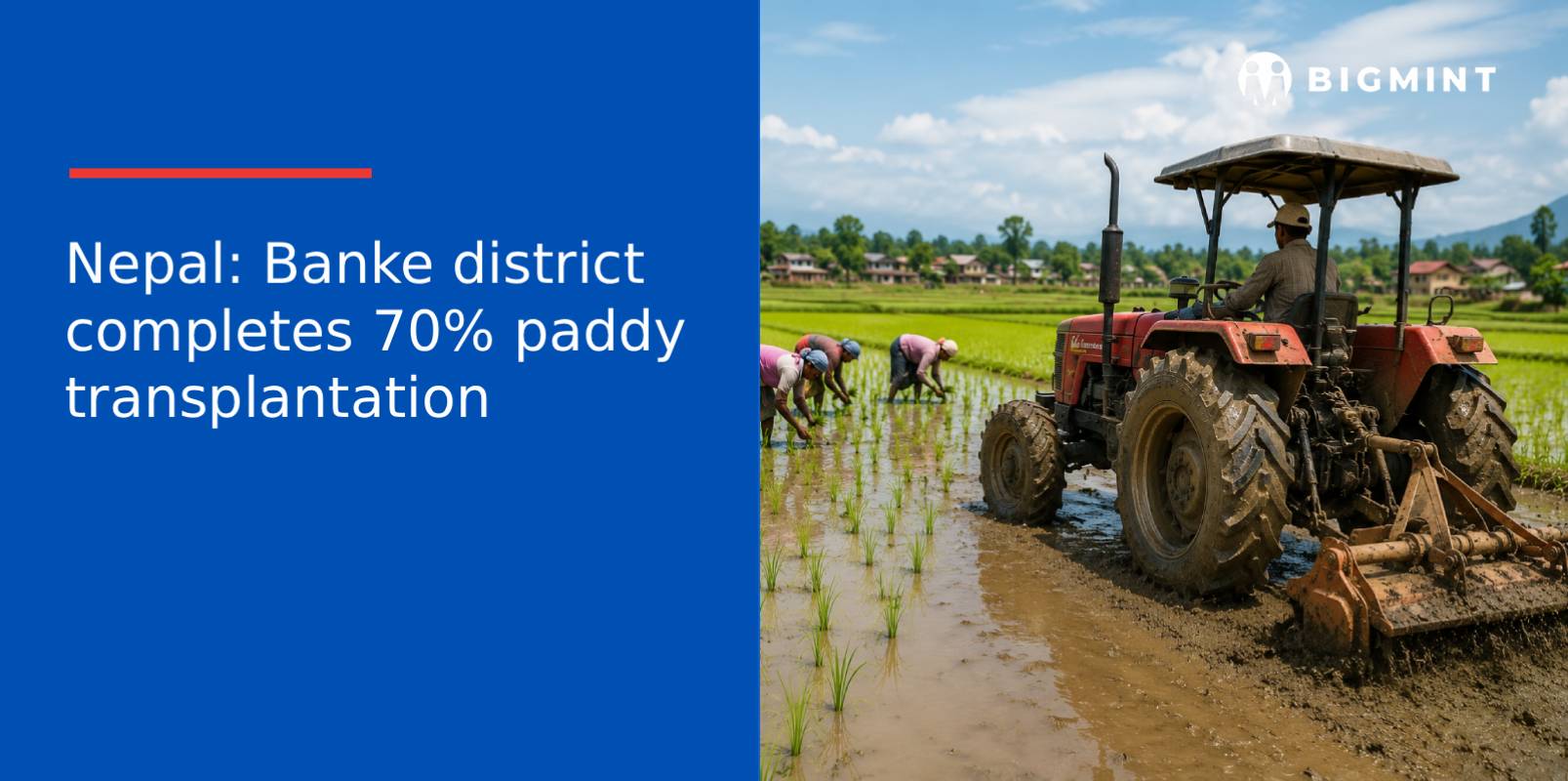
- Banke produces around 150,000 tonnes of paddy annually, depending on seasonal weather conditions.
- Mechanisation accelerates as tractors replace traditional oxen ploughing.
Nepal’s Banke district has seen around 70% of paddy transplantation completed this season. Most irrigated areas have finished transplantation, while planting continues in rain-fed regions as farmers await adequate rainfall.
Banke has 55,826 ha of cultivable land, of which 33,780 ha are dedicated to paddy cultivation. The district produces around 150,000 tonnes (t) of paddy annually, depending on seasonal weather and planting conditions. As of mid-July, more than 20,268 ha have already been planted with rice, indicating steady progress in the district’s kharif cropping season.
Farmers in Nepal’s Banke district are increasingly replacing traditional oxen ploughing with tractors and power tillers, reflecting a growing shift toward agricultural mechanisation that is accelerating land preparation during the ongoing paddy planting season. Government subsidy programmes have supported this transition through the distribution of agricultural machinery, helping farmers complete field operations more efficiently.
With 70% of paddy transplantation already completed, Banke remains on track for a stable rice crop. The increasing adoption of mechanised farming in Banke is expected to support timely paddy transplantation, improve field efficiency, and reduce reliance on traditional draft animals. However, the district’s rice production will continue to depend on favourable monsoon conditions and effective crop management during the growing season.
Relevance of Banke in Nepal’s rice production
Banke, located in Nepal’s western Terai region, is one of the country’s important paddy-producing districts, contributing approximately 2.5–3.0% of Nepal’s total paddy production. The district’s fertile alluvial soils, favorable agro-climatic conditions and extensive irrigated farmland support large-scale paddy cultivation, making it a key contributor to Nepal’s rice output and an important production hub in Lumbini Province. Banke is estimated to produce over 150,000 tonnes of paddy annually, reinforcing its role in the country’s rice supply.
Key Production Factors: Rice production in both Banke and Nepal is primarily influenced by the performance and distribution of the southwest monsoon, irrigation availability, timely transplanting, and access to fertilisers and quality seeds. Crop yields also depend on the area under paddy cultivation, while adverse weather events such as droughts, floods and erratic rainfall, along with pest and disease pressure, remain key risks to production throughout the growing season.
Outlook
Banke’s paddy production is expected to remain stable to slightly higher in 2026, supported by improved rainfall following an initially dry spell that has accelerated transplanting and aided crop establishment. However, final district output will depend on monsoon rainfall distribution, irrigation availability and pest incidence. At the national level, Nepal’s paddy production is projected at around 5.7–5.8 million tonnes, slightly below the previous year’s harvest due to drought during the transplanting period in several key Terai districts that affected both planted area and yields. Going forward, the overall production outlook will largely depend on monsoon performance, input availability and weather conditions during the remainder of the crop season.
Leave a Reply