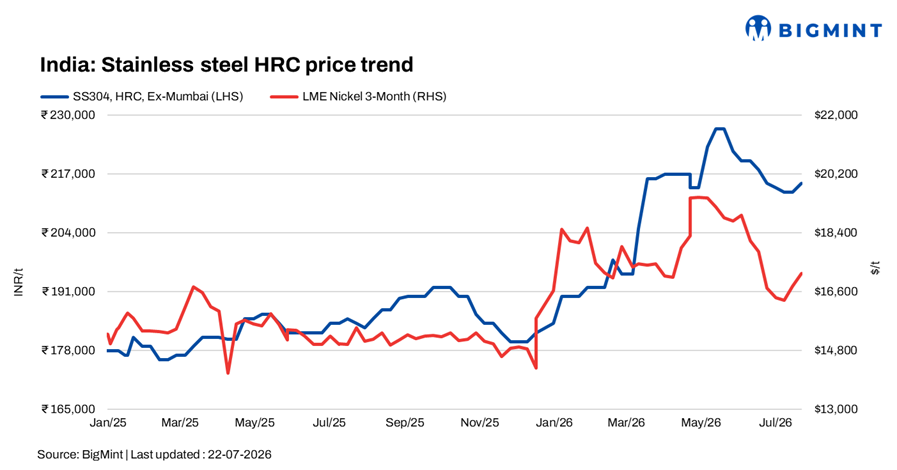
- Higher nickel, molybdenum, scrap costs lift flats prices
- Weak exports continue to weigh on finished longs prices
Indian stainless steel prices showed mixed trends w-o-w in the assessment week ended 22 July 2026, with flats prices rising on higher raw material costs and a stronger dollar. However, longs prices fell w-o-w as demand remained subdued.
A leading Indian stainless-steel producer increased domestic prices of hot-rolled (HR) and cold-rolled (CR) coils, effective 22 July, amid a sustained rise in production costs. The mill raised list prices of 304-grade coils by INR 2,000/t and 316-grade coils by INR 3,000/t. Rising nickel, molybdenum and stainless-steel scrap prices, along with the appreciation of the US dollar against the Indian rupee, pushed up replacement costs. As India remains a net importer of key stainless steel raw materials, the stronger dollar further inflated landed costs and reinforced mills’ pricing power.

Following the revision, the spot market moved in tandem. BigMint’s benchmark assessment for 304 HR coils increased by INR 2,000/t w-o-w to INR 213,000/t exw-Mumbai, while 316 HR coils registered a sharper increase of INR 7,000/t to INR 402,000/t exw-Mumbai. Market participants attributed the stronger-than-list-price increase in 316 to tighter availability, significantly higher molybdenum costs, and improved buying interest.
Trade activity improved during the week as buyers resumed purchases after mills maintained tight material allocations, creating temporary shortages in the spot market. Expectations of further increases in nickel prices and continued volatility in the rupee also encouraged advance bookings.
A buyer said, “There is slight improvement in the market since last week. Nickel is firm, molybdenum is rising, and the dollar is also strong, which have supported stainless steel prices.”
Import offers remain firm
Imported offers continued to move higher, supported by elevated replacement costs and the stronger dollar. Market participants reported indicative offers for 304 HR coils at $2,025-2,050/t CFR India, 304 CR coils around $2,100/t CFR, and 316 HR coils at $4,025-4,040/t CFR. A few import bookings were concluded despite higher offers, reflecting expectations of further price increases.
Long products fail to participate in rally
Unlike flat products, the finished longs market remained under pressure. Domestic demand was subdued, while exports continued to struggle amid currency volatility, geopolitical tensions, and uncertainty surrounding carbon-related regulations and safeguard quota mechanisms in overseas markets.
Reflecting weaker demand fundamentals, BigMint’s benchmark assessment for 304 black bars declined by INR 1,000/t w-o-w to INR 185,000/t exw-Mumbai. Prices of 304 bright bars fell by INR 3,000/t to INR 210,000/t exw-Mumbai.
Export activity remained sluggish, with market participants reporting almost no fresh sales to the Middle East because of ongoing regional tensions. Offers for 304 bright bars remained unchanged at $2,300/t FOB Nhava Sheva, while 316 bright bar offers increased by $100/t to $4,100/t FOB, supported by higher molybdenum costs.
Global market
International raw material trends remained mixed. China’s nickel pig iron (NPI) market softened during the week as stainless steel production cuts and weak downstream demand reduced spot buying. However, prices were supported by limited spot availability and delayed Indonesian shipments.
Chinese stainless steel mills continued to purchase cautiously after lower-priced NPI tenders earlier this month dampened market sentiment. Although nickel ore prices in Indonesia eased during July, producers remained reluctant to lower NPI offers because of elevated production costs and limited inventories. Market participants noted that delayed cargo arrivals and tight port stocks continued to support NPI prices despite weaker stainless steel demand.
The mixed global raw material environment suggests that while cost pressures may ease marginally, they remain elevated enough to support stainless steel pricing.
Outlook
India’s stainless steel flat products market is expected to remain firm over the next few weeks, supported by higher alloy costs, a stronger US dollar, improving spot buying and continued volatility in nickel prices. However, the recovery is likely to remain concentrated in flat products, while the longs segment may continue to face headwinds until export demand improves and overseas trade uncertainties begin to ease.
Leave a Reply