- India accelerates transition toward circular non-ferrous economy
- Duty reform targets downstream manufacturing competitiveness
India’s non-ferrous metals sector covering aluminium, copper, zinc, and lead is at a defining moment. As the country advances toward its Viksit Bharat 2047 vision, recycling is emerging as a critical pillar for supply security, cost efficiency, resource efficiency, and decarbonisation. While policy momentum is strengthening, structural gaps across scrap visibility, infrastructure, formalisation, and import dependence continue to limit the sector’s full potential.
EPR rollout to formalise scrap flows and improve traceability
The rollout of Extended Producer Responsibility (EPR) under the Hazardous and Other Wastes Second Amendment Rules, 2024, effective April 2025, marks a major regulatory shift. Producers are now required to register with the Central Pollution Control Board and ensure collection and recycling of end-of-life products.
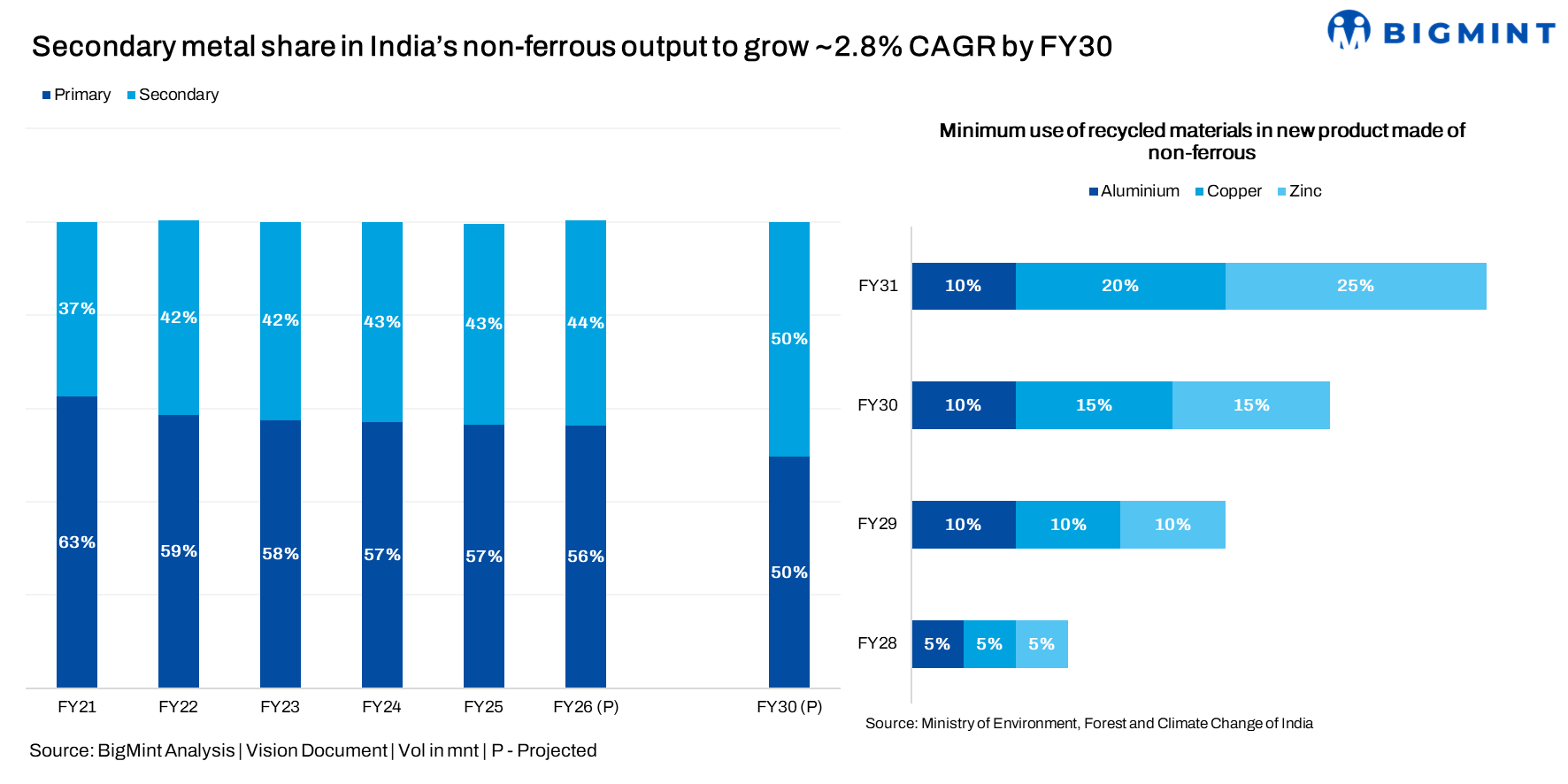
To accelerate circularity, the government has introduced minimum recycled content mandates of 5% by FY28 and 10% by FY29. By FY31, the targets rise to 10% for aluminium, 20% for copper, and 25% for zinc.
However, industry participants believe India may already be operating above these thresholds in practice. Estimated minimum recycled content usage is currently pegged at around 35-40% for copper and 25-30% each for aluminium and zinc. The key issue is that a large share of this recycling activity continues to operate through parallel and informal channels, preventing accurate reflection in official statistics.
According to industry feedback, the Government of India currently does not maintain comprehensive estimates of domestic scrap returning into the recycling stream, particularly from post-consumer channels. As a result, India’s actual recycling ecosystem remains significantly underrepresented.
These regulations are therefore expected not only to increase recycling rates, but also to formalise the fragmented scrap ecosystem, improve traceability, and attract investment into organised recycling infrastructure. In the near term, however, compliance costs are likely to increase, especially for MSMEs transitioning from informal operations into regulated systems.
Balancing primary and secondary metal supply

India’s policy direction is gradually shifting toward a more balanced mix between primary and secondary metals.
In copper, industry experts point out that prior to 1997, domestic demand was largely met through recycling, scrap imports, and secondary production, with limited primary output. Over time, primary production overtook secondary supply in official estimates, although stakeholders argue that domestic-generated scrap continues to circulate through informal and parallel operations that remain statistically invisible.
In aluminium, secondary demand has grown at a CAGR of around 10.7%, significantly outpacing primary demand growth. Over the long term, secondary aluminium could contribute nearly 50% of supply by 2070, supported by its 95% lower energy consumption and significantly lower emissions compared to primary production.
Copper presents a more complex transition. India currently depends on imports for over 90% of its copper concentrate requirements, exposing the industry to significant supply chain vulnerabilities. At the same time, secondary copper demand is projected to grow at a CAGR of 13-14%, reaching around 1.4 mnt by FY30, with policymakers targeting a 55% secondary share.
However, unlike mature recycling economies, India’s copper recycling sector remains dominated by direct melting, accounting for nearly 38% of supply. This often creates inconsistency in purity and product quality. Industry stakeholders, however, argue that India’s collection, sorting, and aggregation ecosystem is already highly efficient. Once scrap is properly segregated according to specifications, direct application in suitable alloy systems can often be more economically viable than expensive secondary refining.
For instance, copper scrap containing traces of aluminium may be more efficiently utilised in aluminium bronze applications rather than undergoing costly refining to produce pure secondary copper. This highlights the need for application-oriented recycling strategies rather than a one-size-fits-all refining approach.
Import dependence continues to expose structural vulnerabilities

A major challenge across non-ferrous metals remains India’s heavy dependence on imported scrap.
In aluminium, India continues to rely on imports for nearly 85-90% of its scrap requirements and emerged as one of the world’s largest scrap importers with around 2 mnt in FY26. In copper, India remained the third-largest global scrap importer, with imports estimated at around 0.41 mnt in FY26.
While tariff structures influence competitiveness, the larger issue remains structural dependence. In aluminium, the long-standing duty differential between scrap imports and primary metal imports continues to create friction between recyclers and primary producers.
In response, a working group under the Ministry of Mines has reportedly recommended abolishing the 2.5% basic customs duty (BCD) on aluminium scrap imports to address the inverted duty structure and improve the competitiveness of downstream manufacturers. The proposal, expected to be submitted to the Ministry of Finance soon, comes as India imports 1.6-1.8 mnt of aluminium scrap annually, with imports projected to rise to 1.9-2 mnt this fiscal amid growing demand for recycled aluminium and limited domestic scrap availability.
In copper, the removal of import duty on scrap in Budget FY26 is expected to support domestic manufacturing and recycling activity. At the same time, global supply risks are intensifying. The US and EU are increasingly considering scrap export restrictions, which could significantly tighten raw material availability for import-dependent economies such as India.
Policies such as Quality Control Orders (QCOs) are also reshaping trade flows by restricting low-quality imports and encouraging domestic value addition.
Taxation and cost competitiveness remain key concerns
Cost structures continue to challenge the competitiveness of India’s recycling industry.
Recyclers face inverted duty structures on machinery and processing equipment, limiting scalability and technology adoption. In copper, concerns have also been raised regarding the impact of customs duties on concentrates and raw materials.
Industry stakeholders, however, note that GST on concentrates functions largely as an input credit mechanism rather than a direct cost burden. Instead, customs duties are viewed as the more significant factor affecting international competitiveness.
The sector has therefore been pushing for targeted policy support, particularly through Production Linked Incentive (PLI) schemes for recycling and downstream industries. Such support is seen as critical given the capital-intensive nature of recycling infrastructure. For instance, establishing a 0.5 mnt copper recycling facility may require investments of nearly ₹10,000 crore.
At the same time, India’s existing levies such as coal cess and electricity duties are increasingly being viewed as implicit carbon pricing mechanisms, gradually aligning the domestic market with emerging global carbon frameworks.
Infrastructure gaps continue despite strong collection networks
Despite policy momentum, industry participants argue that India’s recycling ecosystem is not necessarily underdeveloped, but rather under-recognised.
India already possesses a highly active collection, sorting, and aggregation (CSA) ecosystem, ensuring that non-ferrous scrap rarely reaches landfills. The challenge lies in the fact that much of this activity occurs outside formal reporting systems, leaving the true scale of recycling absent from national statistics.
To improve efficiency and formalisation, industry stakeholders are advocating the development of recycling clusters closer to urban scrap-generation centres. Such clusters would improve logistics viability at the collection and aggregation stage while reducing transportation costs.
There is also a growing push to formally recognise and legalise existing urban mining ecosystems already operating across the country.
Technology adoption remains another priority. Stakeholders recommend creating shared infrastructure platforms within recycling clusters, allowing MSMEs to access advanced sorting and refining technologies through common facilities. Shared investments and online processing-slot models could significantly lower both capex and opex burdens for smaller recyclers while improving processing standards.
For copper specifically, experts have also proposed a “Green Fence” mechanism to restrict low-grade scrap imports and ensure only higher-quality material enters the domestic recycling stream.
Industry roadmap focuses on formalisation and resilience

To unlock the full potential of non-ferrous recycling, industry stakeholders have outlined several long-term priorities. These include a comprehensive National Non-Ferrous Scrap Recycling Policy, formalisation of informal recycling channels through EPR and GST-linked mechanisms, creation of dedicated institutions for standards and application development, and promotion of closed-loop recycling systems across automotive, electronics, and packaging sectors.
There is also increasing emphasis on retaining high-quality domestic scrap within India through appropriate export regulations and value-addition incentives.
Strong policy intent visible, but execution will determine outcomes
India’s push toward a circular non-ferrous economy is clearly gaining momentum. With demand rising across infrastructure, renewable energy, mobility, and manufacturing, recycling will become increasingly important in reducing import dependence, lowering emissions, and ensuring long-term supply security.
However, the transition remains incomplete. The next phase of growth will depend on how effectively India can formalise existing parallel operations, strengthen domestic processing infrastructure, improve traceability, and reduce vulnerability to global scrap trade disruptions.
The opportunity is substantial, but execution will remain the defining factor.
Can India build a globally competitive and self-sustaining non-ferrous recycling ecosystem in time to meet its long-term growth ambitions?
As India accelerates its transition toward a circular non-ferrous economy through policy reforms, recycling, and sustainable manufacturing, these critical industry developments will take centre stage at the Global Commodity Conclave (GCC) 2026, hosted by MCX with BigMint as the Event Partner, from 12-14 August 2026 at the Jio World Convention Centre, Mumbai. Powered by BigMint’s market intelligence and industry expertise, GCC 2026 will bring together policymakers, producers, recyclers, traders, downstream consumers, and global commodity leaders to discuss market trends, policy, technology, sustainability, business opportunities, and the future of India’s non-ferrous metals and recycling ecosystem.

Leave a Reply