- India integrating coal, renewables, and storage to ensure reliable energy transition
- Domestic coal expansion and import substitution remain central to energy security
A series of government policy announcements reveals a coordinated strategy to strengthen energy security while preparing the electricity system for a renewable-dominated future.
Over the past week, a series of parliamentary responses from the Ministries of Coal and Power has provided perhaps the clearest picture yet of how the government views the future of the country’s energy system. While each announcement addressed a specific subject — coal availability, pumped storage, coal production, coal gasification or import substitution — they collectively reveal a coherent long-term strategy rather than isolated policy initiatives.
The government’s objective is no longer simply to produce more coal or add more renewable energy. Instead, it is pursuing a three-pronged strategy centred on energy security, system flexibility and import substitution, while ensuring that India’s rapidly growing economy continues to receive reliable and affordable electricity.
The announcements also underscore an important reality often overlooked in the public debate: India’s energy transition is not being designed as a transition away from coal, but as a transition towards a more diversified, resilient and domestically anchored energy system.
Coal remains foundation of energy security
Despite record additions in renewable energy capacity, coal continues to dominate India’s electricity sector.
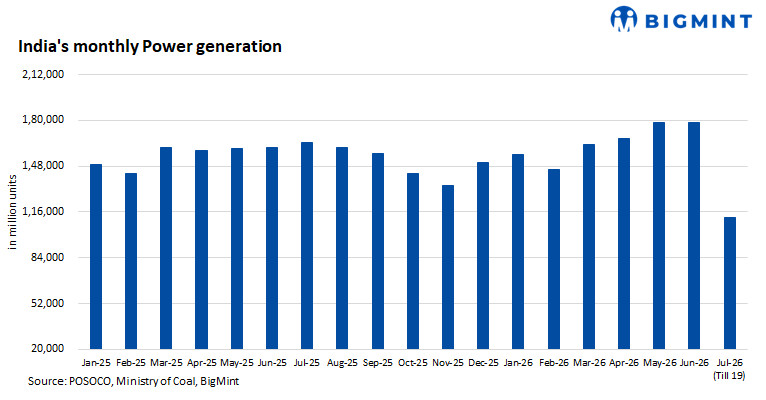
Government data show that coal and lignite account for 230.8 GW of installed capacity and supplied nearly 70% of India’s electricity during April-June 2026. More significantly, coal generated almost 75% of electricity during non-solar evening peak hours, when demand remains high but solar generation disappears.
This distinction is increasingly important.
Renewable energy is now meeting a growing share of daytime electricity demand, but thermal generation continues to provide the dependable capacity required to maintain grid stability after sunset, during prolonged cloudy weather and when wind output weakens.
Rather than reducing coal’s importance, India’s changing generation profile is altering how coal-fired power plants operate–from traditional baseload generators to flexible assets capable of balancing renewable variability.
The government’s continued investment in new thermal capacity and measures to ensure healthy coal inventories reflect this reality.
Domestic coal production becomes strategic imperative
Running alongside power sector policy is an equally strong emphasis on reducing dependence on imported coal.
The commercial coal mining programme, reforms to mine approvals, shorter project development timelines and greater flexibility for captive mine operators all point towards a single objective — expanding indigenous coal production.
The government’s strategy recognises that India possesses one of the world’s largest coal reserves and that greater domestic production not only improves energy security but also reduces exposure to volatile international markets, freight costs and geopolitical risks.
The revised SHAKTI policy, higher Annual Contracted Quantities (ACQ), CoalSETU, longer coking coal linkage tenures and the Coking Coal Mission all seek to maximise domestic utilisation wherever technically feasible.
While imports of premium metallurgical coal will remain unavoidable for the steel industry, policymakers clearly intend to minimise imports of substitutable thermal coal over the coming decade.
Coal being repositioned, not abandoned
Perhaps the most significant shift visible across the government’s announcements is the effort to redefine how coal is utilised.
Rather than relying almost exclusively on electricity generation, policymakers are increasingly promoting higher-value applications such as coal gasification, coal chemicals, methanol, fertilisers and synthetic natural gas.
The newly approved INR 37,500 crore coal gasification incentive scheme illustrates this strategic shift.
Instead of viewing coal merely as a fuel, the government increasingly sees it as an industrial feedstock capable of supporting broader manufacturing and chemical production while reducing dependence on imported natural gas and petrochemical products.
This diversification also provides an important long-term demand avenue for India’s domestic coal sector as renewable energy gradually captures a larger share of electricity generation.
Flexibility becomes defining feature of future grid
The government’s announcements on pumped storage projects are equally revealing.
With almost 24 GW of pumped storage projects either under construction or approved, India is laying the foundations for a much more flexible electricity system.
Unlike conventional thermal expansion, pumped storage investments are designed specifically to complement renewable energy.
During periods of surplus solar generation, these facilities store electricity by pumping water uphill. During evening demand peaks, they generate electricity almost instantaneously.
Combined with the rapidly growing deployment of Battery Energy Storage Systems (BESS), pumped storage allows coal-fired power stations to operate more efficiently while reducing the need for expensive peaking generation.
The revised Flexible Operation Regulations requiring coal plants to operate safely at lower technical minimum loads further reinforce this strategy.
Rather than choosing between coal and renewables, the government is investing in technologies that allow both to coexist more efficiently.
Grid reliability remains non-negotiable
The recurring theme across all policy announcements is reliability.
Every major initiative — from maintaining 14 days of coal inventory at thermal plants to accelerating pumped storage, expanding domestic mining and modernising thermal operations — ultimately supports one objective: ensuring uninterrupted electricity supply.
This reflects the scale of India’s challenge.
Electricity demand continues to rise rapidly as industrialisation accelerates, household incomes increase, electric mobility expands and air-conditioning penetration grows.
Meeting this demand while simultaneously integrating record renewable additions requires far greater operational flexibility than the power system has historically needed.
The government’s policy framework increasingly reflects this operational reality.
Private capital becoming indispensable
Another notable trend is the growing role of private investment.
Commercial coal mining, privately developed pumped storage projects, coal gasification incentives and tariff-based competitive bidding frameworks all demonstrate that future capacity expansion will rely increasingly on private developers alongside traditional public sector companies.
Policy reforms are therefore becoming as important as financial incentives in accelerating investment.
Faster environmental clearances, simplified technical approvals, transmission charge waivers, revenue-sharing models and liberalised mining regulations all aim to reduce project risk and improve investor confidence.
BigMint assessment
Taken together, the recent announcements reveal a far more integrated energy strategy than individual policy releases might suggest. Rather than pursuing isolated objectives, the government is building an energy system around four mutually reinforcing pillars: energy security, import substitution, operational flexibility and industrial competitiveness.
Coal remains central to this strategy — not as a legacy fuel being phased out, but as the backbone of a reliable electricity system and an increasingly important industrial feedstock. At the same time, rapid investments in pumped storage, battery storage and flexible thermal operations demonstrate that policymakers recognise the need to adapt the power system to a future in which renewable energy supplies a growing share of electricity.
The underlying philosophy is pragmatic rather than ideological. Instead of viewing coal and renewables as competing technologies, the government is positioning them as complementary components of a more resilient electricity system. Domestic coal production, storage infrastructure, modern thermal generation and renewable capacity are all expected to evolve in parallel to meet India’s twin objectives of sustaining economic growth and strengthening energy independence.
For market participants, the message is clear. India’s energy transition is unlikely to follow the path seen in many developed economies. Coal demand is expected to remain structurally robust over the medium term, supported by continued growth in electricity consumption, while investment opportunities will increasingly emerge across storage technologies, grid flexibility, commercial mining, coal gasification and domestic supply chains. The future of India’s energy sector is therefore less about replacing one source of energy with another and more about creating a diversified, resilient and self-reliant system capable of meeting the country’s rapidly expanding energy needs.

Leave a Reply