- Mission for Cotton Productivity aims to raise output through better seeds, technology, climate resilience
- Higher MSP, expanded procurement, digital initiatives strengthen farmer support and market transparency
India has reaffirmed its commitment to strengthening the cotton sector through a combination of productivity enhancement, farmer support, digitalisation and quality improvement initiatives. According to the government’s latest publication, ‘White Gold: India’s Cotton Story’, cotton remains one of the country’s most strategic agricultural commodities, supporting nearly 6 million farmers and generating employment for around 40-50 million people across the textile value chain.
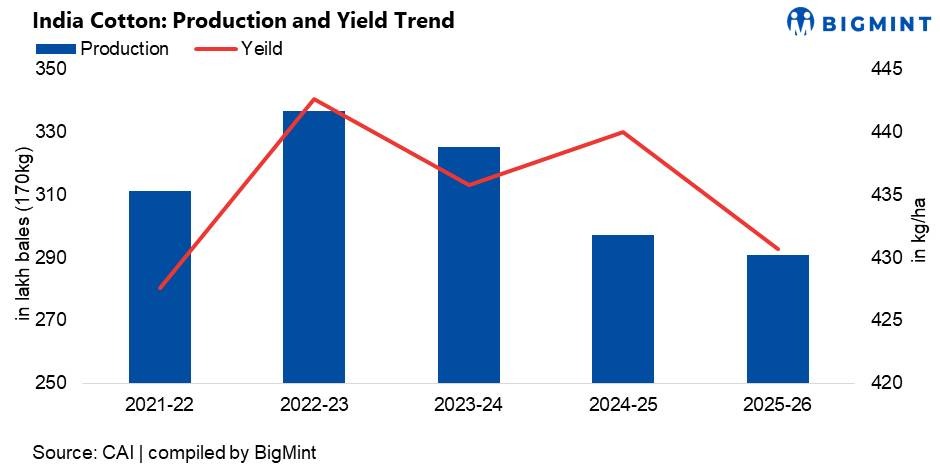
However, India’s cotton balance continues to remain tight. Provisional production for 2025-26 stood at 290.91 lakh bales, while domestic consumption reached 328 lakh bales, resulting in a supply deficit that continues to necessitate imports of premium and Extra Long Staple (ELS) cotton for the textile industry.
Productivity mission targets higher yields
The government’s flagship Mission for Cotton Productivity, with an outlay of INR 5,659.22 crore, aims to increase national cotton production to 498 lakh bales by 2031 from around 297 lakh bales. The programme will cover nearly 24 lakh hectares across 140 districts in 14 cotton-growing states and focus on developing climate-resilient, pest-resistant and high-yielding varieties while expanding domestic ELS cotton cultivation.
Demonstrations under the Special Project on Cotton have already indicated yield improvements of 30-40% through High-Density Planting Systems (HDPS) and closer spacing techniques, suggesting significant scope for productivity gains if adopted on a wider scale. Higher yields are expected to improve raw material availability for spinning mills, reduce reliance on imported fibre and strengthen India’s competitiveness in global textile exports.
Farmer support and quality enhancement
To improve farmer returns, the government has increased the Minimum Support Price (MSP) for the 2026-27 season by INR 557/quintal to INR 8,267/quintal for medium staple cotton and INR 8,667/quintal for long staple cotton. During the 2025-26 marketing season, the Cotton Corporation of India (CCI) procured 105.09 lakh bales worth more than INR 41,530 crore through nearly 24 lakh procurement transactions, providing substantial price support amid subdued market conditions. Digital initiatives, including the Kapas Kisan mobile application, have streamlined procurement through online registration and slot booking, while the Kasturi Cotton Bharat initiative is promoting Indian cotton globally through QR-based certification, blockchain-enabled traceability and quality assurance, aligning domestic fibre with evolving international sourcing requirements.
Market outlook
The policy measures provide a constructive long-term foundation for India’s cotton sector, but meaningful gains will depend on effective implementation and favourable weather conditions. With nearly 62% of the country’s cotton acreage remaining rain-fed, production continues to face risks from erratic monsoon patterns, pest pressure and climate variability.
In the short term, India’s production-consumption gap is likely to keep demand for imported high-quality cotton elevated, particularly among spinning mills producing premium yarn and fabrics. Over the medium term, wider adoption of improved seed varieties, HDPS cultivation, better farm practices and traceability standards could gradually improve yields, enhance fibre quality and reduce import dependence.
If these initiatives are implemented successfully, India could strengthen its position as a reliable supplier of quality cotton and value-added textiles, supporting both export growth and higher farm incomes while improving the resilience of its cotton value chain.
Leave a Reply