- China demand strengthens, copper premiums hit one-year high
- Canada inflation eases by 0.4% as gasoline prices drive slowdown
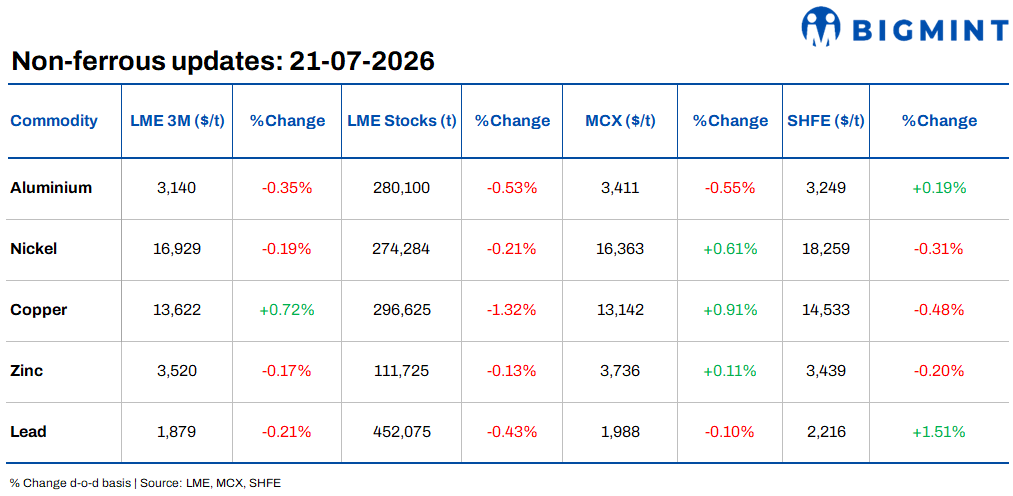
Base metals on the London Metal Exchange (LME) traded mixed on 20 July 2026, with copper rising 0.72% d-o-d to $13,622/t, supported by tightening exchange stocks. Aluminium slipped 0.35% to $3,140/t, lead eased 0.21% to $1,879/t, nickel declined 0.19% to $16,929/t, while zinc fell 0.17% to $3,520/t.
LME inventories continued to trend lower across all major base metals, reflecting ongoing supply tightness. Copper stocks fell 1.32% d-o-d to 296,625 t, extending recent declines and reinforcing bullish sentiment. Aluminium inventories dropped 0.53% to 280,100 t, while nickel stocks slipped 0.21% to 274,284 t. Zinc inventories edged down 0.13% to 111,725 t, and lead stocks declined 0.43% to 452,075 t.
Domestic market overview
India’s non-ferrous scrap market remained largely stable on 20 July. Aluminium tense scrap (loose), ex-Delhi, held steady at INR 265,000/t, while ex-Chennai prices also remained unchanged at INR 255,000/t.
Meanwhile, copper armature scrap (Cu 99%), ex-Delhi, increased by INR 6,000/t, or 0.49% d-o-d, to INR 1,234,000/t, tracking stronger LME copper prices amid steady domestic buying interest.

Oil retreats though geopolitical risks persist
Global crude oil prices edged lower on 21 July after the previous session’s sharp rally, with Brent crude falling 1.92% d-o-d to $88.49/bbl and WTI crude declining 2.52% to $82.14/bbl. Natural gas slipped 0.94% to $2.85/MMBtu.
Despite the decline in crude prices, markets remain focused on inflation risks from prolonged geopolitical tensions. While Canada’s June inflation eased to 2.8% from 3.2%, largely due to a 10% m-o-m fall in gasoline prices, renewed hostilities between the US and Iran have already pushed fuel prices higher again, raising concerns that energy-driven inflationary pressures could re-emerge.
The outlook remains uncertain as higher energy costs continue to fuel inflationary pressures. UBS warned that households have so far absorbed rising fuel costs by reducing savings rather than cutting consumption, a trend that may prove unsustainable if oil prices remain elevated. Meanwhile, stronger US dollar levels and resilient fuel demand continue to underpin market volatility, keeping investors focused on developments in the Middle East and their potential impact on global energy supplies.
Other updates
China demand and Chile disruptions lift copper prices
Copper prices strengthened as tightening physical supplies in China and production disruptions in Chile reinforced concerns over global availability. China’s refined copper imports climbed to a nine-month high in June, while the Yangshan copper premium—a key indicator of import demand—rose to a 14-month high of $100/t, up 133% so far this year.
Meanwhile, SHFE copper inventories down more than 80% since mid-March, and LME inventories have fallen 24% since end-May. On the supply side, severe winter weather disrupted operations at several Chilean mines, adding to concerns over lower output.
Codelco shifts focus to returns
Chile’s state-owned copper miner Codelco is prioritizing profitability over production growth as it seeks to recover from years of declining output and rising debt. The company produced 1.33 million tonnes of copper in 2025, its lowest level in decades, while total debt has climbed to nearly US$25 billion.
Chairman said future investment decisions will focus on projects capable of generating stronger returns rather than pursuing volume growth, with the proposed US$7.5 billion El Abra expansion under evaluation.

Leave a Reply