- GST cuts, easier financing supports broad-based sales growth
- Monsoon recovery to support rural vehicle demand
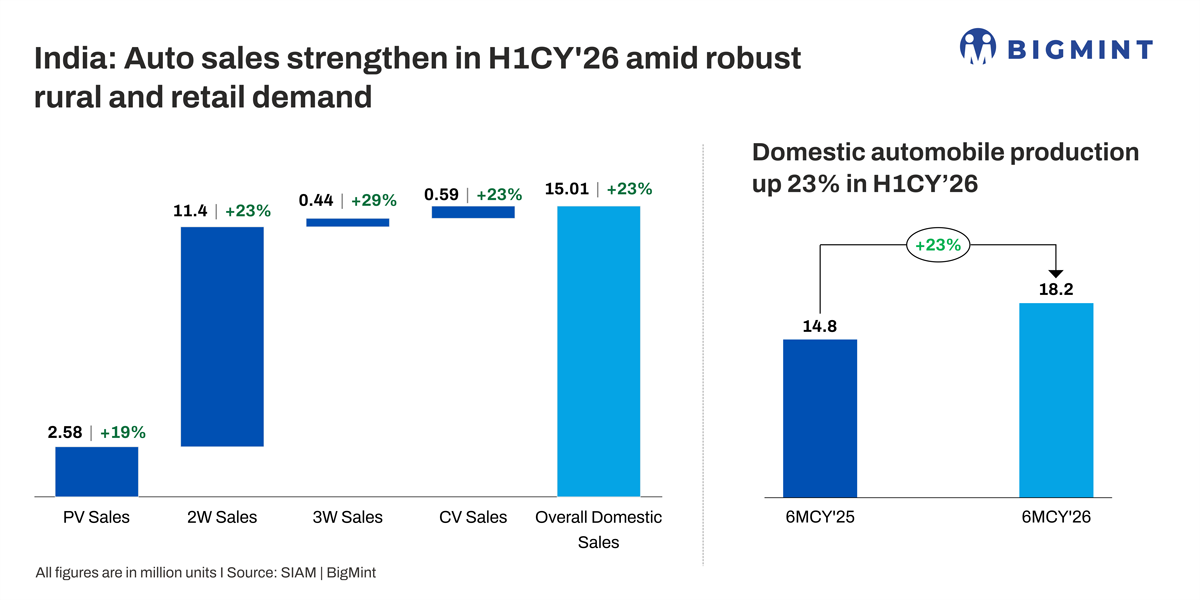
India’s automobile sector recorded strong growth in H1CY’26, according to SIAM data, supported by healthy demand across all major vehicle segments. Passenger vehicle sales increased 19% y-o-y to 2.58 million units from 2.17 million units in H1CY’25, while two-wheeler sales rose 23% to 11.40 million units from 9.24 million units. Three-wheeler sales also climbed 29% to 0.44 million units from 0.34 million units.
Commercial vehicle sales increased 23% y-o-y to 0.59 million units from 0.48 million units. Overall domestic automobile sales rose 23% to 15.01 million units from 12.24 million units, while total automobile production advanced 23% to 18.20 million units from 14.80 million units in H1CY’25.
Retail automobile sales rise 18% y-o-y in H1CY’26
Meanwhile, FADA’s retail data for H1CY’26 reflected healthy y-o-y growth across all vehicle segments. Passenger vehicle sales increased 24% to 2.57 million units from 2.07 million units in H1CY’25, while two-wheeler sales rose 21% to 11.09 million units from 9.17 million units. Three-wheeler sales also grew 13% to 0.69 million units from 0.61 million units.
Commercial vehicle (CV) sales increased 11% to 0.59 million units from 0.53 million units, while tractor sales rose 25% to 0.55 million units from 0.44 million units. Overall retail automobile sales increased 18% to 15.49 million units from 13.10 million units, indicating broad-based growth across all vehicle segments.
Industry leaders cite strong demand and easing financing as key drivers of auto sales
According to SIAM President Shailesh Chandra, automobile sales in H1CY’26 were supported by supportive domestic demand, lower GST rates, softer financing costs, the low base effect, and new model launches, despite disruptions in West Asia. Passenger vehicle demand remained robust, driven by strong utility vehicle (SUV) sales, which accounted for around 68% of the segment, while two-wheeler sales continued to benefit from the momentum created by the GST reduction. Increased economic activity and easier financing supported three-wheeler demand, whereas commercial vehicle sales were backed by replacement demand and higher offtake from the mining and cement sectors.
SIAM also noted that steady consumer sentiment, easing monsoon deficiency, moderate inflation, and expectations of healthy festive demand are expected to support the market, although commodity costs, geopolitical developments, and the progress of the monsoon remain key watchpoints. SIAM Director General Rajesh Menon added that all vehicle segments recorded high double-digit growth during Q1 FY’27, reflecting broad-based strength in domestic demand.

According to FADA President C. S. Vigneshwar, retail automobile sales in H1CY’26 were supported by resilient consumer demand, improved OEM supplies following the West Asia ceasefire, easing crude oil prices, and steady freight and e-commerce activity. Entry-level demand remained healthy, while pre-Kharif farm preparations and continued strength in Bharat (rural) markets supported overall sales despite a temporary rural pause in June due to the delayed and uneven southwest monsoon.
Passenger vehicle demand was further aided by a record 40.35% share of alternative-fuel vehicles (CNG, hybrid, and EVs), while June OEM price hikes of around 2-3% had only a limited impact on bookings. Vigneshwar added that the record June retail performance reflected the structural strength of India’s automobile market, although he urged OEMs to align dispatches with retail demand during the monsoon period to prevent dealer inventories from rising further.
Impact on aluminium ADC12 alloy
India’s ADC12 aluminium alloy market remained supported by healthy automobile production, although demand stayed subdued due to comfortable OEM inventories and cautious procurement. ADC12 alloy ingot prices declined across major markets, with Chennai at INR 338,000-342,000/t, Delhi at INR 345,000-350,000/t, and Pune at INR 338,000-340,000/t. Southern India witnessed sharper corrections amid lower tense scrap prices, competitive imports, and arrivals of previously booked Malaysian cargoes, while the northern market remained relatively firm due to shortages of tense and aluminium wheel scrap.
In the near term, ADC12 prices are expected to remain under pressure amid subdued buying, comfortable inventories, and delayed July OEM settlement negotiations. However, the medium-term outlook remains cautiously positive, as the proposed EU 15% aluminium scrap export duty and the UAE’s decision on extending its scrap export ban could tighten global scrap availability and support ADC12 alloy prices.
Outlook
According to FADA, the near-term outlook for July 2026 remains cautiously optimistic, with over half of dealers expecting sales growth, supported by improving monsoon conditions, faster Kharif sowing, easing crude oil prices, and normalised OEM supplies following the West Asia ceasefire. Healthy booking pipelines for passenger vehicles, particularly EVs and CNG models, continued freight and infrastructure activity, and improving rural cash flows are expected to support demand, although July price hikes, financing delays, and uneven rainfall remain key risks.
For the July-September 2026 period, dealer sentiment strengthens further, with 66.17% expecting growth as the festive season approaches. Demand is likely to be supported by rural income recovery, Ganesh Chaturthi and Onam-related buying, sustained goods movement, and stable policy conditions. However, FADA identified a weak monsoon or El Niño, further price increases, and inventory build-up as the key risks to the outlook.
Leave a Reply