- Rebar prices decline across markets on inventory pile-up
- Weak trade sentiment puts pressure on HRC prices, CRC stable w-o-w
- Market expects further correction in rebar, HRC likely to remain rangebound
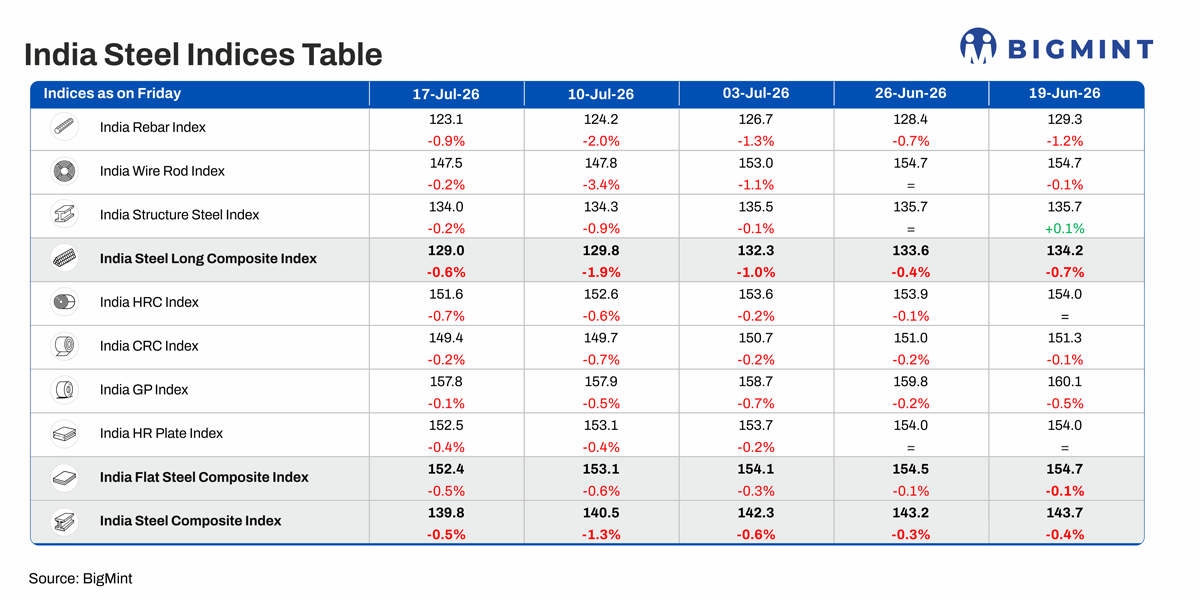
Morning Brief: BigMint’s India steel composite index fell by 0.5% w-o-w, as assessed on 17 July 2026 last, as domestic steel prices continued their downward trajectory with the seasonal slowdown impacting construction and housing projects. Inventory pile-up across markets and product categories pointed to subdued demand in the trade and distributor channels.

Both the flat and long steel sub-indices recorded declines w-o-w; the rebar index dropped 0.9% on the week, while HRC fell by 0.7%, somewhat steeper than previous weeks following the downward price revisions of the primary mills.
Highlights of price movements
HRC prices drop amid subdued trade sentiment: BigMint’s bi-weekly benchmark assessment for HRC (IS 2062, Gr E250, 2.5–8 mm/CTL) stood at INR 57,800/t as of 17 July, down by INR 100/t w-o-w from INR 57,900/t recorded on 10 July. The benchmark assessment for CRC (IS 513, Gr O, 0.9 mm/CTL) remained stable at INR 65,000/t as of 17 July, unchanged from the assessment on 10 July. These assessments are ex-Mumbai for the distributor-to-dealer segment and exclude 18% GST.
Disruptions continue to weigh on construction activity and downstream steel consumption. Supply availability remains adequate across most regions, with no significant constraints reported on the domestic supply side. However, weak buying interest and predominantly need-based procurement kept trading activity muted.
Last week, the major domestic mills reduced HRC list prices by around INR 1,000/t ($11/t) to INR 64,400-67,750/t ($674-709/t) to stimulate trading activity. Nevertheless, flat steel demand remained subdued across regions.

“Rising distributor-level inventories of around 20-25 days and weak downstream demand are impacting trading activity,” a trader informed BigMint. Market participants reported that buying activity was largely confined to immediate requirements, and distributors deferred purchases, as expectations of further price corrections persisted. Ample stock availability and subdued consumption continued to discourage fresh buying.
Bulk HRC imports decline: India’s bulk HRC imports stood at 91,381 t as of 10 July and are expected to reach 189,349 t by mid-August. BigMint data show that imports had declined by 42% m-o-m in June. The DGTR’s antidumping investigation into HRC imports from China, Japan, and Russia is expected to reshape India’s import market. The initiation of the probe, along with the possibility of retrospective antidumping duties sought by domestic steelmakers, has made importers increasingly cautious about placing fresh orders.
This comes at a time when imported HRC is already significantly more expensive than domestic material due to the existing 11.5% safeguard duty and higher landed costs, reducing the commercial attractiveness of imports.
HRC export offers decline: The HRC export markets showed mixed trends even as offers to the EU and Vietnam declined. For the Middle East, offers remained unchanged. A trader informed: “Although trading activity has started to improve gradually, market sentiment remains mixed as some buyers are still assessing the available quota allocations under the revised quota system, while others have begun resuming purchases.”
Tensions around the Strait of Hormuz have escalated again over the past few days, making the market increasingly complicated and uncertain. Participants continue to closely monitor the situation. On the other hand, offers to Vietnam declined amid weak downstream demand and ample inventories.

BF-rebar prices weaken: India’s blast furnace (BF)-route rebar market remained under pressure as weak construction activity during the monsoon, cautious distributor procurement, and comfortable inventory levels continued to weigh on demand. BigMint’s benchmark assessment for BF-route rebar (IS 1786 Fe550D, 12-32 mm) declined by INR 1,100/t w-o-w to INR 47,900/t ex-Mumbai (distributor-to-dealer, excluding GST).
In response to sluggish buying, major steelmakers reduced list prices further by INR 1,000-1,500/t ($ 10-15/t) in mid-July to improve sales and maintain dispatch volumes. Primary steelmakers reported an increase in finished steel inventories as previously booked project orders were largely executed, while fresh order inflows remained weak. Consequently, mills increased trade discounts and adopted more competitive pricing strategies to improve inventory turnover and sustain dispatch volumes.
Buying interest continued to remain restrained as market participants anticipated further price correction, while project execution slowed due to persistent rainfall and reduced construction activity.
IF-rebar prices drop across markets: IF-route rebar prices fell across major markets last week. A wide bid-offer gap encouraged active negotiations between buyers and sellers, with most transactions concluded at levels below the initial offer prices. However, the overall decline in prices remained limited as tight raw material availability and firm input costs restricted mills from offering steeper discounts. Mill inventories were reported at around 10-15 days, while order booking visibility remained limited to approximately three-five days, indicating continued short-term procurement.
Outlook
BigMint expects domestic steel prices to remain weak as monsoon-led slowdown in project execution, inventory pile-up in the distribution channel, and expectations of further price correction weigh on buying interest. Although the HRC market has softened much less compared with rebar amid policy-driven support and export opportunities, the spread with landed imports remains fairly large for both FTA countries and China. Therefore, prices are mostly likely to remain rangebound in July.
Leave a Reply