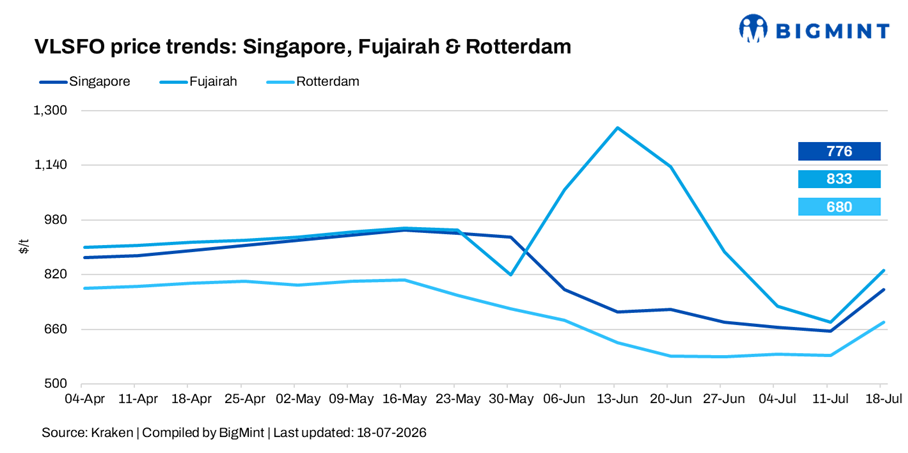
- VLSFO rebounds sharply across key bunkering hubs
- Brent and WTI jump $9-11/bbl, lifting bunker prices
Global bunker fuel markets rebounded strongly in the week ended 18 July 2026, with benchmark Very Low Sulphur Fuel Oil (VLSFO) prices rising sharply across major bunkering hubs – Singapore, Rotterdam and Fujairah. The recovery was driven by firmer crude oil prices amid renewed geopolitical tensions in the Middle East, which heightened concerns over potential supply disruptions and pushed up energy prices.
Marine Gas Oil (MGO) and High Sulphur Fuel Oil (HSFO) prices also strengthened, supported by elevated feedstock costs, geopolitical risk premiums, and steady bunker demand across major shipping routes. The increase in bunker prices is expected to keep voyage costs elevated for vessel operators in the near term.

Regional bunker markets
- Singapore: VLSFO prices climbed by $122/tonne (t) w-o-w to $776/t, while MGO and HSFO rose by $200/t and $127/t to $1,150/t and $578/t, respectively. The gains were supported by stronger bunker demand at the world’s largest bunkering hub, with higher stem enquiries coinciding with renewed geopolitical risk premiums in crude oil markets. Tight prompt fuel availability also encouraged suppliers to maintain firmer offer levels.
- Rotterdam: VLSFO prices increased by $97/t w-o-w to $680/t, while MGO and HSFO advanced by $216/t and $66/t to $1,176/t and $521/t, respectively. The market strengthened as higher refinery feedstock costs filtered through to bunker prices, while improved arbitrage economics and steady inland fuel demand across Northwest Europe supported pricing despite relatively comfortable inventories.
- Fujairah: VLSFO prices registered the sharpest increase among the major bunkering hubs, surging $153/t w-o-w to $833/t. MGO and HSFO also climbed by $211/t and $97/t to $1,393/t and $587/t, respectively. Prices were lifted by heightened geopolitical tensions in the Middle East, which raised concerns over regional energy supply and shipping disruptions. Strong replenishment demand from vessels transiting the Gulf further underpinned bunker prices.
Factors influencing bunker prices
- Brent crude extends weekly gains: Brent crude futures (September 2026 contract) settled at $85.98/barrel (bbl) on 17 July, rising $9.33/bbl w-o-w from $76.65/bbl. Prices were supported by escalating geopolitical tensions in the Middle East, which fuelled concerns over potential supply disruptions. Expectations of tighter global crude availability, coupled with precautionary buying and a stronger risk premium, further lifted Brent prices.
- WTI jumps on geopolitical risk premium: WTI crude futures climbed to $82.49/bbl on 17 July, up $11.08/bbl w-o-w from $71.41/bbl. The rally was driven by renewed US-Iran tensions and growing concerns over crude shipments through the Strait of Hormuz, a critical global oil transit route. Rising geopolitical uncertainty, along with fears of supply disruptions and stronger market buying interest, continued to support WTI prices.
Outlook
Global bunker prices are expected to remain firm and volatile in the near term, supported by elevated crude oil prices, geopolitical tensions in the Middle East, and persistent uncertainty over global energy supply. Any disruption to crude flows or shipping through key routes such as the Strait of Hormuz could keep bunker fuel prices elevated. However, adequate fuel availability at major bunkering hubs and stable refinery output may help limit sharp price spikes.

Leave a Reply