- Proportion of H2 around 60% in coke oven reduction gas
- HBIS achieves DRI metallisation rate of around 94%
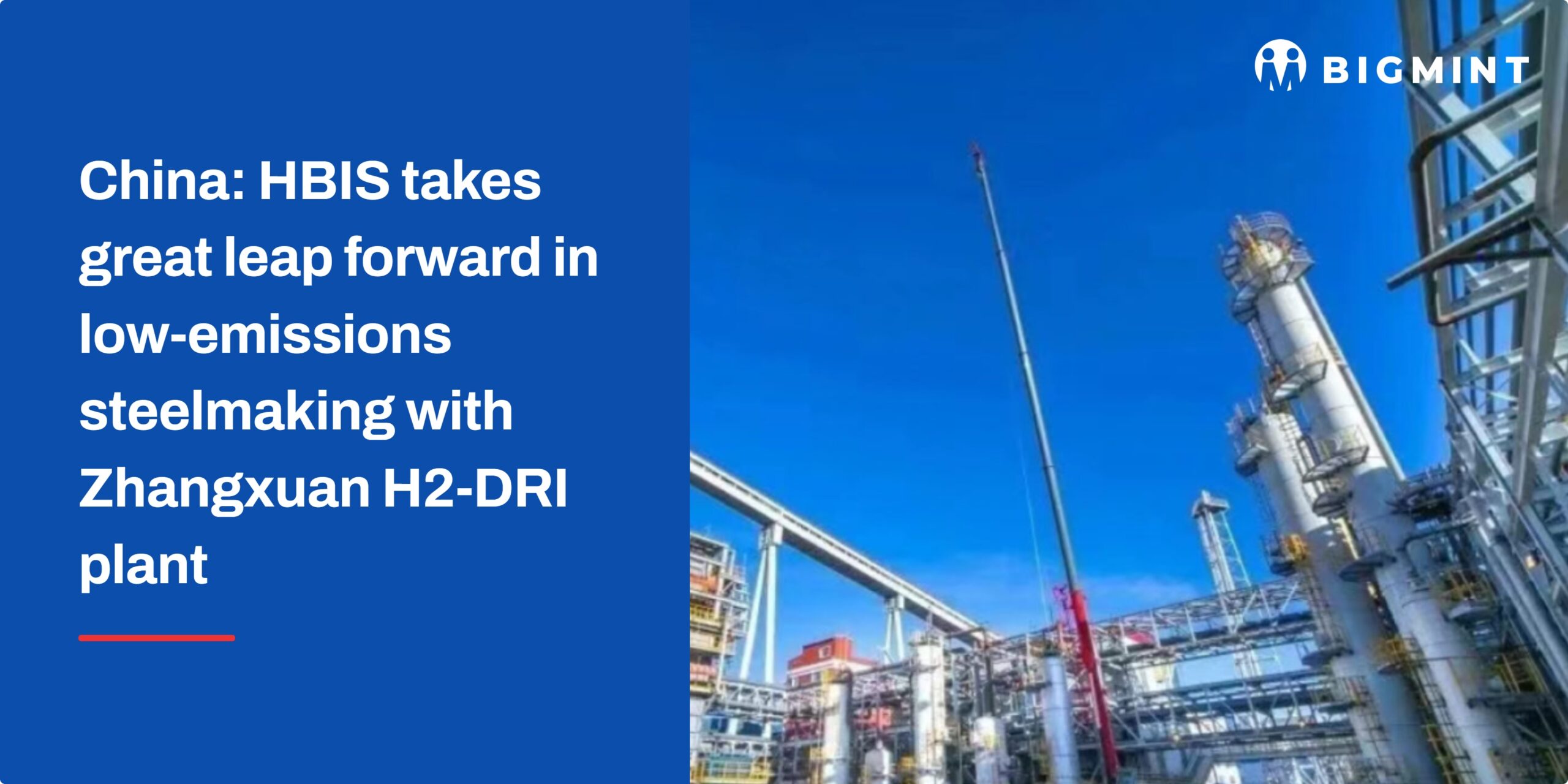
Ziangxian Technology is China’s first industrial-scale hydrogen metallurgy pilot production base, established by HBIS. In 2023, a direct reduced iron (DRI) facility with an annual capacity of 600,000 tonnes (t) commenced commercial production, and the company is pursuing the establishment of a hydrogen metallurgy production system with an annual capacity of 1.2 million tonnes (mnt) in the long term.
The 2026 Asia Steel Forum was held in Beijing, China, from 15 to 16 July. On the first day of the event, participants visited Zhangxuan Technology in Zhangjiakou, Hebei Province, where they toured the hydrogen-based direct reduction facilities, electric arc furnaces (EAFs) and special steel production lines, and exchanged views with company representatives on hydrogen metallurgy technology and business strategies.
Instead of the conventional method of reducing iron ore using coke in a blast furnace, Zhangxian Technology produces direct reduced iron (DRI) by feeding high-hydrogen-content reducing gas into a shaft furnace. The DRI produced is then processed through an electric arc furnace, continuous casting and rolling processes, and is used as raw material for high-value-added steel products such as automotive steel sheets.
After reviewing the production process through explanations and videos provided by the company, the participants toured the hydrogen-based shaft furnace, electric arc furnace and subsequent production lines in turn.
Commercial production of 600,000 t DRI
At the heart of Zhangxuan Technology lies its gas-based direct reduction facility, which utilises ENERGIRON technology. ENERGIRON is a direct reduction technology jointly developed by the Italian plant engineering firms Tenova and Danieli.

The DRI facility currently in commercial operation has an annual production capacity of 600,000 t. Tenova presents this facility as the world’s first instance of stable, industrial-scale DRI production, having increased the proportion of hydrogen in the reduction gas to over 60%.
The plant employs the ‘Zero Reformer’ method, which does not require an external gas reformer. According to the company, whilst it currently utilises refined coke oven gas (COG) generated at the steelworks as the reducing gas, the plant is designed to allow for an increased proportion of green hydrogen or even operation using pure hydrogen (100%) in the future.
Furthermore, HBIS is advancing the Zhangxuan project as a pilot hydrogen metallurgy initiative with an annual capacity of 1.2 mnt. Currently, the first-phase facility, with an annual capacity of 600,000 t, is in commercial production, whilst the design of an additional DRI plant is underway. The company plans to commence construction of follow-up facilities around 2030 to complete the 1.2 mnt/y system.
According to HBIS, the metallisation rate of DRI during the initial production phase stood at approximately 94%, and it is being utilised as a high-quality feedstock to replace or supplement scrap iron in electric arc furnaces.
Purifying COG to produce H2-enriched reducing gas
The direct reduction process at Zhangxian does not currently rely solely on green hydrogen to reduce iron ore. Coke oven gas (COG) generated during the steelmaking process is purified to produce a high-hydrogen-content reducing gas, which is then fed into the shaft furnace.
Coke oven gas contains hydrogen, carbon monoxide, methane and other components. Zhangxian Technology purifies and adjusts this gas to suit the direct reduction process, utilising it as a reducing agent for iron ore.
Unlike conventional gas-based DRI processes that use natural gas as the primary feedstock, HBIS has adopted a ‘zero-reformer’ approach that utilises coke oven gas generated at its existing plants. The company explains that by reusing this by-product gas, it has reduced fossil fuel consumption and carbon emissions whilst laying the groundwork for the future expansion of green hydrogen applications.
A closed-loop system was also introduced at the site, whereby used gas is purified and sent to compression equipment before being reintroduced into the process.
However, carbon emissions do still occur in the current process, as coke oven gas contains carbon monoxide and hydrocarbons. The facility in Zhangxian can be regarded not as a completely carbon-free steelmaking process, but rather as a low-carbon direct reduction process based on hydrogen-enriched gas, which significantly reduces carbon emissions compared to the blast furnace–electric arc furnace method.
From DRI to EAF and automotive steel sheets
The reason Zhangxian Technology is attracting attention is that it has integrated DRI production with the actual production of steel products into a single process.
The DRI produced in the shaft furnace is fed into an electric arc furnace, where it is melted together with scrap steel. It is then processed through continuous casting and rolling to produce high-value-added products such as automotive steel sheets. This has established a single production system integrating hydrogen metallurgy, electric arc furnace steelmaking, continuous casting and sheet production.
A company representative explained that DRI and scrap steel are currently used together as raw materials for the electric arc furnace, with the current input ratio standing at approximately 20:80.
Zhangxuan Technology’s annual production capacity for automotive steel sheets is 1.5 mnt. Last year, it produced approximately 800,000 t, and this year it is aiming to produce 1 mnt.
HBIS supplies this low-carbon steel under the ‘HINEX Steel’ brand. It is developing low-carbon product ranges tailored to specific demand sectors, such as the automotive, home appliance and new energy equipment industries, whilst also expanding the management of product-specific carbon footprints, life cycle assessments (LCA) and Environmental Product Declaration (EPD) certification.
Furthermore, the company is working with global automotive manufacturers, including BMW, to establish a low-carbon steel supply chain and is expanding the use of low-carbon steel in the automotive sector.
Managing production costs key to adoption of H2-DRI
The most significant change observed during this visit was that hydrogen-based direct reduction technology has moved beyond the experimental stage and is now being applied to actual steel production processes.
However, the issue of reducing production costs remains a challenge. A site official explained that to ensure the competitiveness of hydrogen-based shaft furnaces, current production costs must be drastically reduced by more than half. In particular, the stable supply of price-competitive green hydrogen and low-carbon electricity was cited as a key condition for future business expansion.
Currently, Zhangxuan employs a method of increasing the hydrogen content by utilising coke oven gas generated at existing steelworks. Whilst this approach has the advantage of reducing carbon emissions by utilising existing facilities and by-product gases, expanding the use of green hydrogen and renewable energy-based electricity in the long term is essential to reduce emissions to carbon-neutral levels.
Zhangxian Technology is not yet a fully realised carbon-free steelworks. However, it is highly significant in that it operates as a fully functional production system, linking DRI production using hydrogen-enriched reducing gas to the manufacture of electric arc furnaces and automotive steel sheets.
Meanwhile, HBIS has set out a target to reduce carbon emissions by 10% from their 2025 peak, by 30% by 2030, and to achieve carbon neutrality by 2050. Key measures to achieve this include the expansion of hydrogen metallurgy and electric arc furnaces, increased use of scrap steel and DRI, a higher proportion of green electricity, the utilisation of biomass, and carbon capture, utilisation and storage (CCUS).
This article is published as part of a content sharing agreement between SteelDaily and BigMint
Leave a Reply