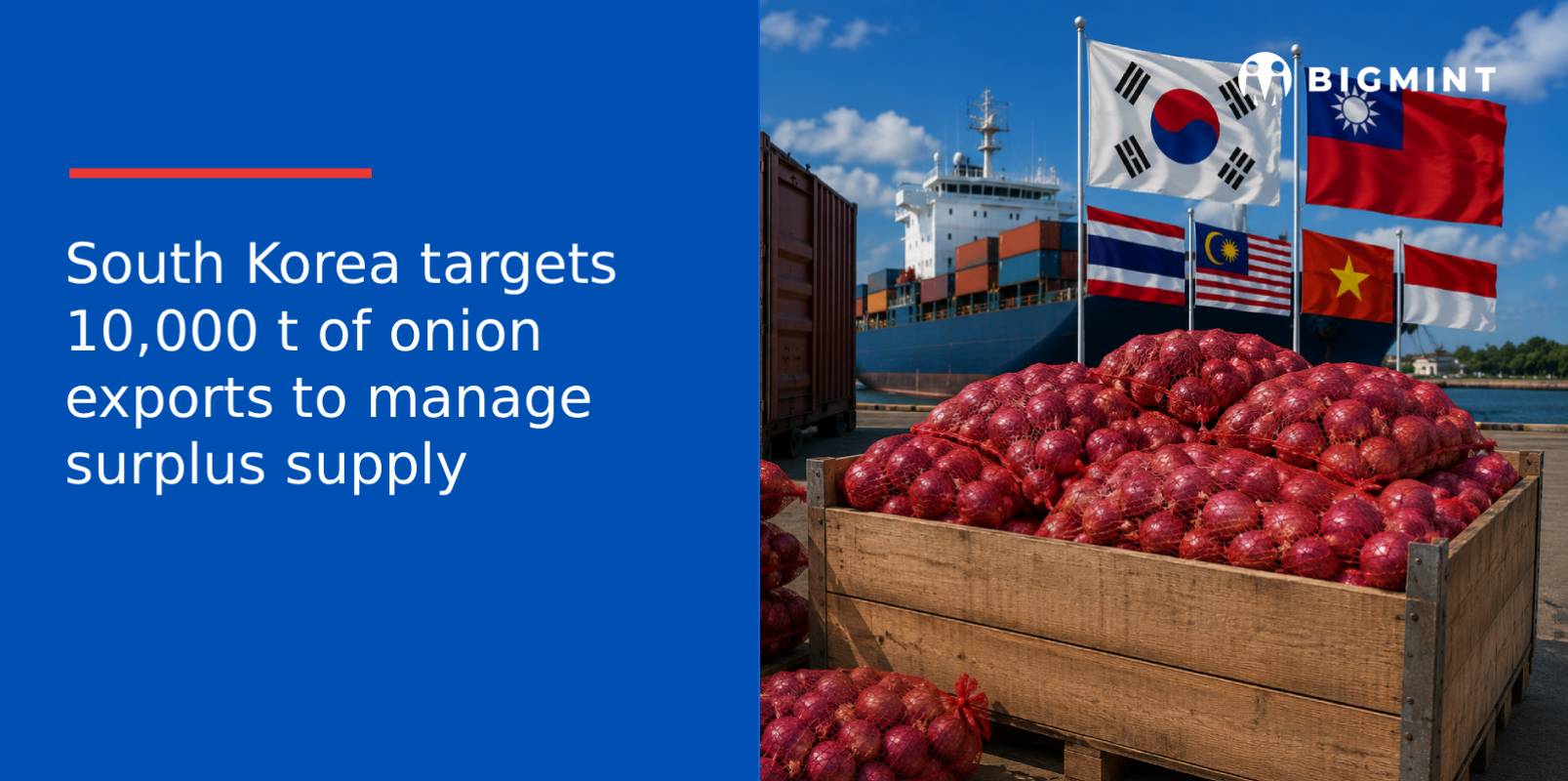
- Exports will focus on Taiwan, with additional shipments to SE Asia
- 2026 onion production forecast above normal levels
South Korea is stepping up onion export promotion and domestic supply management measures after forecasting a larger-than-normal 2026 onion crop. According to the Ministry of Agriculture, Food and Rural Affairs, the government plans to support exports of 10,000 t of onions while increasing stockpiling and other market intervention measures to prevent oversupply during the harvest season.
Production outlook points to higher supplies
The Korea Rural Economic Institute (KREI) projects mid- to late-season onion production at 1.088 million tonnes (mnt), around 41,000 t above a normal year. Although the cultivated area has declined, improved yields per hectare are expected to lift overall production.
To help absorb the larger crop, the government will increase purchases and stockpiling of mid- to late-season onions to 20,000 t, up 82% from the annual average. The measure aims to prevent oversupply during the harvest period and address supply fluctuations during the off-season.
Export support to focus on Taiwan and Southeast Asia
The government plans to support exports of approximately 10,000 t of onions this season, including 2,000 t through direct government assistance and 8,000 t through the National Agricultural Cooperative Federation (NACF).
The Ministry of Agriculture, Food and Rural Affairs, together with the NACF, marked the start of the export programme on 4 June 2026 with the first shipment of 100 t of new-season onions from Hamyang Nonghyup in Gyeongnam to Taiwan.
According to the ministry, export efforts will focus primarily on Taiwan, while additional shipments will target Southeast Asian markets, including Thailand. Export support may be expanded further depending on overseas demand and domestic production.
Govt strengthens domestic supply management
Alongside export promotion, South Korea is implementing a series of domestic measures to reduce excess supplies. The government plans to delay shipments of 5,000 t, while local agricultural cooperatives in major producing regions will receive interest-free funding to support onion purchases.
Government and local authorities will also remove surplus onions from 223 hectares, equivalent to 1.6% of the country’s cultivated onion area. Earlier in the season, authorities suspended shipments of 15,000 tonnes of early-season onions and purchased 5,000 t of mid-season onions for storage through agricultural cooperatives.
To stimulate domestic demand, the ministry is extending promotional measures, including discounts of up to 40% at supermarkets and traditional markets, public meal service programmes and consumer promotion campaigns.
South Korea exported 58 t of onions from the 2024 harvest and 467 t from the 2025 harvest. Earlier this season, the government also announced plans to export 2,000 t of premium new-season onions to Vietnam and Taiwan.
Outlook
South Korea is relying on a combination of export expansion, stockpiling, shipment controls and domestic consumption promotion to manage its larger 2026 onion crop. Export demand from Taiwan and Southeast Asian markets, together with the implementation of domestic supply management measures, will play a key role in balancing the market during the season.
Leave a Reply